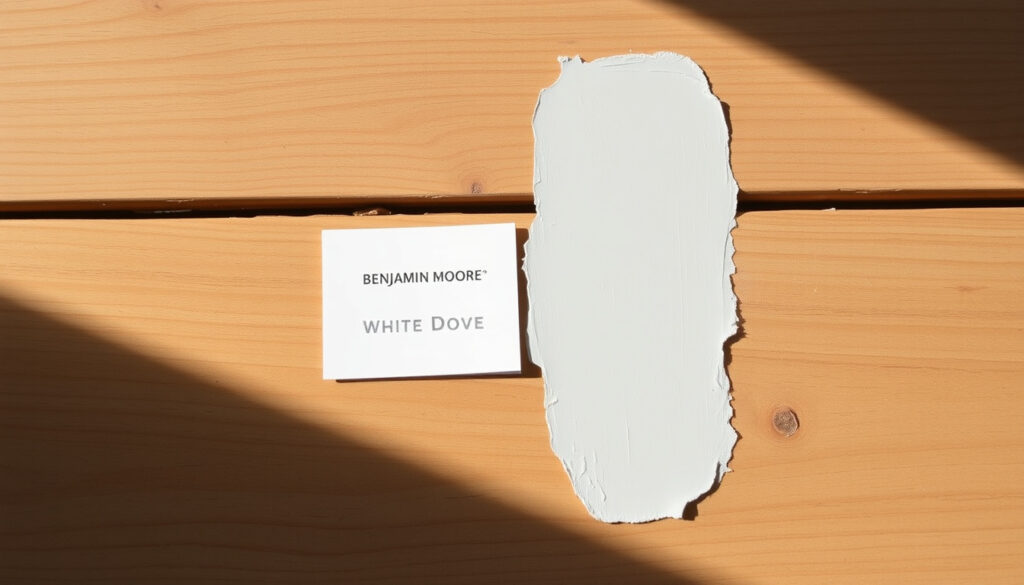
Benjamin Moore White Dove: Undertone, LRV & Tips
Choosing a white paint sounds simple until you’re standing in the lighting aisle wondering why one sample looks pink, another blue, and a third just plain grey. Benjamin Moore White Dove (OC-17) is one of those whites everyone recommends—but the reason it works is also why it sometimes doesn’t.
LRV: 83.16 ·
Undertone: Cream/warm ·
Color Family: Off-white ·
Manufacturer: Benjamin Moore ·
Availability in Ireland: Benjamin Moore Ireland and The Colour Hub
Quick snapshot
- Warm white with cream undertones (Benjamin Moore official page)
- LRV measured at 83.16 (Benjamin Moore product data)
- Not recommended for exterior use per Benjamin Moore UK (Benjamin Moore UK guide)
- Exact colour trend predictions for 2026 are speculative
- Undertone perception depends heavily on lighting and surrounding colours—no single “always true” answer
- 2025: White Dove remains a popular colour in interior design circles
- 2026: Design trends indicate a shift towards warm creams and away from cool greys
- Test White Dove with large swatches in your actual room before committing
- Pair with cool accents if you want to neutralise the warmth
Key facts at a glance.
| Attribute | Value |
|---|---|
| LRV | 83.16 |
| Undertone | Cream/warm |
| Color Code | OC-17 |
| Manufacturer | Benjamin Moore |
| Ireland Availability | The Colour Hub, Benjamin Moore Ireland |
| Price Range | €8.50 – €134.00 (size/finish dependent, per The Colour Hub (Irish retailer)) |
Is Benjamin Moore White Dove warm or cool?
White Dove is a warm white. Its cream undertones give it a soft, welcoming feel, but the story doesn’t stop there. The Benjamin Moore product page lists an LRV of 83.16, meaning it reflects a lot of light. In bright, north-facing rooms, that reflectivity can make it read cooler than expected. In low-light or south-facing spaces, the warmth emerges.
White Dove is a warm white that can appear cooler depending on light. Test it on your wall before you commit—your north-facing kitchen may see a different White Dove than your south-facing bedroom.
How light affects the warmth
- North-facing rooms: the cooler natural light can mute the cream undertone, making White Dove read closer to a soft white.
- South-facing rooms: warm afternoon light amplifies the yellow in the cream undertone, making it appear noticeably warmer.
- Artificial warm bulbs (2700K–3000K) intensify the cream; cooler LEDs (4000K+) neutralise it.
Interior designer Kylie M Interiors (respected paint colour reviewer) notes that White Dove reads warmer in low light and cooler in strong north-facing light. This means the same paint can look like two different colours in two different rooms.
How to test White Dove in your lighting
Large swatches are essential. Benjamin Moore themselves warn that screen colours differ from the actual painted colour. Paint a 2×2 foot area on your wall and observe it at different times of day. If the room gets strong afternoon sun, prepare for a warmer version of White Dove.
When to not use White Dove?
White Dove is versatile but not universal. Three situations where it can backfire.
Rooms with strong yellow or orange light
If your room already has warm-toned elements—think honey-oak trim, terracotta tiles, or amber glass pendant lights—White Dove’s cream undertone can push it into beige territory rather than staying a fresh white. Kylie M Interiors points out that White Dove can look greige when placed next to pale gray paint colours, and the same logic applies with warm wood: the contrast becomes muddy instead of crisp.
Surfaces with pink or red undertones
In rooms with pinkish tiles, red brick accents, or rosy floorboards, White Dove’s warm base can exaggerate the pink rather than neutralising it. PaintDB (colour database) describes the undertone as having a faint green-gray cooling influence, which can sometimes fight with pink undertones, creating an unintended purple/brown shift.
Exterior applications
Benjamin Moore UK lists White Dove for interior use only. On exterior surfaces, constant UV and weather exposure can intensify the cream undertone, leading to a yellowed appearance over time. If you want a warm white outside, consider a dedicated exterior formulation.
What is the undertone of Benjamin Moore White Dove?
The undertone is a soft cream—sometimes described as warm yellow, sometimes as a grayed yellow. Multiple independent sources confirm it: The Color Concierge (paint colour expert) says White Dove’s yellow undertones are “grayed out” and rarely show strongly, while Minimal and Modern (design blog) calls it a soft yellow-gray undertone that can read as a true white in bright rooms.
How White Dove stacks up against other popular whites.
| Colour (all Benjamin Moore) | LRV | Undertone | Best for |
|---|---|---|---|
| White Dove OC-17 | 83.16 | Cream/warm | Walls, trim, cabinets |
| Chantilly Lace OC-65 | 86.90 | Cool white (no yellow) | Bright, crisp spaces |
| Simply White OC-117 | 84.63 | Warm but neutral | Open floor plans |
| Decorator’s White CC-20 | 83.81 | Cool white (grey undertone) | Modern, minimalist |
The pattern: White Dove sits in the warm-white camp, but with enough gray in the base to avoid looking sterile.
How undertone affects room perception
A cream undertone makes a room feel cosy and enveloping. In north-facing rooms—common in Irish homes—White Dove’s warmth can compensate for the lack of direct sunlight, making the space feel less cold and cave-like. However, if you pair White Dove with blue-grey furniture or cool-toned artwork, the cream can clash, creating a muddy overall palette.
White Dove’s cream undertone is its superpower and its weakness. It makes rooms feel soft and cohesive, but it also limits compatibility with cool-toned decor. If your sofa is slate blue, White Dove may look dingy rather than warm.
Why is White Dove paint so popular?
Its versatility. White Dove works on walls, trim, cabinets, ceilings—essentially any interior surface. Kylie M Interiors includes it among the best Benjamin Moore white paints because it “pairs well with deep saturated colours or deep neutrals.” It’s not a pure white, so it softens edges without disappearing into the background.
Another reason: timelessness. White Dove has been a top seller for years, and trends (like the shift away from cool greys toward warm creams) only reinforce its relevance. The Color Concierge notes it’s “frequently positioned as warmer and softer than a crisp, cool white.” Homeowners don’t want to repaint every few years—White Dove offers a safe bet that won’t look dated.
Pairing with other colours
- Deep navy (e.g., Hale Navy): creates a crisp, classic contrast.
- Charcoal or black (e.g., Wrought Iron): modern and dramatic.
- White Dove on trim + a saturated wall colour: balances warmth without fighting.
Minimal and Modern says White Dove is “balanced enough to avoid strongly yellow or strongly pink behaviour” in many interiors—which is exactly why it’s a go-to for open floor plans where different lighting zones meet.
Does White Dove ever look yellow?
Yes—under the right (or wrong) conditions. Minimal and Modern describes the undertone as soft yellow-gray; in a south-facing room with warm afternoon light, that yellow becomes more visible. The Color Concierge confirms that while the yellow is “grayed out,” it still emerges when the surrounding light or decor is warm.
Conditions that make White Dove appear yellow
- South-facing rooms with direct sun during peak hours.
- Rooms with warm artificial light (2700K bulbs, incandescent lamps).
- Surfaces with yellow-hued wood tones (oak, pine, honey maple).
- White Dove applied next to pale grey or blue walls (can make it look more yellow by contrast).
How to prevent a yellow cast
Use cooler lighting (4000K LEDs) in the room. Test by placing a large sample next to your existing trim or furniture. If you already have warm oak floors, consider whether you want the paint to harmonise (yellow + yellow = more beige) or contrast (choose a cooler white to balance). Heathered Nest advises that White Dove can look greige next to pale gray—so if your palette is cool, White Dove may not be your best bet.
Specifications
Four paint colours, one pattern: White Dove stands apart from cooler whites in a way that matters for everyday use.
| Spec | White Dove (OC-17) | Chantilly Lace (OC-65) |
|---|---|---|
| LRV | 83.16 | 86.90 |
| Undertone | Cream/warm | Cool white |
| Light Reflectance | High | Very high |
| Yellow Potential | Moderate in warm light | Very low |
| Best on | Walls, trim, cabinets | Trim, ceilings |
| Interior/Exterior | Interior only | Interior only |
| Popularity (2025) | High | Very high |
Upsides
- Warm and inviting without being beige
- Works on all interior surfaces
- High LRV keeps spaces bright
- Pairs well with both deep and muted colours
Downsides
- Can appear yellow in south-facing rooms or warm light
- Not suitable for exterior use per manufacturer
- Can clash with cool-toned decor
- Undertone perception varies widely by lighting
Timeline
Two dates, one direction: White Dove’s popularity aligns with a broader shift from cool greys to warm creams.
| Period | Event |
|---|---|
| 2025 | White Dove remains a top interior designer pick for walls and cabinetry |
| 2026 | Trend forecasters predict a rise in warm cream tones, further boosting White Dove’s relevance |
The implication: if you’re planning a renovation in 2025-2026, White Dove aligns with the warming colour direction.
What’s clear and what’s not
Confirmed facts
- White Dove is a warm white with cream undertones (Benjamin Moore)
- LRV is 83.16 (official data)
- Not recommended for exterior use per Benjamin Moore UK
What’s unclear
- Exact colour trend predictions for 2026 are speculative
- Undertone perception depends heavily on lighting and surrounding colours—no single “always true” answer
- Some secondary sources list LRV as ~85 vs 83.16, showing inconsistency (The White Laurel)
Expert perspectives
White Dove is a soft warm white with yellow or creamy undertones moderated by gray.
— Kylie M Interiors (interior paint colour specialist)
White Dove is not a stark white and not a cream, but an off-white with a gray component that softens the warmth.
— The Color Concierge (colour consultant)
Summary
White Dove is a warm, cream-undertoned off-white that works beautifully in the right room—north-facing spaces, rooms with cool-toned decor, and as a trim colour. In south-facing rooms, kitchens with yellow wood, or spaces with warm artificial light, it can shade into an unintended yellow. For Irish homeowners, where soft diffuse light is common, White Dove will lean warm in most interiors. The catch: test a large sample on your wall before buying. The choice between White Dove and a cooler white like Chantilly Lace comes down to whether you want warmth (and accept the risk of yellow) or want a crisp neutral. For the Irish renovator, the decision is straightforward: use White Dove in north- or east-facing rooms for a cosy warmth; avoid it in south-facing rooms with warm wood or yellow light, or pair it with cool accents and 4000K LEDs to keep it neutral.
loconsolo.com, yourpaintconsultant.com, facadecolorizer.com, thewhitelaurel.com, postcardsfromtheridge.com
Frequently asked questions
Can White Dove be used on kitchen cabinets?
Yes, it’s a popular choice for cabinets due to its warm but not yellow appearance. Ensure you use a durable finish like Advance or Scuff-X (Benjamin Moore).
What colors complement White Dove?
Deep navy (Hale Navy), charcoal (Wrought Iron), and warm greys (Edgecomb Gray) work well. Avoid pairing with cool blues or pale greys—they can make White Dove look dirty (Kylie M Interiors).
Does White Dove make a room look bigger?
With an LRV of 83.16, it reflects plenty of light and can make a space feel open. However, its warm undertone means it won’t expand a room as much as a cool white like Chantilly Lace (LRV 86.90) (Benjamin Moore).
How does White Dove compare to other whites?
It’s warmer than Chantilly Lace and Simply White, but not as yellow as Creamsicle tones. It has more gray base than Decorator’s White. It’s a mid-range warm white (Kylie M Interiors).
What is the best sheen for White Dove?
For walls: eggshell or matte. For trim: satin or semi-gloss. For cabinets: semi-gloss or high-gloss with a durable enamel (Benjamin Moore).
Where can I buy Benjamin Moore White Dove in Ireland?
The Colour Hub (Irish stockist) and Benjamin Moore Ireland’s website carry the full range. Prices start around €8.50 for a sample pot.
Can I use White Dove on the exterior of my house?
Benjamin Moore UK lists White Dove for interior use only. For exteriors, choose a dedicated exterior formulation like Benjamin Moore’s Aura Exterior (Benjamin Moore UK).
More related posts
 Bubble Gum Simulator Infinity Codes – Active June 2026
 How to Check Lowe’s Gift Card Balance (Online, Phone, Store)
 Extremely Thin Hair Low Maintenance Bob Hairstyles for Fine Hair – Styles for Effortless Volume
 What Is POTS Disease? Symptoms, Causes & Treatment
 Pacers vs Phoenix Suns Match Player Stats: Box Scores
 Carrie Beth Van Dyke – Not Missing, Just Private
 Union Station Kansas City: Guide to Attractions, Pricing & More
 Trump’s Approval Rating: Latest Polls & Trends (2026)