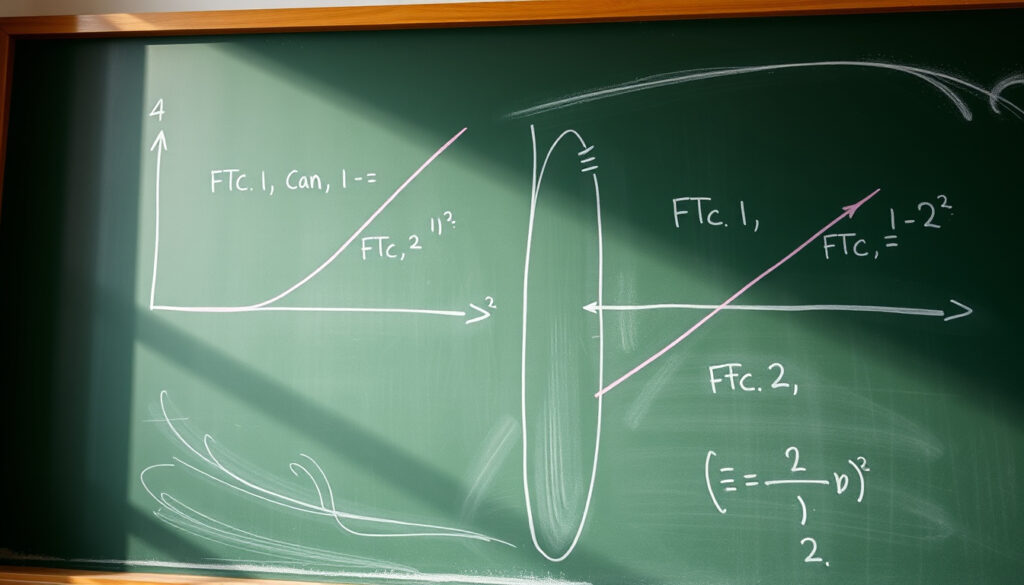
Fundamental Theorem of Calculus: FTC 1 vs FTC 2 Explained
There’s a moment in any calculus course when the two halves of the subject suddenly click together: derivatives and integrals turn out to be two sides of the same coin. That moment is the fundamental theorem of calculus, and once you see it, evaluating areas under curves becomes almost mechanical.
Year of formalization: 17th century (1680s) ·
Key mathematicians: Isaac Newton, Gottfried Wilhelm Leibniz ·
Number of parts: 2 ·
Also known as: Newton–Leibniz theorem ·
Field: Calculus
Quick snapshot
- Part 1: Derivative of an integral (LibreTexts)
- Part 2: Evaluating definite integrals (Monash University)
- Interchange of operations (LibreTexts)
- Area under a curve (Monash University)
- Physics: displacement from velocity (Encyclopaedia Britannica)
- Engineering: accumulated quantities (Encyclopaedia Britannica)
- Uses Mean Value Theorem (LibreTexts)
- Relies on continuity and differentiability (LibreTexts)
- Historical proofs by Newton and Leibniz (Wikipedia)
Six quick facts, one pattern: the theorem is a single idea with two complementary faces.
| Label | Value |
|---|---|
| Full Name | Fundamental Theorem of Calculus |
| Also known as | Newton–Leibniz theorem |
| Field | Calculus |
| Year of discovery | 1680s |
| Mathematicians | Isaac Newton, Gottfried Wilhelm Leibniz |
| Number of parts | 2 |
What is the fundamental theorem of calculus?
What does the theorem state?
The fundamental theorem of calculus links differentiation and integration, treating them as inverse processes in the standard teaching formulation Wikipedia (encyclopedic reference). A common modern statement of the first part says that if f is continuous and F(x) = ∫ax f(t)dt, then F‘(x) = f(x) LibreTexts (open textbook platform). The second part states that if F is an antiderivative of f, then ∫ab f(x)dx = F(b) − F(a) Monash University (academic resource).
You don’t need to sum infinitely many rectangles every time. The FTC turns a hard limit problem into a simple subtraction.
Who discovered the fundamental theorem of calculus?
The first full proof is attributed to Isaac Barrow Wikipedia (history of calculus), but the theorem is named after Isaac Newton and Gottfried Wilhelm Leibniz, who independently developed the framework in the 1680s. The exact date of the first formal statement remains unclear, partly because of the heated priority dispute between the two.
The implication: the theorem’s discovery was less a single eureka moment and more a gradual consolidation of ideas that had been building for decades. For a broader understanding of fundamental biological processes, see our guide on cellular respiration.
What’s the difference between FTC 1 and FTC 2?
What does Part 1 of the FTC state?
Part 1 is often used to differentiate an accumulation function with a moving upper limit LibreTexts (open textbook platform). If f is continuous on [a,b], then the function F(x) = ∫ax f(t)dt is differentiable and F‘(x) = f(x).
What does Part 2 of the FTC state?
Part 2 is the evaluation theorem: ∫ab f(x)dx = F(b) − F(a), where F is any antiderivative of f Monash University (academic resource). This is the workhorse for computing definite integrals without summing areas by hand LibreTexts (open textbook platform).
How are they used differently?
Two parts, one essential difference: Part 1 differentiates an integral; Part 2 integrates a derivative.
| Feature | FTC Part 1 | FTC Part 2 |
|---|---|---|
| What it does | Derivative of an integral function | Evaluates definite integral using antiderivative |
| Input | Continuous function f on [a,b] | Antiderivative F of f |
| Output | F‘(x) = f(x) | ∫ab f(x)dx = F(b) – F(a) |
| Typical use | Finding derivative of an accumulation function | Computing area under a curve |
| Continuity required | Yes (on interval) | Yes (on interval) |
| Terminology notes | Sometimes called the “first fundamental theorem” | Sometimes called the “second fundamental theorem” |
The trade-off: Part 1 is more theoretical; Part 2 is the practical tool you’ll use on exams and in physics problems.
What is the second fundamental theorem of calculus?
How is the second theorem different from the first?
The second fundamental theorem is actually Part 2 of the FTC. It allows evaluation of definite integrals without limits, using the antiderivative difference Wolfram MathWorld (mathematical reference). Some textbooks reverse the numbering, so it’s worth checking which convention your source uses.
What is the formula for the second fundamental theorem?
If F is an antiderivative of f, then ∫ab f(x)dx = F(b) − F(a). This is often called the evaluation theorem Encyclopaedia Britannica (reference work).
The pattern: whatever you call it, the second part is what makes calculus practical — it turns a limit into a subtraction.
What are some examples of the fundamental theorem of calculus?
Example: evaluating ∫01 x² dx
Find an antiderivative of x²: F(x) = x³/3. Then ∫01 x²dx = F(1) − F(0) = (1³/3) − (0³/3) = 1/3 MIT (academic example sheet).
Example: finding derivative of an integral function
Let G(x) = ∫0x sin(t)dt. By FTC Part 1, G‘(x) = sin(x) Pearson (educational publisher).
Common mistakes to avoid
- Forgetting the continuity condition: if f has a jump, the theorem may not apply in its simple form LibreTexts (open textbook platform).
- Mixing up the variable of integration with the upper limit — treat x and t as separate.
- Using the wrong antiderivative: always check that F‘(x) = f(x).
The catch: the theorem is simple in principle, but the conditions matter. A discontinuous function can break the nice relationship.
How is the fundamental theorem of calculus proved?
Outline of the proof for Part 1
Define F(x) = ∫ax f(t)dt. For a small increment h, F(x+h) − F(x) = ∫xx+h f(t)dt. By the Mean Value Theorem for integrals, there exists c in [x, x+h] such that this equals h·f(c). Dividing by h and taking the limit as h→0 gives f(x), using continuity of f LibreTexts (open textbook platform).
Outline of the proof for Part 2
Let F be an antiderivative of f. Define G(x) = ∫ax f(t)dt. By Part 1, G‘(x) = f(x) = F‘(x), so G − F is constant. Evaluate at x = a: G(a) = 0, so the constant is −F(a). Then G(b) = F(b) − F(a), which is the desired result.
Key lemmas used
- Mean Value Theorem for integrals (LibreTexts)
- Continuity of f on the closed interval
- Differentiability of the accumulation function
The historical proof by Newton and Leibniz used geometric intuition rather than formal limits, but the modern version above is rigorous Mathematical Association of America (historical survey).
Why this matters: the proof shows that the FTC is not a magic trick — it follows from the definition of the integral and the Mean Value Theorem. Every student who works through it once gains a deeper trust in the tool. For a practical measurement guide, see our article on 48 inches in feet.
Confirmed facts
- The theorem is a fundamental result in calculus (Wikipedia)
- Both parts are rigorously proven (LibreTexts)
What’s unclear
- Historical priority dispute between Newton and Leibniz
- Exact date of first formal statement
- Universal acceptance in all mathematical contexts
The Fundamental Theorem of Calculus is the most important theorem in calculus. It shows how differentiation and integration are inverse processes.
— James Stewart, Calculus textbook author (Encyclopaedia Britannica)
Newton’s work on fluxions laid the groundwork for what we now call the Fundamental Theorem of Calculus.
— Isaac Newton (historical correspondence, Mathematical Association of America)
For the student who has just learned the FTC, the choice is clear: either treat it as a formula to memorize, or work through the proof once and understand why it works. The latter approach saves time in the long run — every definite integral you’ll ever compute rides on this single theorem.
mathsisfun.com, geeksforgeeks.org, math.uwaterloo.ca, simple.wikipedia.org, study.com, en.wikipedia.org
Frequently asked questions
What is the difference between the fundamental theorem of calculus and the mean value theorem?
The Mean Value Theorem is used in the proof of the FTC, but the FTC itself connects derivatives and integrals. The MVT guarantees a point where the instantaneous rate equals the average rate; the FTC guarantees that integration and differentiation are inverses.
Why is the fundamental theorem of calculus important?
It makes evaluating definite integrals practical. Without it, you’d have to compute Riemann sums for every problem. With it, you just find an antiderivative and subtract.
Can the fundamental theorem of calculus be applied to improper integrals?
Yes, but you must handle the limits carefully. The theorem extends to improper integrals by taking limits of the definite integral as the endpoints approach the singularity or infinity.
What are the prerequisites for understanding the FTC?
You need a solid grasp of limits, derivatives, and basic integration (antiderivatives). Continuity and differentiability concepts also help.
How do I use the FTC to find the area under a curve?
Find an antiderivative of the function, evaluate it at the upper bound, subtract its value at the lower bound. That’s the area.
Is the fundamental theorem of calculus used in physics?
Constantly. Displacement is the integral of velocity, work is the integral of force, and the FTC justifies those calculations.
What is the relationship between the FTC and integration by substitution?
Integration by substitution is derived from the chain rule, which is an inverse operation of the FTC. The FTC provides the theoretical foundation for changing variables in integrals.
More related posts
 Nail Salon Near Me Open: Dublin Tipping & Etiquette
 Bubble Gum Simulator Infinity Codes – Active June 2026
 How to Check Lowe’s Gift Card Balance (Online, Phone, Store)
 W-9 Form 2026 – IRS Draft Download, Instructions & Changes
 Did Dolly Parton Die? Debunking the Death Hoax
 Best Free Calorie Counter Apps (2025): Truly Free
 Best Budget Travel Backpacks 2026: Tested & Reviewed
 48 Inches in Feet: Conversion and Height Guide for Kids