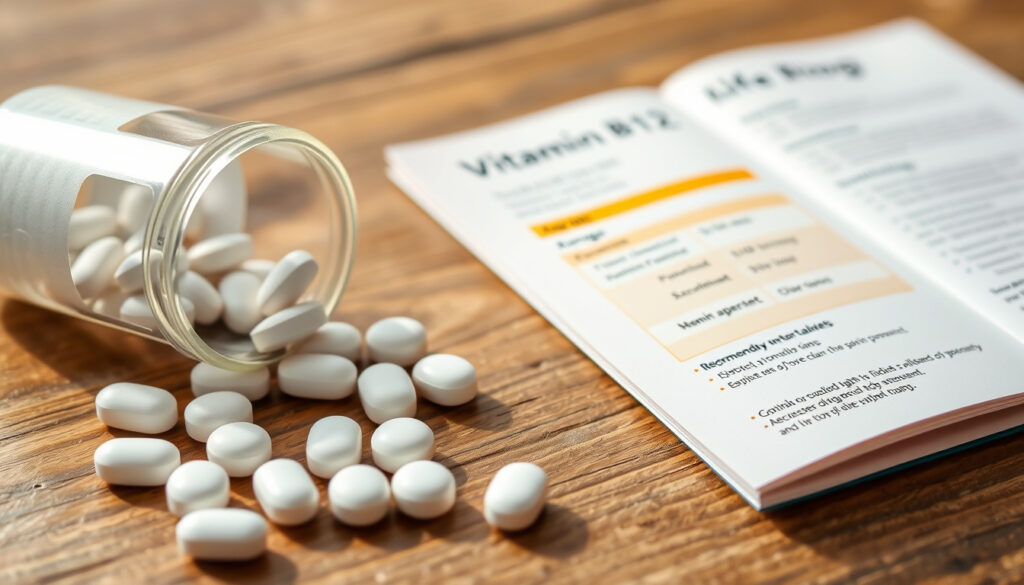
Vitamin B12 Dosage for Adults: RDA, Safety, and Age Guide
Most people don’t give a second thought to their vitamin B12 intake until a blood test reveals low levels or a doctor mentions deficiency — that’s when the numbers get confusing: the official recommended daily allowance is 2.4 micrograms, yet the supplement aisle is stacked with 1,000-mcg tablets. This guide unpacks why that gap exists, what the latest science says about age-related absorption, and how to choose a safe, effective dose for your life stage.
RDA for adults: 2.4 mcg/day ·
Common OTC dose: 1,000 mcg/day ·
Adults over 50: 10–12 mcg/day (increased need)
Quick snapshot
- RDA for adults is 2.4 mcg/day (NIH Office of Dietary Supplements)
- No upper tolerable limit established — B12 is water-soluble (NIH)
- High doses up to 5,000 mcg are safe for most people (Mayo Clinic)
- Optimal dose for deficiency prevention in the elderly is not precisely established (NCBI Bookshelf)
- Long-term effects of very high doses (e.g., 5,000 mcg daily for years) are not well studied (Harvard T.H. Chan School of Public Health)
- Optimal dose for preventing deficiency in vegans is not established (Harvard T.H. Chan School of Public Health)
- No toxic threshold — excess excreted in urine within hours (NIH)
- Absorption declines gradually after age 50; supplements show effect in 1–3 months (NCBI Bookshelf)
- Awareness of age-related atrophic gastritis is driving updated geriatric guidelines (Administration for Community Living)
- More research needed on optimal supplementation for vegans and older adults (Harvard T.H. Chan School of Public Health)
Four key facts, one takeaway: the gap between the official 2.4 mcg RDA and what people actually take is driven by absorption biology, not marketing hype.
| Label | Value |
|---|---|
| RDA for adults | 2.4 mcg |
| DV per serving (typical supplement) | 41,667% (1,000 mcg) |
| Older adult recommendation | 10–12 mcg |
| Safety of high doses | No known toxicity; water-soluble |
What is the recommended vitamin B12 dosage for adults?
Official RDA from NIH and Mayo Clinic
- The U.S. Recommended Dietary Allowance for vitamin B12 for men and women age 19+ is 2.4 mcg per day (NIH Office of Dietary Supplements). This figure also appears in guidance from Mayo Clinic and MedlinePlus.
- For pregnancy the RDA rises to 2.6 mcg/day; for lactation it is 2.8 mcg/day (NIH).
Common supplement doses: 25–100 mcg vs 1,000 mcg
- Over-the-counter doses typically range from 25 mcg to 100 mcg for daily maintenance, but the most popular dose across US pharmacies is 1,000 mcg per day (GoodRx).
- Nature’s Plus suggests 25–100 mcg for general support and 250–1,000 mcg for those at risk of deficiency (Nature’s Plus).
Why many adults exceed the RDA
- The RDA is set to prevent deficiency in a healthy population, not to treat existing low levels or compensate for age-related absorption decline. As people age, 10–30% of older adults may be unable to absorb naturally occurring B12 from food (NCBI Bookshelf).
- Once intake exceeds about 1–2 mcg per meal, passive diffusion kicks in — only a small fraction is absorbed, making higher doses necessary to achieve adequate blood levels (NIH).
The implication: healthy adults may need less, but age-related changes demand higher intake.
A healthy 30-year-old who eats meat, eggs, and dairy likely meets the RDA without supplements. But someone over 50 with atrophic gastritis may need 1,000 mcg daily just to stay in the normal range — a 400× gap driven by physiology, not marketing.
Is it ok to take 1,000 mcg of B12 a day?
Safety profile of high-dose B12
- Yes, 1,000 mcg daily is considered safe for the general adult population. The NIH states that vitamin B12 is generally safe even at high doses and that no tolerable upper intake level has been established because toxicity risk is low.
- UCLA Health notes that 2,000 mcg is more than 800 times the RDA but still safe, and excess is excreted in urine (UCLA Health).
Absorption limitations: how much is actually absorbed
- Oral absorption via intrinsic factor is capped at about 1.5 mcg per meal. For doses above that, passive diffusion accounts for roughly 1–2% of the dose — so a 1,000 mcg tablet may deliver only about 10–20 mcg of bioavailable B12 (NIH).
- This explains why 1,000 mcg is a standard OTC dose: the body can only use a tiny fraction.
When 1,000 mcg is appropriate
- High-dose supplements are routinely used to correct deficiency, treat pernicious anemia, and support older adults with impaired absorption (Mayo Clinic).
- Mayo Clinic advises taking higher doses only under a healthcare provider’s recommendation, as rare side effects (headache, nausea) are possible.
The catch: even at high doses, only a fraction is bioavailable, so the risk is low.
Is 5000 mcg of vitamin B12 too much to take?
Safety of 5,000 mcg compared to RDA
- Five thousand micrograms is over 2,000 times the RDA, yet the safety profile remains favorable. Harvard T.H. Chan School of Public Health states that up to 1,000 mcg/day of oral B12 for deficiency treatment is generally safe, and higher doses (like 5,000 mcg) are not associated with toxicity because B12 is water-soluble.
- The NIH confirms no upper limit; excess is excreted in urine (NIH).
Clinical uses for 5,000 mcg doses
- Five thousand mcg tablets are used sublingually or in injectable forms for severe deficiency, pernicious anemia, and cases where oral absorption is severely compromised (Mayo Clinic).
- Some practitioners prescribe 5,000 mcg weekly or monthly for maintenance after initial correction.
Potential side effects (rare)
- Though very safe, some people report mild headache, nausea, or diarrhea (Mayo Clinic).
- Harvard Nutrition Source notes emerging (low-confidence) data suggesting that supplements of 25 mcg/day or higher may increase fracture risk — a finding that requires further study (Harvard).
What this means: high doses are safe but usually overkill for those without absorption issues.
While high-dose B12 is safe, taking 5,000 mcg daily without a deficiency is like drinking from a fire hose: your kidneys handle the overflow, but you’re spending money on expensive urine. For routine maintenance, lower doses (25–100 mcg) often suffice.
What is the vitamin B12 dosage for seniors?
Why seniors need more B12
- Aging often brings atrophic gastritis, a condition that reduces stomach acid and intrinsic factor production, impairing the release and absorption of B12 from food (NCBI Bookshelf). The NCBI review notes that 10–30% of older adults may be unable to absorb naturally occurring B12.
- The NIH consumer fact sheet recommends that people over 50 get most of their B12 from fortified foods or supplements because these forms are better absorbed.
Dosage recommendations for ages 40, 50, 60, 70
- Mayo Clinic recommends 10–12 mcg per day for older adults (Mayo Clinic). However, many clinicians suggest 1,000 mcg daily for those with known absorption issues.
- The official RDA does not increase with age — it remains 2.4 mcg for all adults — but absorption decreases, so the NCBI Bookshelf advises meeting the RDA via fortified foods or supplements after age 50.
- The Administration for Community Living clarifies that older adults do not require more B12 than younger adults, but absorption may decrease, making supplements prudent.
Difference between natural food sources and supplements
- Natural B12 from meat, fish, and dairy is protein-bound and requires stomach acid for release. In contrast, the crystalline form in supplements is free and can be absorbed even with low stomach acid (NIH).
- For a senior with atrophic gastritis, a 1,000 mcg supplement may deliver more usable B12 than several servings of salmon.
The pattern: the gap between RDA and actual need widens with age, making supplementation the practical solution.
What is the daily value for vitamin B12?
Definition of Daily Value (DV)
- The Daily Value (DV) is a reference amount set by the FDA to help consumers understand how a serving of food or supplement contributes to their daily nutrient needs. For vitamin B12, the DV is 2.4 mcg for adults and children age 4+ (FDA; NIH).
- It is not an individualized recommendation but a general benchmark for labeling.
DV for B12: 2.4 mcg
- The DV is identical to the RDA for adults. A supplement providing 1,000 mcg of B12 delivers 41,667% of the DV per serving — a striking number that simply reflects how far real-world supplementation diverges from the minimal requirement (NIH).
How to interpret supplement labels
- Look for “Cyanocobalamin” or “Methylcobalamin” on the ingredients list. The %DV helps you compare products, but the absolute mcg dose matters more for therapeutic use.
- A label showing 41,667% DV for 1,000 mcg is not dangerous — it simply indicates the pill provides far more than the baseline. The body adjusts by excreting excess (NIH).
The catch: the %DV is for labeling, while the mcg dose determines therapeutic effect.
Upsides
- Vitamin B12 is water-soluble; excess is excreted, not stored, making toxicity virtually impossible.
- High doses (1,000–5,000 mcg) are safe and widely available over the counter.
- Supplementing can reverse deficiency symptoms — fatigue, memory lapses, neuropathy — in weeks.
- Fortified foods and supplements provide an effective solution for older adults with absorption issues.
Downsides
- Very high doses (5,000 mcg) are unnecessary for most people and can waste money.
- Emerging (low-confidence) evidence from Harvard suggests a possible link between high-dose supplements and fracture risk, requiring further research.
- Oral absorption is limited — a 1,000 mcg tablet only yields about 10–20 mcg of usable B12.
- Some people experience mild side effects: headache, nausea, or diarrhea.
Confirmed facts
- RDA for adults is 2.4 mcg (NIH, Mayo).
- High doses up to 5,000 mcg are safe for most people.
- Older adults often need higher intake due to decreased absorption.
- No upper tolerable limit established.
What’s unclear
- Optimal dose for deficiency prevention in the elderly is not precisely established.
- Long-term effects of very high doses (e.g., 5,000 mcg daily for years) are not well studied.
The recommended daily amount of vitamin B-12 for adults is 2.4 micrograms.
— Mayo Clinic (trusted medical institution)
The dose of 2000 micrograms of B12 is more than 800 times the recommended daily amount.
A common dose of OTC vitamin B12 is 1,000 mcg each day.
The decision for millions of adults between a modest 25-mcg tablet and a 1,000-mcg daily dose comes down to one question: is your body absorbing B12 efficiently? For a healthy 30-year-old who eats animal products, the RDA of 2.4 mcg may be enough. For anyone over 50, on a vegan diet, or with digestive conditions, the science is clear: a higher dose — typically 1,000 mcg — is the practical way to maintain adequate levels. The safety margin is enormous, but so is the variance in individual need. For the average older adult, choosing a 1,000 mcg supplement over ignoring the issue is the difference between staying neurologically sharp and risking the slow march of deficiency — an easily preventable outcome.
ods.od.nih.gov, pmc.ncbi.nlm.nih.gov, aarp.org, health.harvard.edu, lpi.oregonstate.edu, aafp.org
Frequently asked questions
What are the symptoms of vitamin B12 deficiency?
Fatigue, weakness, memory problems, numbness or tingling in hands and feet, and a smooth red tongue are common signs. Severe deficiency can lead to megaloblastic anemia and neurological damage (NIH).
Can I take vitamin B12 with other medications?
B12 is generally considered safe with most medications. However, metformin (for diabetes) and proton pump inhibitors (for acid reflux) may reduce B12 absorption. Always check with your doctor (Mayo Clinic).
Is vitamin B12 injection better than oral supplements?
Injections bypass digestive absorption entirely and are used for severe deficiency or pernicious anemia. For most people, high-dose oral supplements (1,000 mcg) provide enough absorbed B12 to correct deficiencies (NIH).
How long does it take to correct a B12 deficiency?
With adequate supplementation, symptoms often improve within a few weeks. Full normalization of blood levels may take three to six months (Mayo Clinic).
Should I take B12 in the morning or at night?
There is no strong evidence regarding timing. Some people find that B12 taken in the morning supports energy, but because it is water-soluble, the time of day does not affect absorption or safety (NIH).
Does vitamin B12 help with energy and fatigue?
Yes, if fatigue is caused by a B12 deficiency. For people with normal levels, high-dose B12 is not an energizer — any surplus is excreted (NIH Consumer Fact Sheet).
What foods are rich in vitamin B12?
Clams, liver, trout, salmon, beef, dairy, eggs, and fortified cereals are top sources. Plant-based foods do not naturally contain B12, so vegans need fortified foods or supplements (NIH).
More related posts
 Apple Music for Artists: Claim, Payouts & Spotify Comparison
 Where to Watch Ted Lasso: Streaming on Apple TV+ & Alternatives
 Where to Watch Los Angeles Rams vs Chicago Bears: Channel & Time
 Mikki Mase Net Worth 2026: $10M-$43.5M Estimates
 Why Am I Always Cold? Common Causes and Treatments
 Netflix 24 Hour Customer Service Number: Call 24/7 Support
 What Is POTS Disease? Symptoms, Causes & Treatment