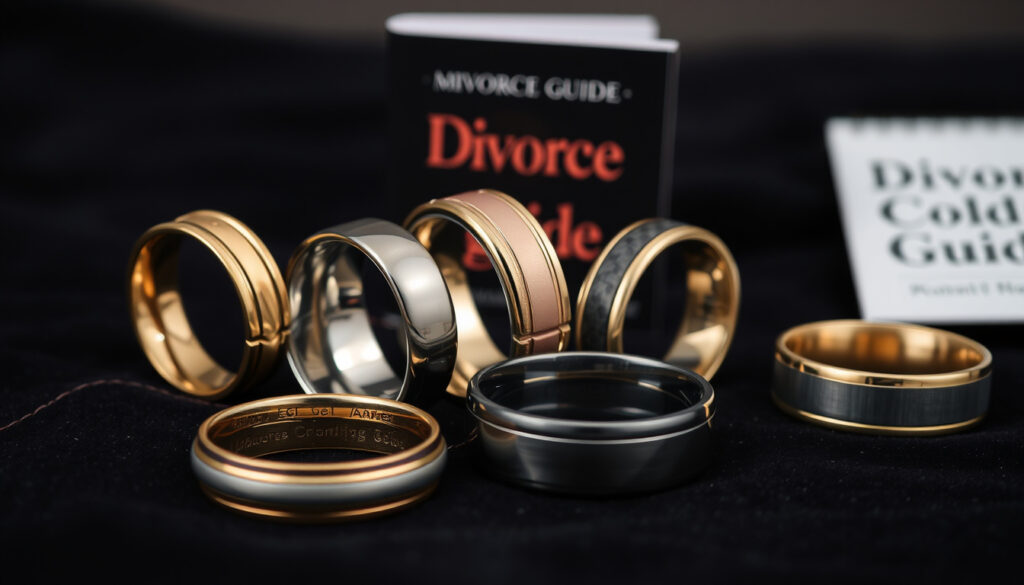
Wedding Bands for Men: Cost, Materials, Meanings, Divorce Guide
Few pieces of jewelry carry the weight of a wedding band — a ring that signals commitment, status, and identity in a single glance. For most men, it’s the one accessory they’ll wear daily for decades, through career shifts, workouts, and the quiet moments in between.
Typical price range: $100–$2,000 · Density of platinum: 21.4 g/cm³ · Mohs hardness of tungsten carbide: 9–9.5
Quick snapshot
- Average cost for a men’s wedding band is approximately $500–$600 (The Knot (wedding industry research))
- Simple bands start under $100; luxury platinum or diamond bands exceed $5,000 (Shane Co. (national jewelry retailer))
- Metal choice is the primary price driver — tungsten and titanium are budget-friendly (The Knot (wedding industry research))
- Platinum: densest and heaviest, hypoallergenic, resizable (Blue Nile (online jewelry retailer))
- Tungsten carbide: Mohs 9–9.5, nearly scratch-proof but not resizable (Blue Nile (online jewelry retailer))
- Gold: classic, resizable, but softer and prone to scratching (Blue Nile)
- Online retailers like Manly Bands and Staghead Designs offer custom and unique metals
- In-store try-ons help with fit and feel, especially for resizable metals
- Sizing is critical — tungsten and titanium cannot be resized after purchase
- The 3-month rule is a marketing tradition, not a binding guideline
- A divorce ring symbolizes a new chapter after marriage ends
- Not wearing a wedding ring can signal practical reasons or deeper issues
Key facts at a glance
The numbers below distill what matters most when choosing a men’s wedding band — from cost to durability to cultural conventions.
| Attribute | Value |
|---|---|
| Average cost (typical) | $500–$600 (The Knot) |
| Full price range | $100–$2,000+ (up to $8,500 for premium) (Blue Nile) |
| Hardest metal | Tungsten carbide (Mohs 9–9.5) |
| Heaviest common metal | Platinum (density 21.4 g/cm³) |
| Most traditional metal | Gold (yellow, white, rose) |
| Most hypoallergenic | Platinum and palladium |
| Resizable metals | Gold, platinum, palladium — not tungsten, titanium, or tantalum |
| Budget-friendly option | Silicone rings under $30 for multi-packs (RingReel (wedding ring pricing guide)) |
| Common finger for wedding ring | Left ring finger (many Western cultures) |
How much should a guy’s wedding band cost?
Factors that influence price (material, brand, custom work)
- Metal type is the dominant cost factor: tungsten and titanium rings run under $200, while platinum bands start near $700 (RingReel).
- Custom engravings, inlays (wood, carbon fiber, meteorite), and diamond settings add $200–$1,000+ to the base price.
- Brand markup varies widely: a simple gold band from a mass retailer may cost $200, while the same weight from a luxury house can be $1,500.
- Silicone rings provide a practical alternative — single bands under $10, seven-packs under $30 (RingReel).
Average budget ranges for different metal types
- Titanium: under $150 to $340 (RingReel).
- Tungsten carbide: under $200 to $400 (RingReel).
- 18K yellow gold: $590 to $1,550 (RingReel).
- 950 platinum: $690 and up (RingReel).
- 950 palladium: $1,000 to $1,500+.
- The Knot reports an overall average of $600 based on its 2023 study (The Knot).
The trade-off: A lower-cost ring in tungsten or titanium will outlast a softer gold band if you never need a resize. The moment your finger changes size — and it will — gold’s resizability becomes the feature that saves you from buying a whole new ring.
What is the best male wedding band?
Comparing gold, platinum, titanium, tungsten, silver, and rubber
Brilliant Earth, a major online jeweler, offers men’s wedding bands in platinum, 14K and 18K yellow gold, 14K and 18K white gold, 14K rose gold, tungsten, titanium, tantalum, meteorite, zirconium, and forged carbon (Brilliant Earth (online jewelry retailer)). That breadth of choice means the “best” metal depends almost entirely on your priorities.
- Platinum — naturally white, dense (21.4 g/cm³), hypoallergenic, and resizable. It develops a soft patina over time rather than wearing away. Highest cost but longest lifespan.
- Gold (yellow, white, rose) — classic and resizable, but softer. Blue Nile notes yellow gold is more prone to scratching and denting than harder metals (Blue Nile). White gold typically needs rhodium plating every 1–2 years.
- Tungsten carbide — Mohs hardness 9–9.5, nearly scratch-proof. Cannot be resized. Brittle under sharp impact.
- Titanium — lightweight, strong, corrosion-resistant, and affordable. Cannot be resized.
- Tantalum — deep gray, nearly as dense as platinum, but not resizable.
- Meteorite and forged carbon — unique aesthetics at a premium. Meteorite requires oiling to prevent rust; carbon is ultralight.
- Silicone — safe for gym, construction, and tactical use. Under $30, replaceable, no resizing needed.
Leading brands from the marketplace
- Manly Bands — known for unconventional materials like reclaimed wood, meteorite, and military metals.
- Staghead Designs — gold, titanium, and tungsten rings with custom engraving and inlay options.
- Shane Co. — reliable in-store and online selection with bands starting under $200 (Shane Co.).
- Helzberg Diamonds — range from $100 simple bands to $5,000+ luxury styles (Helzberg Diamonds (national jewelry chain)).
- Kay.com — frequent sales with prices starting around $48.56.
A groom who works with his hands every day — carpenter, mechanic, firefighter — will destroy a gold band in months. The same ring on an office worker could last a lifetime. Matching metal to lifestyle determines whether the ring survives the first year intact.
What is the best website to buy mens wedding bands?
Online vs. in-store shopping considerations
- Online retailers offer wider selection and often lower prices, but you cannot try before you buy. Many offer free returns or at-home try-on kits.
- In-store allows you to feel the weight, inspect the finish, and get professionally sized — especially important for metals that cannot be resized later.
- A smart approach: get sized at a local jeweler, then compare online pricing for the exact model.
Top retailers and their strengths
- Blue Nile — strong filter system for metal, shape, width, and price. Transparent pricing. Men’s rings from under $200 to over $8,500 (Blue Nile (online diamond and jewelry retailer)).
- Brilliant Earth — wide material range including tantalum, zirconium, and forged carbon. Strong on ethical sourcing (Brilliant Earth).
- Manly Bands — unique designs with reclaimed materials, strong customer reviews for originality.
- Staghead Designs — custom and semi-custom designs with broad metal options.
- Shane Co. — lifetime warranty, free resizing for resizable metals, local stores.
- Helzberg Diamonds — reputable chain with solid return policy and frequent sales (Helzberg Diamonds).
Buying online without trying a similar metal first is the #1 reason men return their wedding band. Spending $50 at a local jeweler to feel platinum versus tungsten in your hand prevents the headache of a $600 return.
The catch: The best website is the one that matches your risk tolerance. If you need to feel the ring, shop in-store. If you want the widest choice for your budget, online wins — but only if you know your exact size and have confirmed the return policy.
What does the 3-month rule for rings mean?
History and origin of the 3-month salary rule
- The rule suggests spending two to three months’ salary on an engagement ring. It originated from a De Beers marketing campaign in the mid-20th century.
- It was never a legal, religious, or cultural mandate — it was a retail strategy to normalize higher spending.
- Modern jeweler surveys show that the average spend is far lower, and most financial advisors recommend spending what fits your budget, not a formula.
Modern interpretations and alternatives
- Many couples today discuss a ring budget openly and ignore the 3-month rule entirely.
- The rule applies to engagement rings, not wedding bands — men’s wedding bands are typically less expensive.
- Alternative rule of thumb: spend what you can pay in cash without going into credit card debt.
What does wearing a ring in the middle finger mean?
- In many Western cultures, the ring finger (fourth finger) is the traditional wedding band location.
- The middle finger often symbolizes balance, responsibility, or individuality — but no universal marital meaning exists.
- Some men wear a ring on the middle finger after divorce or to signal a specific personal meaning.
What does it mean when a married man does not wear his wedding ring?
- Practical reasons dominate: a man who works with machinery, in construction, or as a firefighter may remove the ring for safety.
- Medical reasons — skin allergies, swelling, arthritis — also lead men to go ringless.
- Emotional or relational causes are possible but not automatic. No single interpretation is reliable without broader context.
- What’s unclear: The exact motivation can only be known through conversation. Assuming the worst is as unfounded as assuming the best.
What is the divorce ring?
Definition of a divorce ring
A divorce ring is a new ring that a divorced individual wears to symbolize a fresh start, independence, and a new chapter in life. Unlike a wedding band, which represents union, a divorce ring represents personal rebirth. The trend has grown on social media and in jewelry marketing as a form of self-expression post-divorce.
Who legally owns an engagement ring after divorce?
- Legal ownership of an engagement ring after divorce varies by state and jurisdiction.
- Some states consider it a conditional gift — given on the condition of marriage. If the marriage occurs, the ring belongs to the recipient. If the marriage ends, ownership depends on who broke the engagement or the specific state law.
- Other states treat the ring as an unconditional gift once the marriage takes place, meaning the recipient keeps it.
- Divorce decrees can override default rules, so consultation with a family law attorney is essential.
- What’s unclear: Exact legal outcomes depend on state law, whether fault is considered, and the specific language in any prenuptial or postnuptial agreement.
What are some good ideas for a divorce ring?
- Repurpose the original band — have a jeweler reshape or reset the metal into a new design.
- Choose a birthstone or a gemstone that represents a personal milestone.
- Bold modern design — tungsten or titanium bands with carbon fiber or meteorite inlays reflect a new identity.
- Right-hand wear — moving a ring to the right hand or a different finger signals a new status.
The same metal that once symbolized ‘forever’ can be melted down and reshaped into ‘next chapter.’ The divorce ring market is growing precisely because people want the physical reminder of a past commitment transformed, not discarded.
What do divorced men do with their rings?
When to stop wearing a wedding ring after divorce?
- There is no fixed timeline — some men stop wearing the ring the day the divorce is finalized, others gradually phase it out.
- Practical signals: once the ring no longer feels like a symbol of your current life, it is time.
- Some men switch the ring to the opposite hand or a different finger before removing it entirely.
- What’s unclear: Social norms around post-divorce ring removal vary by region, culture, and social circle. No universal rule applies.
Options: selling, storing, repurposing, or wearing a new band
- Sell — gold and platinum have scrap value. Selling to a refiner or through a consignment dealer recoups part of the cost.
- Store — many men keep the ring in a drawer or safe as a keepsake, especially if it has sentimental value or will be passed to a child.
- Repurpose — have a jeweler melt the metal into a new piece: a pendant, a bracelet, or a new ring.
- Replace with a divorce ring — choosing a new band that represents the next chapter.
What this means: The decision is personal, not prescriptive. For a man who wants closure, selling or repurposing the ring can be cathartic. For one who values history, storage preserves the story. The key is avoiding guilt over any choice.
Legal ownership of rings after divorce is not always sentimental. In many states, the engagement ring is considered a conditional gift — meaning ownership can be contested in court. Check with a family law attorney before selling or discarding any ring involved in a divorce proceeding.
Metal comparison: which wedding band fits your life?
Four metals dominate the men’s wedding band market, each with distinct trade-offs in cost, durability, feel, and resizability.
| Attribute | Gold (14K/18K) | Platinum | Tungsten carbide | Titanium |
|---|---|---|---|---|
| Price range | $200–$1,500 | $700–$3,000+ | $100–$400 | $100–$350 |
| Mohs hardness | 2.5–3 | 4–4.5 | 9–9.5 | 6 |
| Density (g/cm³) | 15.6 (14K) – 17.7 (18K) | 21.4 | 15.6 | 4.5 |
| Resizable? | Yes | Yes | No | No |
| Hypoallergenic? | Usually (nickel may cause reactions) | Yes | Yes (if nickel-free grade) | Yes |
| Scratch resistance | Low — scratches easily | Medium — develops patina | Very high | Medium |
| Weight feel | Moderate | Heavy, substantial | Moderate | Very light |
The trade-off: Gold and platinum are investments that can be resized and refinished — but they require maintenance. Tungsten and titanium are nearly maintenance-free but unforgiving if your finger size changes or the ring gets damaged. The choice between ‘can be fixed’ and ‘won’t break’ is the buyer’s core decision.
Specifications: what the numbers tell you
Six properties separate a ring you will love for decades from one you will replace in a year.
| Property | What it means for your ring |
|---|---|
| Mohs hardness | Rates scratch resistance. Tungsten (9–9.5) is virtually scratch-proof; gold (2.5–3) scratches with normal wear. |
| Density | Higher density = heavier feel. Platinum (21.4 g/cm³) is nearly twice as dense as gold. |
| Hypoallergenic rating | Platinum and palladium are safest for nickel-allergic skin. White gold often contains nickel and may cause reactions. |
| Patinization | Platinum develops a soft, non-destructive patina over time that is desirable to many wearers. Gold and tungsten maintain their polish. |
| Resizability | Gold and platinum can be sized up or down. Tungsten, titanium, tantalum, and zirconium cannot — requiring full replacement if your finger changes size. |
| Rhodium plating | White gold is typically plated with rhodium for brightness. Plating wears off in 1–2 years and requires reapplication. |
| Brittleness | Tungsten carbide is hard but brittle — it can crack under a sharp impact (e.g., dropping on tile). Titanium and gold are tougher. |
| Conductivity | Metal rings conduct electricity. Silicone and ceramic do not — a safety factor for electricians and engineers. |
Mohs hardness is the most common metric cited by jewelers, but it measures only scratch resistance, not toughness. The tungsten ring that survives a decade of desk work may shatter if dropped on concrete. A gold ring that looks scratched at year one can be polished back to new at year ten. Always ask about brittleness, not just hardness.
Pros and cons of common wedding band materials
Upsides
- Platinum: densest, longest-lasting, hypoallergenic, resizable, develops a desirable patina
- Gold: timeless appearance, resizable, familiar alloy, wide price range
- Tungsten: extremely scratch-resistant, affordable, heavy feel at moderate price
- Titanium: lightweight, strong, affordable, hypoallergenic
- Silicone: cost-effective, safe for active jobs, replaceable, no resizing needed
Downsides
- Platinum: highest cost, heavy feel may be uncomfortable for some, scratches over time (patina not for everyone)
- Gold: soft — scratches and dents easily, white gold requires periodic rhodium plating
- Tungsten: cannot be resized, brittle under impact, difficult to remove in emergencies
- Titanium: cannot be resized, lightweight feel may seem cheap to some, scratches more than tungsten
- Silicone: not formal or traditional, wears out and needs replacement, no resale value
How to buy a men’s wedding band: a step-by-step guide
Step 1: Determine your budget
- Set a hard maximum based on your savings, not a rule of thumb. The average is $600, but many quality bands exist under $300 (Diamonds.pro (jewelry buying guide)).
- Factor in potential future costs: resizing, rhodium plating, and engraving add $50–$200 over the ring’s lifetime.
Step 2: Choose a metal that fits your lifestyle
- Office worker? Gold or platinum will hold up well with standard care.
- Active job (construction, mechanic, firefighter)? Titanium, tungsten, or silicone are safer bets.
- Allergies? Platinum or palladium are the safest choices for sensitive skin.
Step 3: Get professionally sized
- Visit a local jeweler to measure your finger. Size varies by temperature, time of day, and hand dominance.
- For tungsten and titanium rings, sizing is irreversible — confirm your size before ordering.
Step 4: Select a retailer and compare policies
- Check return windows: 30 days is standard, but some retailers offer 60 or 90 days.
- Look for warranty coverage on resizing, rhodium replating, and damaged stones.
- Read reviews about sizing accuracy — some online brands run large or small.
Step 5: Place the order and confirm the timeline
- Standard orders ship in 1–2 weeks; custom designs take 4–8 weeks. Order early if the wedding date is fixed.
- Insure the ring after delivery — homeowners or renters insurance can cover loss or theft with a jewelry rider.
The implication: Buying a wedding band is a five-step process where only one step involves cash. The other four — budget, metal, size, and retailer policy — determine whether the ring becomes a daily pleasure or a recurring hassle.
Confirmed facts and what remains unclear
Confirmed facts
- Tungsten and titanium are significantly more scratch-resistant than gold (Brilliant Earth (metal comparison guide)).
- Platinum is denser and heavier than all common gold alloys (Blue Nile).
- White gold is typically rhodium-plated to maintain a bright white color and requires periodic replating.
- The 3-month rule is a marketing tradition originating from the diamond industry, not a legal or religious mandate.
- Men’s wedding bands average $500–$600, with a typical range of $100–$2,000 (The Knot).
What’s unclear
- Exact cost ranges vary significantly by region, brand, and current metal commodity prices.
- Legal ownership of an engagement ring after divorce depends on state laws and whether the marriage was completed — outcomes are not uniform.
- The meaning of a married man not wearing his wedding ring can be personal, practical, or relational — no single interpretation applies.
- How long rhodium plating on white gold lasts depends on wear frequency, skin chemistry, and ring care habits.
Expert perspectives
“Platinum is the most durable metal over the long run because it doesn’t wear away. Gold will lose metal every time it’s polished, but platinum just gets moved around on the surface.”
— Jewelry industry expert from Brilliant Earth’s metal guide
“In many states, an engagement ring is considered a conditional gift. If the marriage takes place, the condition is met and the ring belongs to the recipient. But if the marriage ends, ownership can be contested depending on the jurisdiction.”
— Family law attorney perspective cited in multiple legal guides
“The average cost of a men’s wedding band is $600, but guys often stress about spending too little. The number matters less than whether the ring fits your life.”
— The Knot, 2023 Jewelry and Engagement Study
“Tungsten carbide is hard enough to scratch glass, but it will crack if you drop it on tile. There’s no perfect metal — just the best match for your habits.”
— Jewelry industry expert from Diamonds.pro buying guide
Summary: making the choice that fits your life
Wedding bands for men sit at the intersection of tradition, identity, and daily practicality. The metal you choose determines not just the look and feel on your finger, but how much maintenance, replacement risk, and long-term cost you will carry. For the office-based buyer in a moderate climate, gold or platinum balanced with a resizing contingency plan makes sense. For the first responder or tradesman whose hands face constant abuse, titanium or silicone offers durability without the risk of a shattered $600 ring. The man navigating divorce should repurpose, sell, or replace — but do it on his own timeline, not someone else’s expectation.
How do I measure my ring size for a men’s wedding band?
Visit a local jeweler for professional sizing. Your finger size varies by temperature, time of day, and hand dominance. For tungsten and titanium rings, sizing is irreversible, so confirm your size before ordering.
Can tungsten rings be resized?
No. Tungsten carbide rings cannot be resized due to the hardness of the material. If your finger size changes, you will need to purchase a new ring.
What is the difference between a wedding band and an engagement ring?
An engagement ring is typically given at the proposal and features a prominent center stone. A wedding band is exchanged during the wedding ceremony and is usually a simpler metal band.
Is platinum worth the extra cost?
Yes for buyers who want the densest, longest-lasting metal that develops a desirable patina and is hypoallergenic. No for budget-conscious buyers who need a resizable ring and prefer the lower cost of gold or tungsten.
What does the middle finger represent when wearing a ring?
In many Western cultures, the middle finger often symbolizes balance, responsibility, or individuality. It has no universal marital meaning. Some men wear a ring on the middle finger after divorce or as a personal style choice.
How long does rhodium plating on white gold last?
Rhodium plating on white gold typically lasts 1 to 2 years with regular wear. The duration depends on skin chemistry, wear frequency, and ring care habits. Replating costs around $50–$100 at most jewelers.
jeweltrendpro.com, jeweltrendpro.com, jeweltrendpro.com, jeweltrendpro.com
More related posts
 Myrtle Beach Submarine Spotted? Truth Behind Viral Video
 How to Say Hi in Spanish: Hola and Beyond
 Fundamental Theorem of Calculus: FTC 1 vs FTC 2 Explained
 Audi e-tron GT Review: Price, Specs & Used Guide in Ireland
 Everything but the House: Is It Legit? (2025 Guide)
 Best Cordless Stick Vacuum: Expert-Tested Reviews & Picks