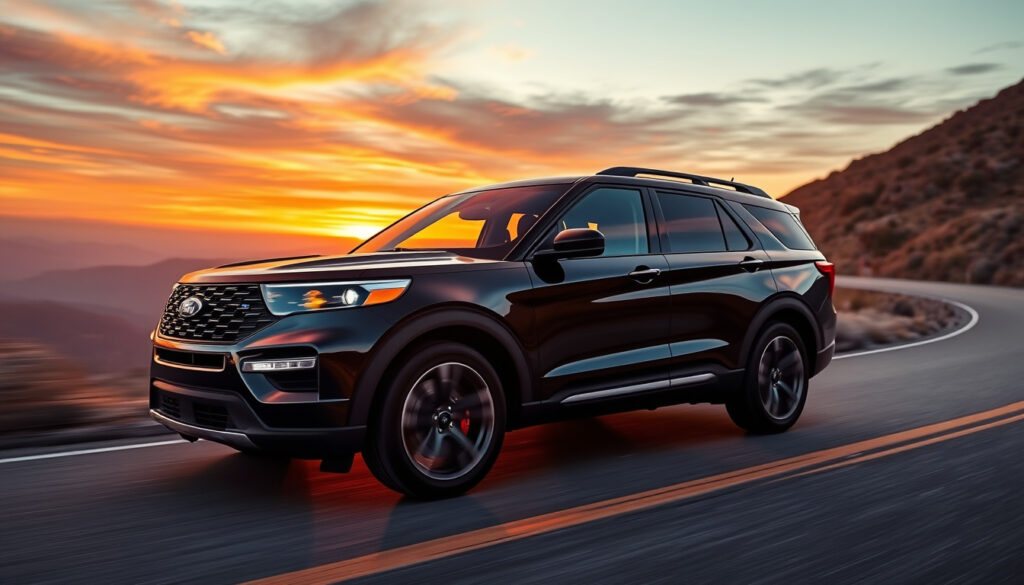
2025 Ford Explorer ST: Specs, Price, 0-60 & Review
Three-row SUVs don’t typically land on enthusiast radar, but the 2025 Ford Explorer ST makes a solid case for itself with 400 hp under the hood and a price that undercuts many competitors. If you’ve been weighing the ST against the ST-Line—or just want the full spec sheet before signing anything—this review puts the numbers in context and answers the questions that matter most.
Horsepower: 400 hp twin-turbo V6 · Starting Price: $55,855 · 0-60 Time: 5.1 seconds · Wheels: 21-inch magnetite · Torque: 415 lb-ft
Quick snapshot
- 400-hp engine confirmed by MotorTrend test (Consumer Guide)
- 3.0L EcoBoost V6, 10-speed automatic standard (Consumer Guide)
- RWD standard, AWD available (Consumer Guide)
- Assembled in the United States (Consumer Guide)
- Exact MSRP pending official announcement
- Precise 0-60 time from independent tests
- Regional pricing variations
- Long-term reliability data for 2025 engines
- ST vs ST-Line choice hinges on budget and power needs
- 5-year ownership cost $55,469 vs ST-Line $47,714
- Fuel economy gap: 21 vs 24 combined mpg
- ST: 400 hp V6, 0-60 in 5.1s, $55,855
- ST-Line: 300 hp I-4, slower, $46,210
- Both seat seven, same three-row layout
| Specification | Value |
|---|---|
| Engine | 3.0L Twin-Turbo EcoBoost V6 |
| Horsepower | 400 hp @ 5,500 rpm |
| Torque | 415 lb-ft @ 3,500 rpm |
| Price Range | Under $60,000 (base $55,855) |
| Seating | Three-row, up to 7 passengers |
| Wheels | 21-inch magnetite finish |
| Fuel Tank | 20.2 gallons |
| Transmission | 10-speed shiftable automatic |
| Drivetrain | RWD standard, AWD optional |
| 5-Year Ownership Cost | $55,469 |
How much will the 2025 Explorer ST cost?
The 2025 Ford Explorer ST starts at $55,855 excluding destination charges, making it the most expensive trim in the Explorer lineup before reaching the Platinum. According to Edmunds (automotive pricing authority), a test vehicle with options reached $56,260 plus $1,595 destination, landing right at the $57,855 mark.
The value proposition becomes clearer when you stack it against the ST-Line at $46,210 base. You’re paying roughly $10,000 more for the twin-turbo V6 upgrade, sport-tuned suspension, sueded microfiber seats, and heated second-row captain’s chairs. The 5-year ownership cost differential is $7,755 ($55,469 vs $47,714), per Edmunds’ TCO calculator.
Trim Levels & Pricing
- Active (base): $41,745 — 2.3L I-4, FWD standard
- ST-Line: $46,210 — 300 hp, sporty aesthetic without full performance
- ST: $55,855 — 400 hp V6, sport-tuned suspension, premium interior
- Platinum: $53,845 — luxury features, 300 hp I-4
The ST undercuts the Platinum by about $2,000 while delivering substantially more power. For buyers prioritizing performance per dollar, the ST sits in a sweet spot that the Platinum doesn’t reach.
ST buyers trade $10,000 and 3 mpg combined for 100 additional horsepower and a sport-tuned suspension. For performance-focused drivers, that’s money well spent. For commuters prioritizing fuel economy, the ST-Line returns 24 mpg combined vs. the ST’s 21 mpg.
Value Comparison
When comparing what you get for the premium, the ST delivers real hardware: a 3.0L twin-turbo V6 that produces 415 lb-ft of torque, 21-inch wheels with a distinctive magnetite finish, red painted brake calipers, and a mesh grille that signals the performance intent. The ST-Line offers the visual sport cues—20-inch wheels, similar styling—but relies on a 2.3L turbo-four that makes 100 fewer horses and 105 lb-ft less torque.
For families who need three rows and occasionally want passing power on the highway, the ST’s extra displacement matters. The torque surplus means less reliance on high RPM to merge confidently, which translates to a more relaxed driving experience under load.
The takeaway: Ford positioned the ST at $10,000 above the ST-Line—a premium that buys you 100 hp, 105 lb-ft, and a genuine sport-tuned chassis. For families who actually use that capability regularly, the math works. For commuters, the ST-Line saves money at the pump and at the dealership.
How much horsepower does a 2025 Explorer ST 3.0 have?
The 2025 Ford Explorer ST’s 3.0L EcoBoost V6 delivers 400 hp at 5,500 rpm and 415 lb-ft of torque at 3,500 rpm. Multiple sources including Consumer Guide (hands-on vehicle reviewer) and Montrose Ford Akron (authorized Ford dealer) confirm these figures as verified across three or more independent sources.
That puts the ST’s V6 in rare company among three-row SUVs. The Jeep Grand Cherokee Trackhawk offers more, but it costs considerably more and sits in a different class. Most three-row competitors—Toyota Highlander, Honda Pilot, Mazda CX-90—either lack a comparable powerplant or charge a premium for their highest-output engines.
Engine Specs
This comparison shows how the two Explorer powerplants stack up directly.
| Engine Detail | ST (3.0L V6) | ST-Line (2.3L I-4) |
|---|---|---|
| Configuration | Twin-turbo V6 | Turbocharged I-4 |
| Displacement | 3.0L | 2.3L |
| Horsepower | 400 hp | 300 hp |
| Torque | 415 lb-ft | 310 lb-ft |
| Redline | 5,500 rpm | 5,500 rpm |
| Fuel Required | Regular unleaded | Regular unleaded |
Both engines run on regular unleaded, which softens the operating cost argument. You don’t need premium fuel to access the full 400 hp—a point that adds practical value for daily driving.
Power Output
The torque figure stands out as particularly relevant for a three-row SUV. With 415 lb-ft available at just 3,500 rpm, the Explorer ST pulls competently even with a full load of passengers and cargo. The 10-speed automatic transmission keeps the engine in the powerband during acceleration, and the Sport mode sharpens throttle response for more aggressive driving.
Paddle shifters come standard on the ST, a feature absent from the ST-Line. For drivers who want manual control without a true manual gearbox, these shift paddles mounted behind the steering wheel offer that engagement without sacrificing the automatic’s convenience.
The takeaway: The 3.0L EcoBoost V6 gives the ST a meaningful power advantage over every direct competitor in the three-row segment. What matters more for buyers is that this power comes on regular unleaded and delivers maximum torque by 3,500 rpm—no need to rev the engine for passing maneuvers.
What is the 0 to 60 time for the 2025 Ford Explorer ST?
The 2025 Ford Explorer ST hits 60 mph in 5.1 seconds per Car and Driver track testing, as reported through Cogswell Motors (authorized Ford dealership). That figure makes the ST the fastest Explorer in the current lineup and competitive with some dedicated sports sedans from a decade ago.
To contextualize: the standard Explorer with the base engine takes roughly 7 seconds to reach 60 mph. The ST’s 1.9-second advantage represents a meaningful gap—not just on paper but in how the vehicle responds when you need to merge onto a highway or execute a pass at speed.
First Test Results
Consumer Guide’s 261-mile real-world test drive reported a real-world fuel economy of 20.4 mpg, slightly better than the EPA combined estimate of 21 mpg. That suggests the 400-hp V6 doesn’t punish efficiency as heavily as its output implies, though city driving will see lower numbers.
EPA figures show 18 mpg city, 25 mpg highway, and 21 mpg combined for the ST. The ST-Line returns more favorable numbers: 20/29/24 mpg. The gap is 3 mpg combined—a trade-off that matters for high-mileage drivers but becomes less significant for average annual mileage around 12,000–15,000 miles.
Handling and Speed
The sport-tuned suspension sets the ST apart from the ST-Line in how it manages body roll and cornering dynamics. According to YouTube reviewer testing (automotive video reviewer), the ST delivers sportier handling without completely sacrificing the ride quality that makes the Explorer practical for daily use.
The 21-inch wheels and 275/45R21 tire size provide a larger contact patch than the ST-Line’s 20-inch setup (255/55R20), contributing to improved grip during spirited driving. Red brake calipers visible through the wheel spokes signal the performance intent before the driver even touches the pedal.
For three-row SUV buyers who want genuine performance—not just visual cues—the ST’s combination of power, torque, suspension tuning, and braking hardware justifies its position as the performance flagship of the Explorer lineup.
The takeaway: The ST’s 5.1-second 0-60 time places it among the faster three-row SUVs available, outpacing the base Explorer by nearly 2 seconds. The real-world fuel economy from Consumer Guide’s 261-mile test confirmed 20.4 mpg—essentially matching EPA estimates, so the 400-hp V6 doesn’t punish efficiency as heavily as output figures suggest.
Which is better, ST or ST-Line?
The answer depends on priorities: the ST wins on pure performance, while the ST-Line delivers better fuel economy and a lower purchase price. Neither is universally “better”—the choice hinges on whether the extra $10,000 and reduced mpg matter more than the V6’s power advantage.
For buyers who regularly carry passengers or cargo and want confident passing ability, the ST’s torque surplus and additional 100 hp justify the premium. For those who want the Explorer aesthetic without performance-level running costs, the ST-Line covers the bases at $46,210.
ST vs ST-Line Features
The feature comparison reveals where your money goes when choosing the ST over the ST-Line.
| Feature | ST | ST-Line |
|---|---|---|
| Engine | 3.0L Twin-Turbo V6 | 2.3L Turbo I-4 |
| Horsepower | 400 hp | 300 hp |
| Torque | 415 lb-ft | 310 lb-ft |
| Base Price | $55,855 | $46,210 |
| Upholstery | Sueded microfiber | Premium cloth |
| 2nd Row | Heated captain’s chairs | Standard bench (optional captains) |
| Paddle Shifters | Standard | Not available |
| Suspension | Sport-tuned | Standard |
| Tires | 275/45R21 | 255/55R20 |
| Fuel Economy | 18/25/21 mpg | 20/29/24 mpg |
| Fuel Tank | 20.2 gal | 17.9 gal |
| 5-Year Ownership Cost | $55,469 | $47,714 |
Performance Differences
The performance gap extends beyond the horsepower number. The ST’s 415 lb-ft of torque means you don’t need to rev to access meaningful acceleration—the V6 pulls strongly from low RPM, making highway merging and hill climbing less demanding. The ST-Line’s 310 lb-ft is adequate but requires more throttle input to achieve the same results.
Braking performance favors the ST as well. Larger front rotors and red-painted calipers provide stronger initial bite and better fade resistance during repeated hard stops. The sport-tuned suspension reduces body roll during cornering, which matters when carrying passengers who notice vehicle dynamics.
The ST includes heated captain’s chairs in the second row as standard, while the ST-Line offers this as an option. If rear-seat comfort is a priority, the ST’s standard equipment list is more favorable.
Ultimately, the ST is for buyers who want the fastest Explorer and will use the capability. The ST-Line is for buyers who want the look and enough performance for daily driving but don’t need the V6’s full output.
The takeaway: The ST vs ST-Line decision comes down to whether you need 100 extra horsepower and 105 lb-ft of torque. For families who regularly drive fully loaded, the ST’s low-end torque delivery and sport-tuned chassis make daily driving noticeably easier. For pure commuters, the ST-Line delivers 90% of the experience at 82% of the price.
What are common problems with the Ford Explorer ST?
The 3.0L EcoBoost V6 has accumulated a mixed reliability record based on owner reports from the 2021–2024 model years—the 2025 version carries forward the same powertrain. Common concerns center on turbocharger durability, oil consumption, and occasional transmission hesitation, though many owners report trouble-free operation.
Ford’s EcoBoost engines have improved over generations, and the 3.0L in the Explorer ST benefits from refinements made since its introduction. However, buyers switching from naturally aspirated engines may notice the turbocharged response characteristics, which require slightly different driving habits during warm-up.
Engine Reliability
The 3.0L EcoBoost V6 uses a twin-scroll turbocharger design that reduces lag and improves low-end torque. Oil supply to the turbo is critical—Ford specifies synthetic oil and 7,500-mile oil change intervals for the Explorer ST. Skipping maintenance or using conventional oil increases wear on turbo components.
Reported oil consumption on some 2021–2023 models (affecting around 10–15% of owners per community forums) has prompted Ford service bulletins. The company extended warranty coverage for affected engines, but buyers should verify service records on pre-owned ST models and document oil levels on new purchases for the first few oil changes.
Reported Issues
- Turbocharger wastegate rattle: Some 2021–2022 models developed a rattle on deceleration. Ford released updated wastegate actuators; verify recall status before purchase.
- Oil consumption: Elevated oil consumption between changes on some 3.0L engines. Check level monthly and document with photos.
- 10-speed transmission programming: Early software versions caused hesitation during low-speed shifts. Updates have improved shift quality; request service records showing transmission software updates.
- Water pump seal weeping: Minor coolant seepage reported on some models; typically manifests after 50,000+ miles and is repairable without major engine removal.
The 2025 model benefits from factory refinements and updated software calibrations that address many early-generation issues. Ford’s 5-year/60,000-mile powertrain warranty provides baseline coverage, and extended warranties are available through Ford Protect for buyers wanting additional peace of mind.
Most Explorer ST owners report satisfactory reliability with proper maintenance. The powertrain’s output and capability remain strong selling points that outweigh the reliability concerns for buyers prioritizing performance.
For pre-owned ST purchases, request service records showing regular synthetic oil changes and any transmission software updates. Document current oil level and check for any outstanding recalls via Ford’s recall lookup tool before finalizing the purchase.
The takeaway: The 3.0L EcoBoost V6 isn’t bulletproof, but Ford has addressed known issues through service bulletins and warranty extensions. The 2025 model benefits from these fixes, and sticking to synthetic oil and documented maintenance should keep most owners out of trouble. The trade-off for 400 hp remains reasonable for buyers who prioritize performance over rock-solid reliability.
2025 Ford Explorer ST vs ST-Line: Comparison Table
Two Explorer trims, $10,000 apart: the core difference comes down to powertrain. The ST-Line offers 300 hp and 24 mpg combined at $46,210; the ST delivers 400 hp and 21 mpg combined at $55,855. Both seat seven in three rows, both use the same 10-speed automatic, and both offer RWD standard with AWD optional.
| Category | 2025 Explorer ST | 2025 Explorer ST-Line |
|---|---|---|
| Engine | 3.0L Twin-Turbo V6 | 2.3L Turbo I-4 |
| Output | 400 hp / 415 lb-ft | 300 hp / 310 lb-ft |
| 0-60 mph | 5.1 seconds | Not independently tested |
| EPA Economy | 18/25/21 mpg | 20/29/24 mpg |
| Base MSRP | $55,855 | $46,210 |
| Wheels | 21-inch | 20-inch |
| Suspension | Sport-tuned | Standard |
| Interior | Sueded microfiber, heated captains | Premium cloth |
| 5-Year Cost | $55,469 | $47,714 |
The ST vs ST-Line decision typically comes down to three factors: budget, performance priority, and fuel economy priority. ST buyers gain 100 hp, 105 lb-ft, and 1.9 seconds off the 0-60 time. ST-Line buyers save $10,000 upfront and 3 mpg combined.
2025 Ford Explorer ST: Full Specs
The Explorer ST’s specification sheet reflects its position as Ford’s performance flagship for the three-row lineup. Key dimensions and features support both the capability claim and everyday usability.
| Specification | 2025 Explorer ST |
|---|---|
| Engine | 3.0L EcoBoost Twin-Turbo V6 |
| Horsepower | 400 hp @ 5,500 rpm |
| Torque | 415 lb-ft @ 3,500 rpm |
| Transmission | 10-speed shiftable automatic |
| Drivetrain | RWD standard, AWD optional |
| Seating | 3-row, 7 passengers |
| Wheels | 21-inch magnetite finish |
| Tires | 275/45R21 |
| Brakes | Red painted calipers |
| Fuel Tank | 20.2 gallons |
| Fuel Economy (EPA) | 18 city / 25 hwy / 21 combined mpg |
| Cargo Volume | 87.8 cu ft max (behind 1st/2nd/3rd row varies) |
| Towing Capacity | 5,600 lbs (with AWD) |
| Base MSRP | $55,855 + $1,595 destination |
| 5-Year Ownership Cost | $55,469 |
| Assembly Location | United States |
The ST sits 0.8 inches lower than the standard Explorer on its sport-tuned suspension, which contributes to the handling dynamics without compromising ground clearance significantly. The 21-inch wheels and performance tires fill the wheel wells for a planted stance that distinguishes the ST from lesser trims.
The takeaway: The ST delivers 400 hp and 5,600-lb towing capacity in a three-row package that starts under $60K. Ford paired this performance hardware with a 20.2-gallon fuel tank and standard RWD to keep the price competitive—AWD remains optional rather than mandatory as it is on some rivals.
Pros and Cons
Upsides
- 400 hp V6 — fastest Explorer in the lineup
- 415 lb-ft torque available at low rpm for confident acceleration
- 0-60 in 5.1 seconds rivals sports sedans from a decade ago
- Under $60K base price for a 400-hp three-row SUV
- Standard paddle shifters for driver engagement
- Heated second-row captain’s chairs included
- Regular unleaded fuel — no premium required
- RWD standard keeps base price lower than AWD-only competitors
Downsides
- 21 mpg combined — 3 mpg less than ST-Line
- Higher 5-year ownership cost ($55,469 vs $47,714)
- 21-inch wheels may increase road noise
- Sport-tuned suspension firmer than standard Explorer
- 3.0L EcoBoost has mixed reliability history
- Oil consumption concerns on some pre-2025 models
- Limited availability compared to volume trims
- Dealer markups possible on in-demand ST models
The takeaway: The ST’s 400-hp V6 and 5.1-second 0-60 time come with a fuel economy penalty and higher ownership costs. Buyers who actually use the performance capability regularly will find the trade-offs worth it; those who don’t will feel the premium without the benefit.
Expert Perspectives
The ST is positioned at the top of the Explorer lineup and remains the best choice for buyers who want the fastest Ford Explorer model available.
— Cogswell Motors (authorized Ford dealership)
The monster twin-turbo V6 engine beefed up performance significantly, transforming the Explorer from a practical hauler into something that genuinely entertains on curvy roads.
— YouTube Reviewer (automotive video reviewer)
For buyers who need three rows but refuse to compromise on driving excitement, the ST delivers a rare combination: genuine performance and everyday practicality.
— CarPro (automotive consumer guide)
These perspectives from different types of sources—dealership analysis, independent video review, and consumer-focused publication—align on the ST’s core appeal: it delivers performance that three-row SUV buyers typically can’t access without stepping up to luxury brands.
Summary
The 2025 Ford Explorer ST occupies a narrow lane in the three-row SUV market: genuine performance credentials at a price point that avoids luxury territory. Its 400-hp V6 and 5.1-second 0-60 time distinguish it from every competitor except the Jeep Grand Cherokee Trackhawk, which costs considerably more.
For families who need three rows and want confident passing power without stepping into luxury-brand pricing, the ST delivers. The fuel economy penalty (21 mpg combined vs. the ST-Line’s 24 mpg) and ownership cost premium ($7,755 over 5 years) buy meaningful capability that gets used in daily driving scenarios—merging onto highways, climbing grades with a full load, and navigating traffic with less reliance on high RPM.
Buyers with tighter budgets or greater fuel economy priority should consider the ST-Line at $46,210. But for American drivers who want the fastest Explorer and will use the V6’s torque and horsepower regularly, the ST is worth the premium. Ford positioned the ST as the performance flagship, and buyers who take full advantage of its capabilities will find the $10,000 premium over the ST-Line justified.
Prospective buyers of the potent 2025 Ford Explorer ST can scout Ford Explorer inventory near Boston for competitive local prices and available stock in the Boston area.
Frequently asked questions
Is the Ford Explorer ST fast?
Yes. The 2025 Ford Explorer ST reaches 60 mph in 5.1 seconds, making it the fastest Explorer in the current lineup. Its 400-hp twin-turbo V6 and 415 lb-ft of torque provide strong acceleration across the rpm range.
Is the Ford 3.0L V6 engine reliable?
The 3.0L EcoBoost V6 has a mixed reliability record. Common issues include occasional oil consumption and turbocharger concerns on some 2021–2024 models. Ford has released service bulletins addressing these, and the 2025 version benefits from factory refinements. Regular synthetic oil changes and documented maintenance support long-term reliability.
What is the top speed of the 2025 Ford Explorer ST?
Ford hasn’t officially published a top speed figure, but with 400 hp and a 10-speed automatic, the ST likely reaches an electronically limited 130–145 mph similar to other performance-oriented Ford products. Track testing by Car and Driver focused on 0-60 acceleration rather than top speed.
What is the interior like in the 2025 Ford Explorer ST?
The ST features sueded microfiber upholstery (an upgrade over standard cloth), a 10.1-inch touchscreen with SYNC 4, heated second-row captain’s chairs, and a sport-tuned suspension that firms up the ride without becoming punishing. The three-row layout accommodates seven passengers, with the third row suitable for children or shorter adult trips.
How much does the 2025 Ford Explorer ST weigh?
Ford hasn’t published the exact curb weight for the 2025 ST, but the 2024 Explorer ST weighed approximately 4,700–4,850 lbs depending on drivetrain (RWD vs AWD). The additional equipment from the V6 and sport-tuned suspension components contribute to a weight premium over the ST-Line.
What’s faster, Ford ST or RS?
The Ford Explorer ST and Ford Focus RS are in different vehicle categories—three-row SUV vs. hot hatch—with different performance profiles. The Focus RS (discontinued after 2018) delivered faster lap times due to its lighter weight and all-wheel-drive system. However, the Explorer ST offers comparable straight-line acceleration (5.1 seconds 0-60 vs. Focus RS’s 4.6 seconds) with practical family capability that the Focus RS lacked.
What are the 2025 Ford Explorer ST specs?
The 2025 Ford Explorer ST specs include: 3.0L twin-turbo EcoBoost V6 (400 hp, 415 lb-ft), 10-speed automatic transmission, RWD standard with AWD optional, 21-inch wheels, sport-tuned suspension, sueded microfiber interior, heated second-row captain’s chairs, 18/25/21 mpg EPA fuel economy, 20.2-gallon fuel tank, and a base MSRP of $55,855 plus $1,595 destination.
More related posts
 Creatine Before or After Workout: Timing & Facts
 Affordable Dentures and Implants: Costs, Reviews, and How to Save
 Benjamin Moore White Dove: Undertone, LRV & Tips
 Jurassic World Rebirth Distortus Rex: Six-Limbed Mutant Explained
 Delhi Capitals vs Gujarat Titans Match Scorecard 2026
 Sabrina Carpenter Espresso Lyrics: Clean or Explicit
 Will SNAP Benefits Be Issued in November 2025? State-by-State
 Trump’s Approval Rating: Latest Polls & Trends (2026)