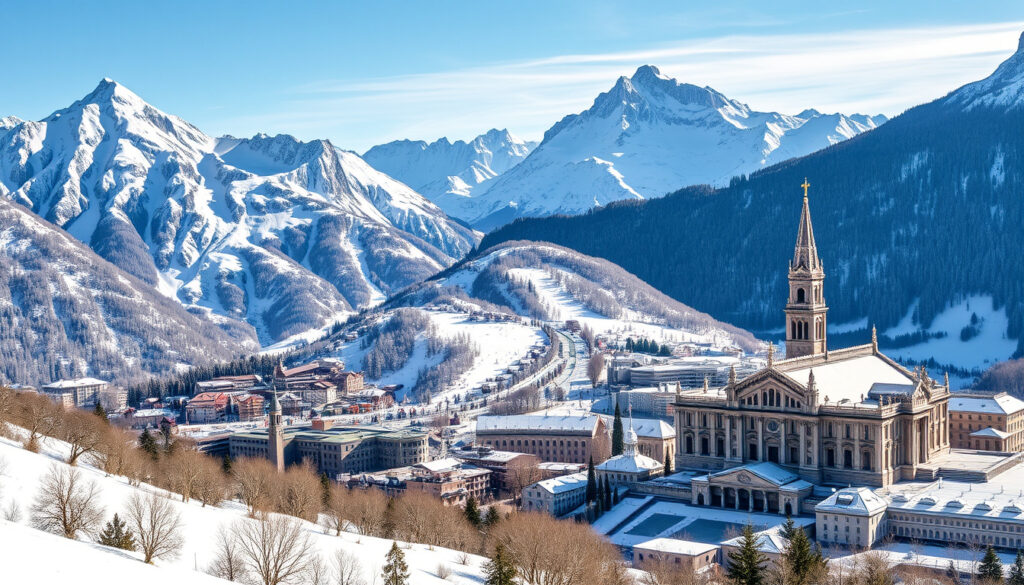
Where Is the Winter Olympics 2026? Milano Cortina Locations
The 2026 Winter Olympics broke 78 years of single-city hosting tradition by splitting duties between Milan and Cortina d’Ampezzo—two cities 250 miles apart across northern Italy. This arrangement created the most geographically dispersed Winter Games on record, with competitions scattered across more than 22,000 square kilometers of mountains, valleys, and urban arenas.
Host Cities: Milano and Cortina d’Ampezzo, Italy · Dates: February 6–22, 2026 · Paralympics: March 6–15, 2026 · Official Site: olympics.com/milano-cortina-2026 · Previous Host Record: Italy’s third Winter Olympics
Quick snapshot
- Milano Cortina 2026 in Italy (Stadium Journey)
- 25 venues across 5 clusters (Roadtrips)
- February 6–22, 2026 (Wikipedia)
- Exact participation status of athletes from nations under current IOC sanctions
- Final attendance figures across all venues beyond San Siro
- Long-term venue usage plans post-Games
- Paralympic Winter Games run March 6–15, 2026
- French Alps confirmed for 2030 Winter Games
- Legacy assessment of venue utilization
The table below summarizes the official parameters for Milano Cortina 2026, drawing from primary Olympic sources.
| Field | Value |
|---|---|
| Official Name | Milano Cortina 2026 |
| Host Nation | Italy |
| Event Dates | February 6 to 22, 2026 |
| Paralympic Dates | March 6 to 15, 2026 |
| Primary Sources | olympics.com, Wikipedia |
Where Are the 2026 Winter Olympics Getting Held?
Italy hosted the Winter Olympics twice before: Cortina d’Ampezzo in 1956 and Turin in 2006. The 2026 Games combined both traditions by naming two cities as co-hosts—a first for the Winter Games. Milano took on the ice sports and the opening ceremony, while Cortina d’Ampezzo handled the mountain events. The organizing committee divided the 25 competition venues into five geographic clusters spread across three Italian regions.
Milano and Cortina d’Ampezzo as Dual Hosts
Milan hosted most of the large arena events, including ice hockey, figure skating, and speed skating. The city also staged the opening ceremony at San Siro Stadium on February 6, 2026, with an audience exceeding 61,000 (ESPN event coverage). The opening featured performances by Andrea Bocelli, Laura Pausini, and Mariah Carey, with Italian President Sergio Mattarella formally declaring the Games open. This was also the first opening ceremony under IOC President Kirsty Coventry, the first woman to hold that position.
Cortina d’Ampezzo, nicknamed the “Queen of the Dolomites,” handled sliding sports, curling, women’s alpine skiing, and biathlon. The cities sit more than 250 miles apart, making this the most geographically dispersed Winter Olympics ever staged.
Venues Across Northern Italy
The five venue clusters covered an extraordinary footprint: the Milano cluster held ice events in newly built and temporary arenas; the Cortina cluster used the Cortina Sliding Centre for bobsled, luge, and skeleton; the Valtellina cluster centered on the Stelvio Ski Centre in Bormio for men’s alpine and the Livigno parks for freestyle events; the Val di Fiemme cluster hosted cross-country skiing and ski jumping in Predazzo; and Verona Arena staged the closing ceremony (Roadtrips venue guide). Of the 25 total venues, 19 were existing facilities, 2 were newly constructed, and 4 were temporary installations—meaning over 90% required no permanent new construction.
The only brand-new permanent venue was the Milano Santagiulia Ice Hockey Arena, designed by David Chipperfield Architects. The rebuilt bobsleigh track in Cortina cost €81 million and revived the 1956 Olympic course.
The implication: by leaning on pre-existing facilities, Italy reduced construction risk but added logistical complexity for athletes and spectators navigating between venues separated by mountain passes and 250 miles of highway.
Where Will the Olympics Be Held in 2026, 2028, 2030, and 2032?
The Olympic rotation follows a predictable pattern: Summer and Winter Games alternate every two years, with host cities selected years in advance. For readers tracking the full cycle, here’s where each upcoming Games lands.
2026 Winter: Milano Cortina
- February 6–22, 2026 in Milano and Cortina d’Ampezzo, Italy
- Approximately 2,900 athletes competing in 116 events
- Five venue clusters across Lombardy, Veneto, and Trentino-Alto Adige
2028 Summer: Los Angeles
- July 14–30, 2028 in Los Angeles, California, USA
- First Games since 1984 for LA; third overall for the city
- Emphasis on existing venues and temporary infrastructure
2030 Winter: French Alps
- Confirmed by the IOC in 2024 for the French Alps region
- Returns Winter Games to France for the first time since Albertville 1992
- Likely centers on Nice or surrounding alpine departments
2032 Summer: Brisbane
- July 23–August 8, 2032 in Brisbane, Queensland, Australia
- First Olympic Games ever held in Australia
- Part of the Southern Hemisphere summer rotation
The 2030 Winter host remained uncertain for years; Denver declined in 1976, and several European and North American cities passed on bids before the IOC confirmed the French Alps proposal. That uncertainty underscores how difficult it has become for cities to commit to Olympic hosting.
What this means: the IOC’s shift toward French Alps reflects a broader preference for compact, venue-reuse bids over ambitious new infrastructure—a direct response to the cost overruns and public backlash that have plagued recent host campaigns.
What Countries Are Banned from the 2026 Winter Olympics?
The IOC has maintained sanctions against Russia since the 2022 invasion of Ukraine, with consequences that extended into the 2026 Winter Games. Understanding who could compete—and under what conditions—required following specific IOC eligibility rules.
Russia’s Status
Russia remained excluded from the 2026 Winter Olympics under IOC suspension. The ban, initially imposed in 2022, had persisted for over three years by the time competitions began in February 2026. Russian athletes who wished to participate had to apply for neutral status under the “AIN” (Authorised Individual Athletes) framework, a pathway that allowed individual competitors to participate without national flags or anthems.
The IOC’s Position 3 regulations specified that athletes from suspended nations could compete only if their national Olympic committee remained barred, and if they met strict neutrality requirements. Belarus faced similar restrictions, though at smaller numbers.
IOC Decisions on War Involvement
The IOC’s Eligibility Commission reviews each suspension case individually. For the 2026 cycle, the governing body confirmed that Russia’s national team would not participate, but left the door open for athletes who could demonstrate independence from state athletic structures. The framework drew criticism from both sides—some nations called for broader bans, while others argued the neutral athlete pathway was too lenient.
Athlete numbers from previously suspended nations tend to fluctuate dramatically between Games cycles. For 2030, the IOC may face renewed pressure to clarify whether Russia’s status will change depending on geopolitical developments.
The catch: the AIN framework creates a narrow pathway that few Russian athletes are likely to navigate successfully, meaning the controversy over participation will persist even after the Games conclude.
Where Is the Winter Olympics 2026 Opening Ceremony?
The 2026 opening ceremony broke with decades of tradition by distributing its key elements across four locations simultaneously. Rather than a single stadium event, the ceremony used San Siro Stadium in Milan as its primary anchor, with additional programming in Livigno, Predazzo, and the streets of Cortina d’Ampezzo.
Primary Site
San Siro Stadium—the iconic home of AC Milan and Inter Milan—served as the main ceremony venue, hosting the formal declarations, the Parade of Nations, and the headline musical performances. The ceremony began at 20:00 CET on February 6, 2026, and ran until approximately 23:29. Italian President Sergio Mattarella declared the Games open, while IOC President Kirsty Coventry presided over her first Winter Games opening.
The ceremony featured tributes to Italian cultural icons, including Leonardo da Vinci and Dante Alighieri. Mariah Carey’s performance of “Volare” became one of the evening’s standout moments. Two cauldrons burned—one in Milan and one in Cortina d’Ampezzo—marking the first time the Winter Olympics used multiple cauldrons in different cities (Wikipedia ceremony record). The dual cauldron design honored Leonardo da Vinci, who had connections to both locations.
Skiing and Other Event Locations
Alpine skiing competitions centered on two distinct venues: the Tofane Alpine Skiing Centre in Cortina hosted women’s events, while the Stelvio Ski Centre in Bormio handled men’s competitions and ski mountaineering. The geographic spread meant athletes and officials moved between clusters regularly, requiring sophisticated logistics coordination.
Closing ceremonies took place at Verona Arena, the ancient Roman amphitheater, marking a deliberate choice to connect the Games to Italy’s historical heritage rather than its modern cities.
The implication: the distributed ceremony model proved that massive spectator events can succeed across multiple sites, potentially influencing how future host cities design their opening productions—though the logistics remain formidable.
Which City Is Hosting the Winter Olympics in 2030?
The IOC confirmed the French Alps as the host for the 2030 Winter Olympics in 2024, marking a return to the traditional European heartland of alpine winter sports. The decision ended years of uncertainty during which several cities had declined or withdrawn their candidacies.
French Alps Bid
The French Alps 2030 bid centered on facilities in or near Nice, with the potential to reuse infrastructure from the 1992 Albertville Games. The IOC’s preference for sustainable, existing-venue approaches favored the French proposal over more ambitious new-construction bids.
Past Declinations Like Denver 1976
Denver’s 1976 withdrawal remains the most famous Olympic declination. After voters rejected a tax increase to fund the Games, Denver relinquished its hosting rights, and Innsbruck stepped in as the replacement host. The episode reshaped how the IOC approached future host city relationships, introducing stricter requirements around public financial backing. More recently, several European cities explored 2030 bids before deciding the political and financial costs outweighed the benefits.
The 2030 Winter host selection process dragged on longer than most cycles, suggesting that even established winter sports nations find Olympic hosting increasingly difficult to justify without strong government guarantees and broad public support.
Confirmed
- Milano Cortina as 2026 host
- Dates February 6–22, 2026
- 25 venues in five clusters
- San Siro opening ceremony venue
- Kirsty Coventry as first female IOC President
- Paralympics March 6–15, 2026
Unclear
- Exact participation numbers for previously suspended nations
- Final attendance across non-San Siro venues
- Long-term usage plans for new venues
- Whether Russia or Belarus will compete in 2030
What People Said
“This was the first opening ceremony of the Winter Olympics and first Olympic Games opening ceremony under the IOC presidency of Kirsty Coventry.”
— Wikipedia Editors on the 2026 Winter Olympics opening ceremony
“Featuring tributes to da Vinci and Dante… an unprecedented four-site, dual-cauldron opening ceremony.”
— ESPN Reporter on the Milano Cortina 2026 ceremony
For athletes and teams, the geographic spread of the 2026 venues meant longer travel times between events but also access to some of the world’s premier mountain training facilities—Cortina’s sliding track, Bormio’s steep alpine runs, and Predazzo’s ski jumping infrastructure represent decades of Olympic-grade investment.
For readers planning to attend future Games, the lesson from 2026 is clear: Italy succeeded in hosting an expansive, multi-site Winter Olympics by leaning on existing infrastructure rather than building for the Games alone. That approach kept costs down but required spectators to navigate significant distances between venues. The 2030 French Alps bid suggests the IOC learned the same lesson.
What country is the Winter Olympics in 2026?
Italy hosted the 2026 Winter Olympics in Milano and Cortina d’Ampezzo. This was Italy’s third time hosting the Winter Games, following Cortina d’Ampezzo in 1956 and Turin in 2006.
Where are the next 5 Winter Olympics?
The upcoming Winter Olympics are scheduled for 2030 in the French Alps. The Summer Olympics fall between Winter Games cycles: 2028 in Los Angeles, 2032 in Brisbane. The 2034 Winter Olympics host has not yet been confirmed.
Who can compete in the Olympics when at war?
The IOC can suspend national Olympic committees for aggression or violations of the Olympic Truce. Suspended nations have athletes compete under neutral status as “Authorised Individual Athletes” without national flags or anthems, as was the case for Russian athletes in recent cycles.
What country is permanently banned from the Olympics?
No nation faces a permanent ban. Suspensions are reviewed periodically and can be lifted when conditions change. Russia’s participation remains under active review; the country was excluded from 2026 but the status for future cycles depends on IOC determinations.
Where is the Winter Olympics 2026 map?
The official Olympics website (olympics.com/milano-cortina-2026) provides venue maps showing the five cluster locations across Lombardy, Veneto, Trentino-Alto Adige, and Verona. The venues span over 22,000 square kilometers.
Countries participating in Winter Olympics 2026?
Approximately 90 national Olympic committees sent athletes to Milano Cortina 2026, competing in 116 events across 19 days. The exact number fluctuated based on late eligibility determinations for athletes from suspended nations.
What’s the smallest nation to win a medal?
Liechtenstein, with a population under 40,000, has won multiple Winter Olympic medals across alpine skiing and other sports. Other tiny nations with outsized Winter Games success include Jamaica (bobsled) and Andorra (alpine skiing).
Related reading: UEFA Euro Qualifiers Standings 2026
archdaily.com, en.wikipedia.org, science.nasa.gov, youtube.com
The 2026 Winter Olympics venues stretch across Milano and Cortina d’Ampezzo in Italy, as detailed in the Milano Cortina location guide with cluster breakdowns.
More related posts
 Affordable Dentures and Implants: Costs, Reviews, and How to Save
 Studio Ghibli Fest 2025: Lineup, Schedule & Tickets
 Austin Abrams Movies and TV Shows: Full Guide
 Kayak Rentals Near Me: Prices, Rules & Best Locations
 Law & Order Ca t: Complete Guide to Every Sea on and Actor (2025 Update)
 Cast of Small Things Like These Film – Full List & True Story
 Nose Piercing Near Me: Cost, Pain, and Safety Tips