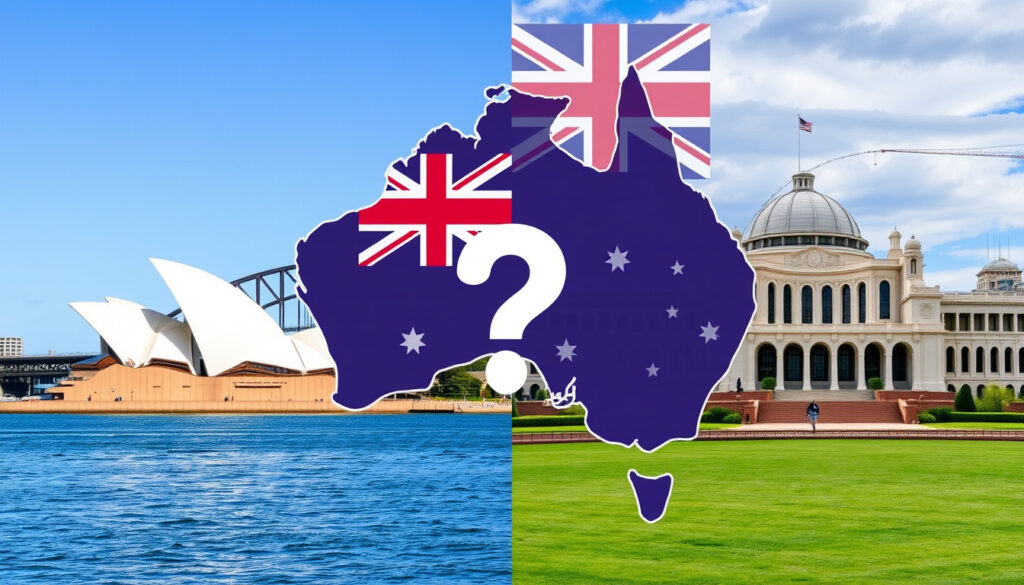
What Is the Capital of Australia? Sydney or Canberra
The question seems simple, but the answer trips up most travelers: Canberra, not Sydney or Melbourne, is the capital of Australia. Chosen as a carefully planned compromise after decades of rivalry, this purpose-built city has been the nation’s seat of government since 1927.
Capital city: Canberra · Population (2024 est.): 484,630 · Year established: 1913 · Area: 814.2 km²
Quick snapshot
- Canberra is the capital of Australia (National Museum of Australia (museum & education authority))
- Parliament moved to Canberra in 1927 (National Capital Authority (federal planning agency))
- Canberra was chosen as a neutral site between Sydney and Melbourne (National Museum of Australia)
- No major uncertainties about the capital’s identity – all key facts are well‑established.
- 1908: Parliament selects Yass‑Canberra as the capital site (National Capital Authority)
- 1913: Official naming and founding ceremony (National Museum of Australia)
- 1927: Federal Parliament relocates to Canberra, making it the permanent capital (ACT Legislative Assembly (territory legislature))
- Canberra continues to serve as the national capital; the Australian Capital Territory exercises self‑government while hosting federal institutions.
The choice of Canberra resolved a deadlock that could have fractured the new federation. Without a compromise capital, neither Sydney nor Melbourne would have accepted the other’s dominance – the entire idea of a united Australia depended on a neutral third city.
| Label | Value |
|---|---|
| Capital | Canberra |
| Population | 484,630 |
| Area | 814.2 km² |
| Founded | 1913 |
| Capital since | 1927 |
| Country | Australia |
Is the capital of Australia Sydney or Canberra?
The answer: Canberra
- Canberra is the capital of Australia. This is a constitutional and historical fact confirmed by the National Museum of Australia (museum & education authority).
- Neither Sydney nor Melbourne has ever been the permanent national capital, though Melbourne served a temporary role for 26 years.
Why many people think it’s Sydney
- Sydney is the largest city in Australia, one of the most iconic, and is often mistaken for the capital by international visitors.
- The confusion is common because many countries house their capital in the largest metropolis – but Australia deliberately broke that pattern.
Common misconceptions
- “Sydney was once the capital” – false. Sydney has never been the national capital. Melbourne was the temporary seat of government from 1901 to 1927.
- “Australia has more than one capital” – false. The country has a single capital: Canberra.
Bottom line: The only correct answer to “what is the capital of Australia” is Canberra. Sydney and Melbourne are state capitals, not the national capital.
Why is Sydney no longer the capital of Australia?
Sydney was never the capital of Australia. The temporary capital was Melbourne from 1901 to 1927, as explained by the ACT Legislative Assembly (territory legislature).
The early capital: Melbourne
- When the six colonies federated in 1901, the Constitution required the federal seat of government to be in New South Wales and at least 100 miles from Sydney.
- Until a permanent capital could be built, Melbourne – already a major city – hosted the Commonwealth Parliament.
The rivalry between Sydney and Melbourne
- The two largest cities fiercely competed for the honor of becoming the national capital. Neither would accept the other as the winner, leading to a stalemate.
- As the National Museum of Australia notes, the capital location was a “compromise because neither Sydney nor Melbourne would accept the other becoming the national capital.”
The selection of Canberra in 1908
- After years of debate, the House of Representatives voted on 8 October 1908 to select the Yass‑Canberra region – a vote of 39 to 33 (National Capital Authority (federal planning agency)).
- Alternative sites considered included Dalgety, Orange, Tumut, Albury, Armidale, Wagga Wagga, and Cowra (Australian Screen Online (curated historical archive)).
The move to Canberra in 1927
- Parliament finally convened in Canberra on 9 May 1927, formally making it the permanent capital.
Bottom line: Sydney never lost the capital because it never held it. The question should be “why isn’t Melbourne still the capital?” – and the answer is the same: a constitutionally mandated compromise.
Does Australia have two capitals?
No. Australia has exactly one capital: Canberra. This is often confused because Australia has six state capitals (Sydney, Melbourne, Brisbane, Perth, Adelaide, and Hobart) plus two internal territory capitals (Darwin and Hobart in its own state).
Defining capital: seat of government
- The seat of the federal government – the Parliament, the Governor‑General, the High Court – is in Canberra.
- No other city hosts these national institutions.
The Australian Capital Territory and Canberra
- The Australian Capital Territory (ACT) was created specifically to house the capital. It is a federal territory, not a state.
- The ACT granted self‑government in 1988, but the Commonwealth retains authority over the “national capital” planning areas.
Other administrative centers
- Some federal agencies have offices in other cities, but that does not make them capitals.
Bottom line: The answer to “does Australia have two capitals” is a clear no. The confusion comes from the sheer number of state capitals, but nationally there is only one.
Which city is bigger, Sydney or Canberra?
Sydney dwarfs Canberra on every metric. The table below shows the contrast.
| Attribute | Sydney | Canberra |
|---|---|---|
| Population | ~5.3 million | 484,630 |
| Area | 12,368 km² | 814.2 km² |
| Role | State capital of NSW | National capital |
Population figures from the Australian Bureau of Statistics (official statistical agency).
Economic and cultural significance
- Sydney is the financial and cultural heart of Australia.
- Canberra is the political center, home to Parliament House, the High Court, and government departments.
Bottom line: In size and population, Sydney is far bigger. But Canberra holds the political power. The two cities are complementary, not competitive.
Why is Canberra the capital of Australia?
Canberra was chosen as a neutral location to end the bitter rivalry between Sydney and Melbourne. The National Capital Authority (federal planning agency) explains that the site was selected because it was “almost exactly 100 miles from Sydney,” satisfying the constitutional requirement.
The compromise between Sydney and Melbourne
- The Constitution (Section 125) mandated that the federal seat of government be within New South Wales, at least 100 miles from Sydney.
- Both Sydney and Melbourne were ruled out – neither could accept the other as capital.
The selection process
- Parliament vetted multiple sites. Dalgety (in NSW) was initially preferred, but the NSW government objected.
- In 1908, the Yass‑Canberra region was chosen by a narrow parliamentary vote.
The founding of Canberra
- The city was designed by American architect Walter Burley Griffin after winning an international competition.
- On 12 March 1913, Lady Denman officially announced the name “Canberra” at a ceremony on the site that is now Parliament House (National Museum of Australia (museum & education authority)).
The role of the Australian Capital Territory
- The ACT provides the constitutional home for the capital, ensuring the federal government has full control over the national seat.
Bottom line: Canberra exists because of a deliberate political compromise. It is a planned capital designed to unite a nation, not to claim glory for any one city.
Timeline: How Canberra became the capital
What many visitors don’t realize is that the capital decision took 26 years to implement – Parliament met in Melbourne for a quarter‑century while Canberra was being built.
- 1901 – Federation; Melbourne becomes temporary capital.
- 1908 – Yass‑Canberra region selected as permanent site.
- 1913 – City officially named and founded.
- 1927 – Parliament moves to Canberra.
- 1988 – Australian Capital Territory granted self‑government.
Confirmed facts about the capital
Confirmed facts
- Canberra is the capital of Australia (National Museum of Australia)
- Sydney is not the capital (ACT Legislative Assembly)
- Melbourne was the temporary capital from 1901 to 1927 (National Capital Authority)
“The site of Canberra was chosen as a compromise because neither Sydney nor Melbourne would accept the other becoming the national capital.”
National Museum of Australia
“The naming and inauguration ceremony of the federal capital took place on 13 March 1913.”
National Museum of Australia
“The Canberra region was chosen in part because it was almost exactly 100 miles from Sydney.”
National Capital Authority
Summary
Canberra’s status as Australia’s capital is not a random quirk but a deliberate constitutional compromise that ended a deadlock between the country’s two largest cities. For the traveler or student asking “what is the capital of Australia,” the answer is simple: Canberra. For anyone curious about why, the lesson is that sometimes the best solution is a neutral third choice – one built from scratch. The next time someone argues that Sydney is the capital, you can point to the history books and the maps: the seat of power lies 248 km southwest, in a city that means “meeting place.”
en.wikipedia.org, australiangeographic.com.au, nca.gov.au, nma.gov.au, nca.gov.au, remitly.com, historyrise.com, aph.gov.au
Frequently asked questions
What is the Australian Capital Territory?
The Australian Capital Territory (ACT) is a federal territory that surrounds Canberra, Australia’s capital. It was created in 1911 to house the national capital and is separate from any state.
Is Canberra the largest city in Australia?
No. Canberra is the eighth‑largest city. Sydney, Melbourne, Brisbane, Perth, and Adelaide are all larger.
What is the population of Canberra?
As of 2024 estimates, the population of Canberra is approximately 484,630 (Australian Bureau of Statistics).
When was Canberra founded?
Canberra was officially founded on 12 March 1913, when the name was announced and the first stones laid.
How far is Canberra from Sydney?
Canberra is about 248 kilometres (154 miles) southwest of Sydney, a drive of roughly three hours.
What is the climate like in Canberra?
Canberra has a temperate climate with four distinct seasons. Winters are cool with occasional frost, summers warm, and autumn and spring are mild.
What are the main attractions in Canberra?
Key attractions include Parliament House, the Australian War Memorial, the National Gallery of Australia, Lake Burley Griffin, and the Australian National Botanic Gardens.
More related posts
 Another Word for Because: 30+ Formal & Academic Synonyms
 Disneyplus.com Login/Begin: How to Activate Disney+ on Your TV
 Thomas Brodie-Sangster: Age, Wife, Movies & TV Shows
 Minions: Rise of Gru: Is It Scary, Where to Watch, and More
 Free QR Code Generator: Top Tools, How-to, and Security Tips
 Stevie Nicks 2025 Tour: Full Dates, Setlist & More
 No Game No Life: streaming, season 2, and FAQ
 Cabin Rentals Near Me – Best Pet-Friendly Lakefront Deals