What Is Apollo the God Of? Domains, Symbols, and Myths
You probably know Apollo as the radiant sun god who drives a chariot across the sky, but the ancient Greeks saw him as something far more layered: a god of music, prophecy, healing, and plague all at once. He was the son of Zeus and Leto, twin of Artemis, and one of the most widely worshipped Olympians, with domains stretching from the lyre to the bow and from the Oracle at Delphi to the punishing plague.
Domains of Apollo: Music, prophecy, healing, plague, archery, sun, poetry, dance, truth ·
Parents: Zeus and Leto ·
Sibling: Artemis (twin sister) ·
Roman equivalent: Apollo (same name) ·
Primary symbols: Lyre, laurel wreath, bow and arrows, raven
Quick snapshot
- Apollo is an Olympian god of music, prophecy, healing, plague, archery, and the sun (Theoi (Greek mythology reference))
- He is the son of Zeus and Leto, twin of Artemis (H-SC Greek Religion notes)
- His symbols include the lyre, laurel wreath, bow, and raven (Encyclopaedia Britannica (established encyclopedia))
- He founded the Oracle at Delphi after slaying Python (Theoi)
- Whether Apollo was originally a sun god or became associated with the sun later (Encyclopaedia Britannica)
- The exact historical origins of Apollo worship (some suggest Anatolian origins) (Ancient-Greece.org (Greek history resource))
- Whether Apollo’s association with crops and herds was a primary domain (Encyclopaedia Britannica)
- The extent of Apollo’s role in intellectual inquiry and the sciences (Ancient-Greece.org)
- First written references to Apollo appear in Homer and Hesiod (8th century BCE) (Theoi)
- Apollo’s cult spread across the Mediterranean through Greek colonization (3rd–1st centuries BCE) (Facts and Details (history resource))
Five key facts about Apollo’s identity, drawn from ancient sources and modern scholarship:
| Attribute | Details |
|---|---|
| Parents | Zeus and Leto (H-SC Greek Religion notes) |
| Siblings | Artemis (twin) (H-SC) |
| Roman equivalent | Apollo (Encyclopaedia Britannica) |
| Sacred animals | Dolphin, swan, raven, snake (Wikipedia (collaborative encyclopedia)) |
| Major cult center | Delphi (Oracle) (Theoi) |
What is Apollo the god of?
Apollo’s portfolio is one of the most diverse among the Olympians. He oversaw music and poetry, prophecy and oracles, healing and plague, archery and the sun, and the protection of the young. Each domain came with its own symbols and myths.
Music and poetry
- Apollo was the patron of music and poetry, often shown with a lyre. He invented string music, according to Encyclopaedia Britannica.
- He led the Muses and presided over song and dance (Theoi).
Prophecy and oracles
- Apollo was the god of prophecy and founded the Oracle at Delphi after killing Python (Theoi).
- He communicated the will of Zeus to mortals and presided over religious law (Encyclopaedia Britannica).
Healing and plague
- Apollo was both a healer and a bringer of plague. He could send disease as punishment or cure it when propitiated (Theoi).
- This dual role reflected the Greek belief that divine power could be benevolent or destructive (Britannica).
Apollo’s power to heal and to harm at will made him one of the most feared gods. A community that pleased him thrived; one that angered him could face sudden epidemic. This ambivalence defined how the ancient Greeks approached divine worship.
Archery and the sun
- Apollo’s bow was a symbol of distance, death, and intimidation (Britannica).
- By the 5th century BCE, he was increasingly linked with the sun. Later tradition identified him with the titan Helios (Britannica).
Protection of the young
- Apollo was considered a protector of young men and oversaw their transition to adulthood (Theoi).
Is Apollo the sun god or Helios?
In classical Greek mythology, the sun was personified as the titan Helios, but over time Apollo absorbed solar attributes. The chart below shows how they compare.
Three differences, one trend: Apollo became the dominant sun figure as his cult grew.
| Aspect | Apollo | Helios |
|---|---|---|
| Primary domain | Music, prophecy, healing, sun (later) | Sun itself (personified) |
| Origin | Olympian, son of Zeus and Leto | Titan, son of Hyperion and Theia |
| Worship | Widespread, major cult at Delphi and Delos | Minor cult, mostly as a celestial body |
- In Homer, Apollo is not yet a sun god; Helios drives the chariot across the sky (Britannica).
- By the 5th century BCE, Athenian writers began to identify Apollo with the sun (Britannica).
- Roman authors such as Ovid fully conflated the two (Britannica).
Was Apollo LGBTQ?
Ancient Greek myths include same-sex relationships among the gods. Apollo had both male and female lovers, and modern readers often interpret these stories through an LGBTQ lens.
Myths of male lovers (Hyacinthus, Cyparissus)
- Apollo fell in love with Hyacinthus, a Spartan prince. After a discus accident killed Hyacinthus, Apollo created the hyacinth flower from his blood (Theoi).
- He also loved Cyparissus, who was transformed into a cypress tree (Wikipedia).
Relationships with nymphs and mortal women
- Apollo pursued the nymph Daphne, who escaped by turning into a laurel tree (Theoi).
- He also loved Cassandra, to whom he gave the gift of prophecy, but when she refused him, he cursed her never to be believed (Britannica).
Apollo’s myths with both men and women show that ancient Greek deities weren’t confined by modern sexual categories. His relationships reflect the culture’s broader acceptance of same-sex bonds, especially in mentorship contexts.
What are 5 facts about Apollo?
- Twin of Artemis: Apollo and Artemis were born to Zeus and Leto on the island of Delos (H-SC).
- Influence over music and arts: He was the leader of the Muses and the inventor of string music (Britannica).
- Oracle at Delphi: After killing the serpent Python, Apollo established his famous oracle at Delphi (Theoi).
- Role in the Trojan War: He sided with the Trojans and sent plague arrows into the Greek camp (Britannica).
- Symbols and attributes: His main symbols were the lyre, laurel wreath, bow, and raven (Britannica).
What did Zeus do to Apollo?
Zeus and Apollo had a typical father-son dynamic—pride mixed with punishment when authority was challenged.
Punishments and conflicts
- After Apollo killed the Cyclopes (who had forged Zeus’s thunderbolts), Zeus forced him to serve the mortal King Admetus for a year (Britannica).
- Apollo once defied Zeus and was threatened with being cast into Tartarus (Wikipedia).
Father-son relationship
- Despite conflicts, Zeus supported Apollo’s oracles and patronages, making him one of the most honored Olympians (Britannica).
Apollo’s punishment for killing the Cyclopes shows that even the most powerful gods faced consequences. But his year of servitude also earned him wisdom and humility, qualities later praised in his role as an oracle-giver.
Who was skinned alive by Apollo?
One of the most gruesome myths involves the satyr Marsyas, who dared to challenge Apollo to a musical contest.
Marsyas the satyr
- Marsyas found a flute discarded by Athena and became so skilled that he challenged Apollo (Britannica).
- Apollo won and, as punishment, flayed Marsyas alive, hanging his skin on a tree (Theoi).
What are Apollo’s symbols and what is he known for?
Apollo’s symbols are the most recognizable in Greek mythology. Each object carried deep meaning about his character.
Lyre, laurel, bow, raven
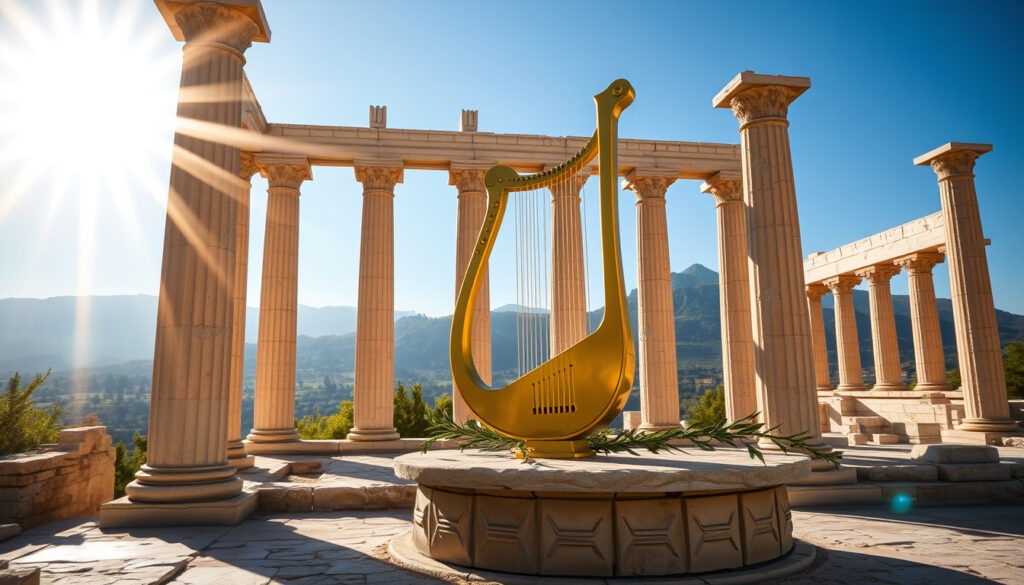
- Lyre: symbol of music, harmony, and civilization (Britannica).
- Laurel wreath: associated with victory, poetry, and his pursuit of Daphne (Theoi).
- Bow and arrows: representing distance, death, and awe (Britannica).
- Raven: his messenger bird, originally white but turned black after delivering bad news (Wikipedia).
Roman name and boxing?
- Apollo’s Roman name is the same: Apollo (Britannica).
- He is not the god of boxing, but he was associated with athletic competitions, especially the Pythian Games at Delphi (Theoi).
Personality traits
- Apollo was considered rational, orderly, and a protector of civilization (Britannica).
- He could also be vengeful and harsh, as seen in the Marsyas myth (Theoi).
“Phoebus Apollo, whom Leto bore, is the lord of the lyre and the bow, and he is the god of prophecy, and he presides over the Muses and over the dances of the gods.”
— Homeric Hymn to Apollo, as referenced by Theoi
“The sanctuary at Delphi was founded by Apollo after he had slain the serpent Python, and there he gives oracles to mortals.”
— Apollodorus, Library, via Encyclopaedia Britannica
“Apollo is the most Greek of all the gods, representing the ideal of masculine beauty, the patron of arts, and the source of prophecy.”
— Pausanias, Description of Greece, cited by Encyclopaedia Britannica
For anyone studying Greek mythology, understanding Apollo’s dual nature—bringer of healing and plague—is key to grasping the Greek worldview: the gods gave and took away, often without warning. The pattern is that order and chaos coexist, and the most civilized deity could be the most terrifying.
medium.com, mythoi.org, popai.pro, uen.pressbooks.pub, thegreekgods.org
Frequently asked questions
What are Apollo’s symbols?
His primary symbols are the lyre (music), laurel wreath (victory), bow and arrows (death), and raven (messenger). The tripod also represents his prophetic power.
Who did Apollo love?
His most famous loves include Hyacinthus, Cyparissus, Daphne, and Cassandra. Each story ended in tragedy or transformation.
Why did Apollo have an oracle at Delphi?
After killing the serpent Python, Apollo claimed Delphi as his sanctuary and established an oracle that became the most famous in the ancient world.
What is Apollo’s Roman name?
Apollo’s Roman name is the same—Apollo. Unlike many Greek gods, the Romans kept his name unchanged.
Is Apollo the god of war?
No, Apollo is not the god of war—that is Ares (Mars). Apollo was associated with archery and fought in the Trojan War, but war itself was not his domain.
More related posts
 Mexico vs Paraguay Lineups: Confirmed XIs Nov 19 2025
 What Does PS Mean? Postscript, Texting, and Slang Explained
 Real Madrid vs Leganés: History, Record & Match Preview
 Monsters, Inc. Sequel, Cancellation & 9/11 Edits: Full Guide
 What Is a Fascist Definition? Simple Explanation & Key Examples
 Best Free Calorie Counter Apps (2025): Truly Free
 Law & Order Ca t: Complete Guide to Every Sea on and Actor (2025 Update)
 How to Draw a Car for Beginners: The Box Method Step-by-Step