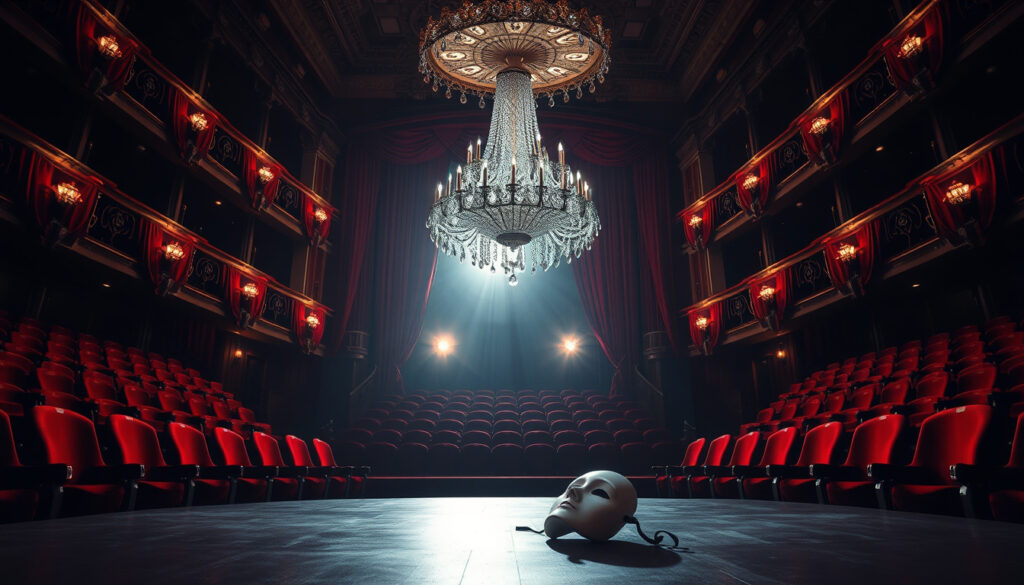
Phantom of the Opera: Story, Warnings, Streaming & Best Film
Few characters in musical theatre spark as many questions as the Phantom — part monster, part broken genius, hiding beneath an opera house in plain sight. Whether you are trying to recall the story, figure out where to watch a version, or simply curious why that mask stays on, this guide brings together the plot, streaming options, content warnings, and an honest look at which film adaptation is worth your time.
West End premiere: 9 October 1986 ·
Broadway premiere: 26 January 1988 ·
Global audience: 145 million+ ·
Tony Awards won: 7 ·
Composer: Andrew Lloyd Webber
Quick snapshot
- The story originated from a novel by Gaston Leroux (Wikipedia entry for the 1925 film)
- Andrew Lloyd Webber composed the music for the 1986 musical (Wikipedia article on the 2004 film)
- The Phantom, named Erik, lives beneath the Paris Opera House (Netflix description)
- Whether Christine truly loved the Phantom or felt pity and fear
- The exact nature of the Phantom’s deformity varies in every adaptation
- Whether elements of the story are based on real urban legends from the Paris Opera
- Christine Daaé is the young soprano caught between two men
- 1910 — Novel published by Gaston Leroux (Wikipedia entry for the novel)
- 9 October 1986 — London premiere (Wikipedia article on the 2004 film)
- 2004 — Joel Schumacher film adaptation released (Wikipedia article on the 2004 film)
- 2023 — Broadway production closes after 35 years (Wikipedia article on the musical)
- West End continues to perform the musical regularly (Official West End page)
- 25th-anniversary streamed versions appear periodically on YouTube (Time Out)
- New stage tours and regional productions remain in rotation (Official tour page)
Here is a quick reference of key facts about the Phantom.
| Label | Value |
|---|---|
| Novel published | 1910 |
| Musical debut | 9 October 1986 (London) |
| Composer | Andrew Lloyd Webber |
| Lyricist | Charles Hart |
| Book by | Richard Stilgoe, Andrew Lloyd Webber |
| Phantom’s real name | Erik |
| Christine’s love interest | Raoul |
| Total songs | 14 |
What is the main story of The Phantom of the Opera?
Plot summary
The story follows Christine Daaé, a young soprano at the Paris Opera House in the 1880s, who is mentored by a mysterious, disfigured figure known as the Phantom. The Phantom, whose real name is Erik, lives in the catacombs beneath the opera house and becomes dangerously obsessed with her (Netflix description). When Christine reconnects with her childhood friend Raoul, the Phantom threatens the management and unleashes a series of violent acts, including a falling chandelier.
The core tension is not about who wins Christine — it is about whether the Phantom can be seen beyond his mask. The musical’s ending leaves that question deliberately unresolved.
Key characters
- Christine Daaé — orphaned soprano, torn between the Phantom and Raoul
- The Phantom (Erik) — musical genius, disfigured, lives in the opera catacombs
- Raoul, Vicomte de Chagny — Christine’s childhood friend and romantic interest
- Carlotta — the prima donna who is threatened by the Phantom
The pattern: every character orbits Christine, and each represents a different kind of love — obsession, devotion, and control.
The Phantom’s backstory
In Gaston Leroux’s 1910 novel, the Phantom was born with a skull-like face, yellow skin, and no nose (Wikipedia entry for the 1925 film). He was abandoned as a child, exhibited at fairs, and later found solace in music and architecture beneath the Paris Opera. Adaptations vary: some present the deformity as a birth defect, others as an accident. The stage musical gives no explicit backstory, leaving the Phantom’s face as pure symbol.
The implication: without a fixed origin, each production decides what his deformity means — and that choice shapes the entire tone.
Why is Phantom’s face deformed?
The novel’s explanation
Gaston Leroux described the Phantom as having a skull-like face with yellow skin, no nose, and sunken eyes. The Phantom himself calls his face “a living corpse” in the novel (Netflix description).
The novel treats the deformity as a biological condition — not supernatural, not an injury, but a congenital disfigurement that condemns Erik to life in shadow.
Differences between stage and film
The 2004 film starring Gerard Butler shows the Phantom with partial mask and scarred flesh, implying burns or trauma. The 1925 silent film with Lon Chaney created a skeletal, noseless look that terrified audiences and set the visual standard (Wikipedia entry for the 1925 film). The stage musical keeps the Phantom’s face fully hidden until the unmasking scene, using prosthetics that vary by production.
The catch: each era reinterprets the deformity to match its own horror sensibility — silent horror, camp terror, or tragic romance.
Symbolic meaning
The mask works as a plot device (the Phantom hides his face) and as a symbol of emotional concealment. The trade-off: a mask that is meant to protect also prevents genuine connection. The musical’s most famous song, “The Music of the Night,” is essentially a plea to be loved beyond appearances.
The Phantom wants to be seen yet cannot bear being seen. That tension is the engine of the entire story.
The pattern: every adaptation uses the deformity to explore a different theme.
Where can I watch the Phantom of the Opera film?
Streaming platforms
The 2004 musical film starring Gerard Butler and Emmy Rossum is available on Netflix, Prime Video, and Hulu depending on your region (Netflix description). The 1925 silent film is in the public domain and available free on YouTube. The 25th-anniversary stage recording has been streamed on YouTube for limited windows, including an October 2025 event reported by Time Out.
DVD and Blu-ray
Digital purchase is available on Apple TV, Google Play, and Vudu. The 1925 version can be bought on Amazon Video, Apple TV Store, and Fandango at Home in the United States (JustWatch US). In the United Kingdom, JustWatch reports no streaming options for the 1925 film at the time of listing (JustWatch UK).
Live performances
The stage musical continues in London’s West End and tours regularly. The Broadway production closed in 2023 after 35 years. The official site, Phantom of the Opera.org, lists ticketing options for current productions.
The pattern: the 2004 film is the easiest to access globally, but the 1925 version is the cheapest. The live show is the most expensive and the most rewarding.
What is the trigger warning for The Phantom of the Opera?
Violence and horror
The musical and film contain murder, including a death by falling chandelier. The 1925 film includes the murder of stagehand Joseph Buquet and a hanging body scene (Wikipedia entry for the 1925 film). The 1962 Hammer Film version was cut by the BBFC for its UK cinema release, with edits to eye-stabbing and hanging-body material (IMDb entry).
Sexual content
The story includes implied sexual tension, non-consensual kissing, and themes of obsession and stalking. The 2004 film contains a scene where the Phantom kisses Christine without her clear consent. The Parents Guide on IMDb lists moderate violence and intense fear elements.
Psychological themes
The Phantom’s manipulation of Christine — gaslighting the opera management, controlling her career, isolating her from Raoul — forms the core of the story’s psychological tension. For viewers sensitive to coercion or stalking dynamics, this is the relevant trigger.
The 1925 film is the most visually intense version. The 2004 film tones down violence but amplifies the non-consensual kiss scene. The stage musical keeps most violence offstage but the psychological manipulation is explicit.
The implication: viewers should choose the version that matches their tolerance for intensity.
Which is the best film version of Phantom of the Opera?
1925 silent film starring Lon Chaney
This version is considered the definitive horror adaptation. Lon Chaney’s makeup — a skeletal, noseless face — set the visual standard for the Phantom. The film includes the Box 5 motif and the murder of Joseph Buquet (Wikipedia entry for the 1925 film). It is public domain and widely available.
2004 movie directed by Joel Schumacher
The most widely seen adaptation, starring Gerard Butler and Emmy Rossum. It adapts the Andrew Lloyd Webber musical directly. Critically mixed, with praise for Rossum’s performance and criticism of Butler’s vocal range (Wikipedia article on the 2004 film).
1990 mini-series
Starring Charles Dance, this version is praised for its fidelity to the novel. It restores the backstory, the Persian character, and the darker ending that the musical omits.
Six adaptations, one pattern: the 1925 film is the visual benchmark, the 2004 film is the crowd-pleaser, and the 1990 mini-series is the faithful adaptation for purists.
| Version | Year | Style | Musical? | Fidelity to novel |
|---|---|---|---|---|
| 1925 (Lon Chaney) | 1925 | Silent horror | No | Medium |
| 1990 mini-series | 1990 | Drama | No | High |
| 2004 (Schumacher) | 2004 | Musical romance | Yes | Low |
The trade-off: the 2004 film is the most accessible but the least faithful. The 1925 film is the most terrifying. The 1990 series is the deepest. For first-time viewers, the 2004 film works as an introduction. For horror fans, the 1925 film is essential. For novel readers, the 1990 mini-series is the one.
Upsides
- Stage musical is one of the longest-running in history, consistently high production value
- 1925 film is public domain — free and legal to watch
- Multiple adaptations mean something for every taste — horror, romance, drama
- Iconic music that transcends the theatre world
Downsides
- No single definitive adaptation — fans argue endlessly over which is best
- 2004 film has poor vocal reviews for its lead
- Content warnings are inconsistent across versions, confusing new viewers
- Broadway closure in 2023 means fewer in-person access points in the US
“It’s a story about a man who wants to be loved despite his appearance.”
— Andrew Lloyd Webber, composer of the stage musical
“A living corpse.”
— Gaston Leroux, describing the Phantom in the original 1910 novel
For someone watching the Phantom of the Opera for the first time, the choice of adaptation dictates the emotional experience. The 2004 film gives you the music. The 1925 film gives you the horror. The stage musical gives you the emotion. For the modern viewer who wants the full story without the romantic gloss, the 1990 mini-series is the best bet — but it is not on any streaming service. The implication is clear: the Phantom is easiest to stream but hardest to experience right.
Frequently asked questions
Who composed the music for The Phantom of the Opera?
Andrew Lloyd Webber composed the music with lyrics by Charles Hart and a book by Richard Stilgoe and Lloyd Webber (Wikipedia article on the 2004 film).
What is the Phantom’s real name?
In the original novel, the Phantom’s real name is Erik (Netflix description).
How long is the Phantom of the Opera musical?
The stage musical runs approximately 2 hours and 30 minutes including one intermission.
What are the most famous songs from The Phantom of the Opera?
The most iconic songs are “The Music of the Night,” “All I Ask of You,” and the title song “Phantom of the Opera.”
Is The Phantom of the Opera based on a true story?
No, but Leroux was inspired by real urban legends about the Paris Opera House’s underground catacombs and a chandelier accident that occurred in 1896.
What age rating is the musical?
The stage musical is generally recommended for ages 10 and up. The 2004 film is rated PG-13 for brief violent images. The 1925 silent film is unrated but contains strong horror elements (Wikipedia entry for the 1925 film).
Can I see the Phantom of the Opera in London?
Yes, the musical continues to perform in London’s West End at His Majesty’s Theatre. Tickets are available through Phantom of the Opera.org.
Are there family-friendly versions of the show?
The stage musical is the most family-friendly with no explicit violence or nudity, but the themes of obsession and manipulation may be intense for very young children.
More related posts
 Best Comedy Club Near Me: Dublin, Cork & Galway
 Where Does JD Vance Live? Official Residence & Ohio Home
 Osgood-Schlatter Disease: Causes, Treatment & Recovery
 Why Am I Bleeding on the Pill When I Shouldn’t Be?
 Monday Night Football Streaming: Where to Watch MNF in 2025
 Exercises for Lower Back Pain: McGill Big 3 & Walking Tips
 Call Amazon Customer Service – Official Number and Live Agent Tips