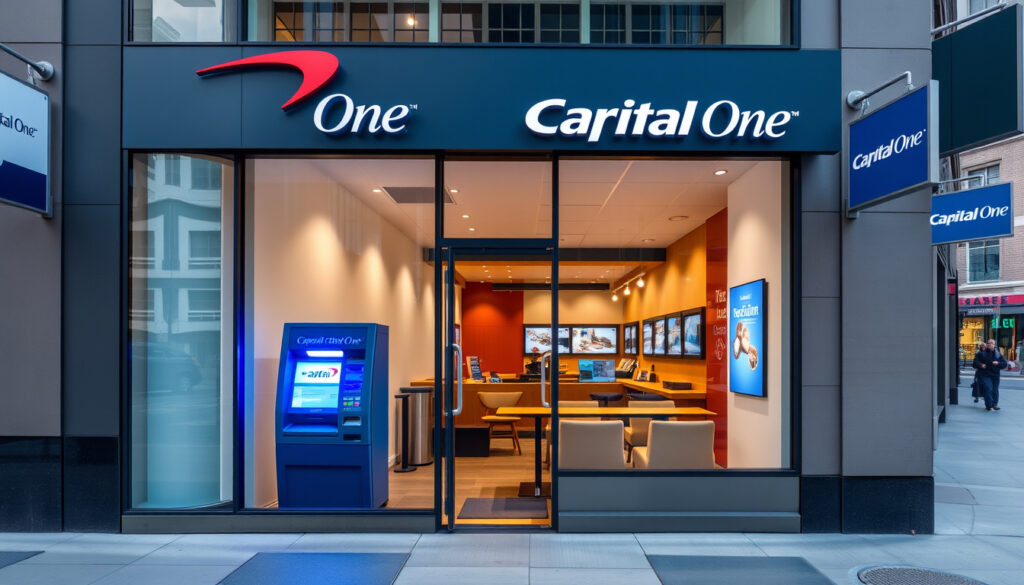
Capital One Near Me: Branches, ATMs & Cafés Guide
You need to deposit cash or ask a question about your account, and you’d rather talk to a person than a chatbot. Capital One, the national bank with roughly 400 full-service branches, offers multiple ways to bank in person — though the exact mix of locations and services isn’t always obvious. This guide cuts through the guesswork to show you exactly how to find a Capital One near you, deposit cash, and speak to an agent, all backed by official data from the bank itself.
Fee-free ATMs in Capital One network: 70,000+ ·
Physical Capital One branches: ~400 (full-service) ·
Capital One Cafés: ~30 ·
AllPoint® ATM surcharge-free locations: 60,000+ ·
Years Capital One has been in operation: Over 30
Quick snapshot
- Capital One runs about 400 full-service branches across the US — Capital One official location types page.
- The bank provides over 70,000 fee-free ATMs via the Allpoint network (Capital One official ATM page).
- Customer service can be reached at 1-800-655-2265 (Bankrate’s consumer banking guide).
- Which specific ATMs accept cash deposits is not publicly itemized — Capital One Help Center.
- Future plans to open or close Cafés remain undisclosed — Capital One location types page.
- Hours vary by location; check the official locator before you go — Capital One’s location finder.
- Use the locator to find your nearest branch, ATM, or Café — Capital One location finder.
- Choose your deposit method: ATM, Add Cash in Store, or teller — Capital One deposit help page.
- Call or chat with an agent if you need personal help — Capital One Help Center.
Six key numbers that define Capital One’s physical footprint — all drawn from official sources:
| Metric | Value |
|---|---|
| Total physical branches (full-service) | ~400 |
| Total ATMs (fee-free network) | 70,000+ |
| Capital One Cafés | ~30 |
| Add Cash in Store locations (CVS, Walgreens, etc.) | ~70,000 |
| Customer service phone number | 1-800-655-2265 |
| Branch states | NY, LA, TX, MD, VA, DC, and others |
The implication: if you live outside these states, your Capital One experience is primarily digital.
Does Capital One have any physical bank locations?
Types of Capital One physical locations
- Full-service branches (all banking services, cash handling, loan assistance).
- Capital One Cafés (coffee, Wi-Fi, financial coaching — no cash deposits).
- Fee-free ATMs (withdrawals, some accept deposits; network of 70,000+ machines).
Capital One operates roughly 400 full-service branches concentrated in states such as New York, Louisiana, Texas, Maryland, Virginia, and the District of Columbia, according to Capital One’s official location types page. In addition, the bank runs about 30 Capital One Cafés — hybrid spaces that offer free Wi-Fi, coffee, and financial education but cannot handle cash transactions. The fee-free ATM network, which includes Allpoint machines, exceeds 70,000 devices, as noted on Capital One’s ATM page.
Full-service branches vs. Cafés vs. ATMs
If you need to deposit cash, a branch is the safest bet. Cafés offer coaching but no cash handling. ATMs are quick, but deposit availability depends on the machine model.
The difference matters for everyday banking. A full-service branch provides the full menu: deposits, withdrawals, cashier’s checks, loan applications, and notary services. Cafés, by contrast, are designed for conversations and account setup — they lack teller windows and secure cash storage, as Capital One’s deposit help page confirms that cash deposits are not accepted at Cafés. ATMs fill the gap for after-hours needs, but only certain models accept cash deposits.
Can I go in person to Capital One bank?
Services available at a Capital One branch
- Cash and check deposits.
- Withdrawals and account transfers.
- Loan applications and credit card services.
- Notary and official document verification.
Yes, walk-ins are welcome. A branch can handle everything from depositing a stimulus check to opening a new account, according to Capital One’s help center for visiting locations. You can also speak to a banker about mortgages, auto loans, or investment products. Some locations, however, may ask that you schedule an appointment for complex services like loan origination.
What to bring to a branch visit
- Government-issued photo ID (driver’s license or passport).
- Capital One debit card or account number.
- Deposit slip (available at the branch or printed from the app).
- Cash or checks you want to deposit.
For most transactions, a valid ID and your debit card are enough. Capital One’s deposit page emphasizes that you can also use a deposit slip pre-filled from the mobile app to speed things up. If you’re depositing a check, endorsing it on the back before you arrive saves time.
Finding a branch near you and hours
Some locations require an appointment for specific services. Always call ahead or check the online locator for open-now status.
The official Capital One location finder lets you search by ZIP code, city, or state. Results show branch addresses, phone numbers, and hours of operation. Many branches are open Monday–Saturday; Sunday hours are rare. Use the “open now” filter to avoid wasted trips.
The pattern: while walk-ins work for basic transactions, you’ll save time by booking an appointment for loan discussions or complex account changes.
Where can I deposit money to Capital One?
Deposit cash at a Capital One ATM
Not every ATM accepts cash. Use the locator to filter for deposit-capable machines.
Capital One ATMs that feature deposit functionality allow you to insert cash directly. According to Capital One’s ATM help page, cash deposits at select Allpoint ATMs are only available for consumer and small business checking customers. To find a deposit-capable ATM, use the location finder and check the “cash deposits accepted” filter. The machine will prompt you to insert bills and confirm the amount.
Deposit cash at a CVS or Walgreens (Add Cash in Store)
- Open the Capital One mobile app.
- Navigate to the “Add Cash in Store” option.
- Generate a barcode at the register.
- Hand cash to the cashier and get a receipt.
Capital One’s Add Cash in Store program works at participating retailers such as CVS, Walgreens, Kroger Family of Stores, and 7-Eleven, as explained on Capital One’s make deposit help page. Limits are $999 per transaction, $1,500 per day, and $5,000 per month, with up to 10 transactions per month, per Capital One’s Ways to Bank page. A small fee may apply depending on the retailer.
Deposit checks via mobile app or ATM
- Endorse the check on the back.
- Take a photo of the front and back in the mobile app.
- Or use an ATM that accepts check deposits (insert envelope).
Check deposits are straightforward. Capital One’s mobile deposit help page notes that the app accepts most personal and business checks, with funds typically available by the next business day. ATMs that accept checks will provide an envelope and deposit slip — just verify the machine has that capability.
How can I speak to a Capital One agent?
Calling Capital One customer service
Phone: 1-800-655-2265 ·
Hours: 8 a.m. – 8 p.m. ET daily
The main customer service line is available seven days a week. Bankrate’s guide lists this number as the primary contact for general inquiries, lost cards, and account assistance. Press prompts to reach the right department — credit card, checking, or loans.
Using the Capital One mobile app chat
- Log in to the Capital One mobile app.
- Tap the chat icon (usually a speech bubble).
- Type your question or request.
- Get real-time assistance from a bot or human agent.
The in-app chat operates 24/7, as stated on Capital One’s help center. It’s useful for quick questions about balances, transactions, or card activation. You can also upload documents directly through the chat window.
Visiting a branch to speak to an agent
Branch agents can help with complex issues like loan applications or fraud that are harder to resolve over the phone.
In-person conversations give you access to a banker who can review documents, explain products, and process applications on the spot. According to Capital One’s EIP check deposit page, branches can also help you cash or deposit government checks. To find an open branch near you, use the location finder and call ahead to confirm availability for your specific need.
How to deposit cash into Capital One?
Follow these step-by-step instructions for each method.
Step-by-step: depositing cash at an ATM
- Insert your Capital One debit card and enter your PIN.
- Select “Deposit” and choose the account (checking or savings).
- Insert cash into the slot (fold bills neatly if prompted).
- Confirm the amount on the screen and take your receipt.
Make sure the ATM says “Accepts Cash Deposits” — not all machines have this function. Capital One’s ATM help page recommends using the location finder with the “deposit” filter to find a cash-ready ATM near you.
Step-by-step: Add Cash in Store
- Open the Capital One mobile app and tap “Add Cash in Store”.
- Generate a one-time barcode on your phone.
- Present the barcode at the cash register at a participating store.
- Hand cash to the cashier and wait for a receipt that confirms the deposit.
This method is ideal if you’re near a CVS, Walgreens, or participating Kroger location. Capital One’s Ways to Bank page notes that deposits are subject to daily and monthly limits, and a retailer fee may apply (typically $3 or less).
Step-by-step: at a branch teller
- Fill out a deposit slip (available at the branch or printed from the app).
- Present the slip along with your cash or checks to the teller.
- Confirm the deposit amount and collect your receipt.
Branch deposits are the most straightforward and have no fees. Capital One’s deposit page emphasizes that tellers can also split a deposit across multiple accounts if needed. No limit on cash amount, but large sums may require a manager’s approval.
Is Capital One a local bank?
Capital One’s national vs. local presence
- Capital One is a national bank chartered in the US.
- Physical branches are concentrated in New York, Louisiana, Texas, Maryland, Virginia, and DC.
- Online accounts are available to residents of all 50 states.
Capital One is not a local community bank. It operates as a top-10 U.S. bank by assets, with a national digital presence and physical locations in about a dozen states. According to Capital One’s location types page, its full-service branches cluster in the mid-Atlantic, Gulf Coast, and Northeast regions. Customers in other states rely entirely on ATMs and remote services.
What ‘local bank’ means for customers
Capital One isn’t a community bank, so you won’t find branches in every town. In states without physical locations, you rely on ATMs and digital services.
For users searching “capital one near me,” the results may show only ATMs or Cafés in many areas. That’s not necessarily a drawback — Capital One’s fee-free ATM network is extensive, and the mobile app offers nearly all banking functions. But if face-to-face service is a priority, you’ll want to verify that a full-service branch is within reasonable distance.
The pattern: Capital One’s branch-light model works well for digital-first customers but can frustrate those who prefer in-person banking outside the core regions.
What is a Capital One Café?
Services at a Café vs. a branch
- Free Wi-Fi and Peet’s Coffee (for customers and non-customers).
- Financial coaches available for one-on-one sessions.
- Account opening assistance.
- No cash deposits, no teller windows, no safe deposit boxes.
A Capital One Café is part coffee shop, part financial education center. According to Capital One’s location types page, Cafés host free workshops on budgeting, credit, and home buying. You can’t deposit cash or withdraw large sums, but you can open an account or get help with the mobile app. The vibe is intentionally casual — no vaults, no bulletproof glass.
How to find a Capital One Café near me
- Visit the Capital One location finder.
- Select the “Cafés” filter.
- Enter your ZIP code or city.
There are about 30 Cafés across the US, mostly in major metro areas like New York, Chicago, Los Angeles, and Washington, D.C. Capital One’s locator shows address, hours, and available services. Unlike branches, Cafés are usually open on weekends and often host community events.
Confirmed facts
- Capital One operates around 400 full-service branches — Capital One official location types page.
- Capital One has over 70,000 fee-free ATMs via Allpoint — Capital One official ATM page.
- Add Cash in Store is available at CVS and Walgreens — Capital One deposit help page.
- Customer service phone number is 1-800-655-2265 — Bankrate’s consumer banking guide.
What’s unclear
- Exact number of branches with cash-deposit ATMs is not itemized — Capital One Help Center.
- Future expansion or closure of Cafés is not detailed — Capital One location types page.
Quotes from trusted sources
“Use the Capital One Location Finder to find nearby Capital One locations, as well as online solutions to help you accomplish common banking tasks.”
— Capital One official website (Locations Finder page)
“Capital One Bank near me: Find branches and ATMs close by — a detailed guide with phone numbers and search tips.”
— Bankrate’s consumer banking guide
For anyone living outside Capital One’s branch footprint, the choice is clear: rely on the 70,000+ ATMs and digital services, or consider a local bank for cash handling. The 400 full-service branches are concentrated in a handful of states, so if you’re in New York, Texas, or Virginia, a branch visit is easy. For everyone else, the mobile app and fee-free ATM network are the backbone of your banking relationship with Capital One. The catch: if you regularly handle large amounts of cash, the branch-free regions may push you toward a competitor with more physical locations.
capitalone.com, reddit.com, capitalone.com, reddit.com, capitalone.com, capitalone.com, yellowpages.com, capitalone.com
Frequently asked questions
What should I bring to a Capital One branch?
Bring a government-issued photo ID and your Capital One debit card. If you’re depositing cash or checks, bring the deposit slip (available at the branch or printable from the app). For account inquiries, your Social Security number may be required.
Can I deposit money at a Capital One ATM without a card?
No, cardless deposits are not available at Capital One ATMs. You need your debit card and PIN. However, cardless withdrawals are offered at fee-free ATMs, as noted on Capital One’s ATM page.
Are Capital One Cafés free to use?
Yes, anyone can walk into a Capital One Café and use the free Wi-Fi or get a free cup of coffee (Peet’s). Financial coaching sessions are also free. No account required for coffee, but account opening help requires you to be a customer or becoming one.
How long does a cash deposit take to show in my account?
Cash deposits at a branch or at a Capital One ATM are typically available immediately. Add Cash in Store deposits are usually credited within minutes, per Capital One’s deposit help page.
Is there a limit to how much cash I can deposit at a store via Add Cash?
Yes, limits apply: $999 per transaction, $1,500 per day, and $5,000 per month, with up to 10 transactions per month, as stated on Capital One’s Ways to Bank page.
How do I find a Capital One location open on Sunday?
Use the Capital One location finder and filter by “Open Now.” Most branches are closed Sunday, but some Cafés and ATMs are available. The locator shows real-time hours for each location.
Does Capital One charge fees for using out-of-network ATMs?
Capital One does not charge its own fee for out-of-network ATM withdrawals, but the ATM owner may charge a fee. Capital One’s ATM page recommends using the fee-free Allpoint network to avoid surcharges.
Can I open a Capital One account online and then use a branch?
Yes. Many customers open accounts online and later visit a branch to deposit cash, update documents, or get a signature guarantee. The account works seamlessly across digital and physical channels.
More related posts
 UEFA Euro Qualifiers Standings 2026: Tables & Groups
 2025 Ford Explorer ST: Specs, Price, 0-60 & Review
 Trump’s Approval Rating: Latest Polls & Trends (2026)
 What Is a Fascist Definition? Simple Explanation & Key Examples
 Where Is the Winter Olympics 2026? Milano Cortina Locations
 50 Pesos to Dollars: MXN to USD Rate (50 MXN = $2.87)
 Back to the Future Cast: Full List & Where They Are Now