Scalp Psoriasis vs Dandruff: How to Tell the Difference
You’re not alone if you’ve stood in the shampoo aisle wondering whether that flaky scalp is dandruff or something more stubborn. About half of people with psoriasis develop it on the scalp, which means its flakes often masquerade as ordinary dandruff (American Academy of Dermatology (dermatology association)) — but a few visual clues and one simple shampoo test can point you in the right direction before you burn another month on the wrong product.
Psoriasis prevalence: About 2–3% of people worldwide (WebMD (health publisher)) · Scalp psoriasis among psoriasis patients: Around 50% have scalp involvement (AAD (dermatology association)) · Dandruff prevalence: Affects up to 50% of adults at some point (GoodRx (health platform)) · Dandruff synonym: Seborrheic dermatitis (WebMD (health publisher)) · Best first diagnostic step: Clinical exam by a dermatologist (Mayo Clinic (medical center))
Quick snapshot
- Scalp psoriasis forms thicker, drier scales than seborrheic dermatitis (Mayo Clinic (medical center)).
- A silvery sheen and dry scale are the clues that favor psoriasis (AAD (dermatology association)).
- Why one person’s scalp flares while another stays quiet is not fully understood. (Mayo Clinic (medical center))
- Whether scalp psoriasis clears for good depends on the person; the course can be unpredictable (Mayo Clinic (medical center)).
- Dandruff flakes fall onto hair and shoulders; psoriasis scale stays stuck to inflamed plaques (WebMD (health publisher)).
- Scale that ignores antifungal washes points to psoriasis, which tends to persist (Mayo Clinic (medical center)).
- If the scale is thick, bleeding, or spreading beyond the hairline, see a dermatologist (AAD (dermatology association)).
- Antifungal washes target dandruff; psoriasis needs its inflammation treated (WebMD (health publisher)).
The pattern underneath those four questions: psoriasis is thick, silvery, and fixed; dandruff is loose, oily, and wandering.
Key facts at a glance
Seven features, one pattern: psoriasis sits in thick, inflamed patches, while dandruff stays loose and greasy.
| Feature | What to look for |
|---|---|
| Scale color | Silver or white in psoriasis; yellow-white in dandruff (Mayo Clinic (medical center)) |
| Flake texture | Thick, adherent, or powdery in psoriasis; loose and greasy in dandruff |
| Inflammation | Marked redness or darkened patches in psoriasis; mild patchy redness in dandruff |
| Location | Scalp, hairline, behind ears, and neck in psoriasis; dandruff often also affects forehead and eyebrows (GoodRx (health platform)) |
| First-line treatment | Prescription anti-inflammatory for psoriasis; OTC antifungal shampoo for dandruff (Mayo Clinic (medical center)) |
| Cause | Immune-driven inflammation in psoriasis; yeast and excess oil in dandruff (WebMD (health publisher)) |
| Hair loss risk | Temporary, if scale is forcefully removed; hair usually regrows after psoriasis clears (AAD (dermatology association)) |
The pattern in practice: psoriasis announces itself through thick scale and inflammation; dandruff announces itself through oiliness and loose flakes. Everything else — product choice, prognosis, escalation — follows from those two physical signs.
How can I know if I have scalp psoriasis?
Both conditions itch and flake, so appearance alone doesn’t always settle it (WebMD (health publisher)). Scale texture gets you further: scalp psoriasis typically produces thicker, drier scales than seborrheic dermatitis, and it often extends beyond the hairline, while dandruff usually stays confined to the scalp (Mayo Clinic (medical center)).
Scalp psoriasis vs dandruff: key visual differences
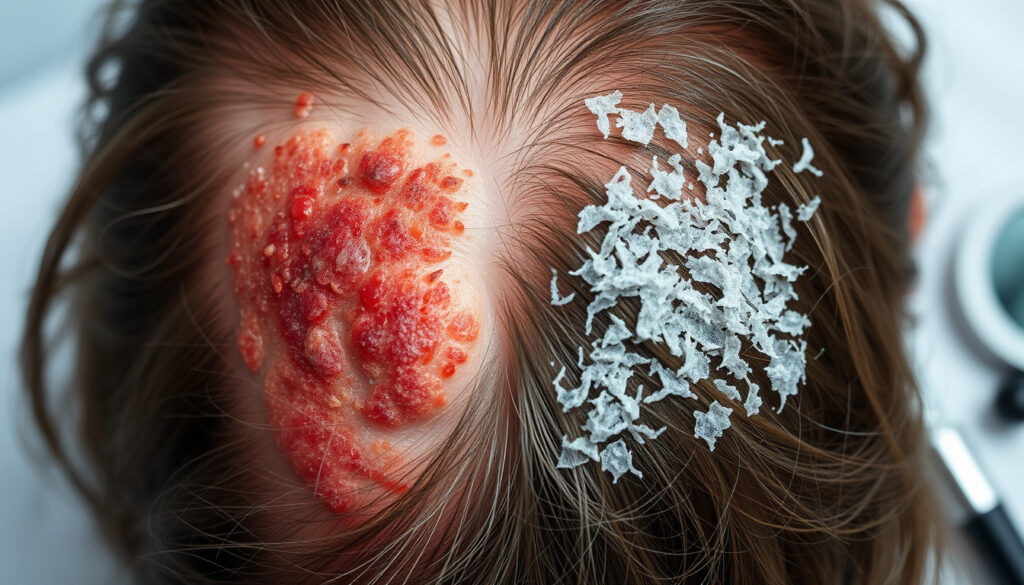
- Scale: dry, silvery-white, sometimes powdery in psoriasis; yellow, greasy, and loose in dandruff.
- Edges: psoriasis plaques have a defined edge and sit on red or darkened skin; dandruff scaling is diffuse.
- Oil: an oily scalp with flakes that fall onto your shoulders favors dandruff (GoodRx (health platform)).
- Location: psoriasis commonly crosses the hairline and can appear behind the ears or on the neck (Mayo Clinic (medical center)); dandruff can reach the eyebrows and facial hair (GoodRx (health platform)).
If the scale is tightly attached and the skin underneath is red or darker than your normal skin tone, that favors psoriasis. A silvery sheen and dry scale are the characteristic clues dermatologists look for (AAD (dermatology association)).
Early signs of scalp psoriasis
- A small red or darkened patch with dry-silver scale at the hairline, behind the ears, or on the crown.
- A patch that feels raised or thick when you run a fingertip over it.
- Scale that comes off in tiny pieces rather than large dandruff flakes.
- Skin that cracks, bleeds, burns, or feels sore when you scratch it (AAD (dermatology association)).
The earliest psoriasis patches are easy to dismiss as dry scalp. The clue is consistency: dandruff moves around the scalp, while early psoriasis tends to sit in the same spot and build scale.
Mild scalp psoriasis vs dandruff
- Mild psoriasis can look like dandruff for weeks — same itch, same visible flakes.
- The difference shows up in the base of the flakes: psoriasis sits on a red or darkened patch with a clear border.
- Dandruff scaling is spread across the scalp without a distinct plaque edge.
The triage test: give an antifungal dandruff wash a few weeks. If the flakes are dandruff, they usually settle. If the scale stays stuck to inflamed patches, that’s the signature of psoriasis — and shampoo alone won’t fix it (WebMD (health publisher)).
The pattern: loose, oily, widespread flaking reads dandruff; thick, silvery, well-defined plaques read psoriasis. When in doubt, a dermatologist can settle it in minutes.
The point of triage is direction: you don’t need a perfect label to know that thick, silvery, well-defined scale deserves a dermatologist’s exam, not another bottle of antifungal shampoo.
What autoimmune disease causes a flaky scalp?
The autoimmune connection is real for one of these conditions and not the other. Scalp psoriasis is an immune-mediated condition: the immune system accelerates skin-cell turnover, which produces silvery scale and inflamed plaques. Dandruff — seborrheic dermatitis, by its clinical name — is a separate condition associated with Malassezia yeast and excess oil (WebMD (health publisher)).
What causes scalp psoriasis?
- Psoriasis: immune-driven inflammation that speeds up skin-cell turnover.
- Dandruff: a yeast-and-oil reaction on the scalp surface, not an autoimmune process.
- Hygiene: neither condition comes from poor washing.
Because psoriasis is inflammatory rather than infectious, the scale builds from inside the skin, which is why it feels thick and adherent. Dandruff builds on the surface, which is why it flakes off so easily. Mayo Clinic notes that scalp psoriasis is generally persistent and more difficult to treat than seborrheic dermatitis — a difference you feel long before you read about it (Mayo Clinic (medical center)).
Common psoriasis triggers include stress, skin trauma (including scratching), infections such as strep throat, cold dry weather, and certain medications.
Is dandruff caused by a fungus?
- Not exactly a fungus: a yeast called Malassezia.
- It lives on most adult scalps and feeds on oil.
- When oil and yeast overgrow, the scalp responds with flaking.
That’s why dandruff treatments are antifungal and why oily-looking hair and yellow flakes point toward dandruff rather than psoriasis (GoodRx (health platform)).
Scalp psoriasis vs seborrheic dermatitis
- Seborrheic dermatitis can reach the eyebrows, beard, and sides of the nose (GoodRx (health platform)).
- Psoriasis can involve the scalp, hairline, neck, and ears — and it may also appear elsewhere on the body (Mayo Clinic (medical center)).
Cause decides treatment. Antifungals don’t calm psoriasis inflammation (WebMD (health publisher)), and treating only yeast leaves the real driver untouched — which is why the same shampoo can work brilliantly for one person and do nothing for the next.
The distinction matters because treatment follows cause: antifungals for yeast-driven dandruff, anti-inflammatories for immune-driven psoriasis.
The catch: if you treat immune-driven scalp psoriasis with antifungals alone, the inflammation stays active — so the treatment path matters as much as the diagnosis.
What are the risk factors for psoriasis?
Risk factors explain why one person develops psoriasis while another never does — and why flares come and go.
Family history and genetics
- A family history of psoriasis is one of the strongest risk factors.
- The immune-driven nature of the disease (WebMD (health publisher)) is why it tends to cluster in families.
- Psoriasis can start at any age, but many people first develop it between 15 and 25 or between 50 and 60.
Genetics load the gun; environment pulls the trigger. That combination is why the first question a dermatologist asks is usually about relatives, not products.
Stress, infections, and lifestyle factors
- Cigarette smoking and heavy alcohol use are associated with higher risk and more frequent flare-ups.
- Obesity and chronic stress track with worse psoriasis activity.
- Infections such as strep throat can trigger guttate or plaque psoriasis in some people.
The modifiable factors — smoking, heavy drinking, weight, and chronic stress — are where prevention actually starts. Other chronic conditions, such as POTS disease, involve similar immune-stress connections, a reminder that inflammatory conditions rarely travel alone.
The implication: you can’t change your genetics, but you can change the factors that make flares more likely.
What not to put on scalp psoriasis?
When the scalp is raw, itchy, and flaking, the instinct is to scrub, exfoliate, or reach for strong products. For psoriasis, that instinct is backwards.
Irritating shampoo ingredients to avoid
- Heavy fragrance and essential-oil-heavy formulas that can sting broken skin.
- Strong sulfate cleansers that strip already-inflamed plaques.
- Alcohol-heavy gels, sprays, and clarifying shampoos that dry the scalp further.
The American Academy of Dermatology is blunt about the result: scratching or scrubbing scalp psoriasis can worsen plaques, enlarge affected areas, and contribute to bleeding (AAD (dermatology association)).
Hair products and styling treatments to skip
- Hair dye and bleach during an active flare.
- Perms and chemical straighteners.
- Heat styling tools that dry the scalp.
- Undiluted essential oils, bleaching agents, or homemade exfoliants.
During a flare, treat the scalp like injured skin: lukewarm water, gentle shampoo, and a soft brush only on healthy areas.
Safe hair care routine
- Wash with lukewarm water, not hot.
- Use fingertips, not nails — and never scrape plaques with a comb.
- Pat hair dry instead of rubbing.
- If thick scale needs softening, use a salicylic acid product (GoodRx (health platform)) rather than picking at it.
Picking at scale is the most common way people make scalp psoriasis worse. Forcefully removing the scale can cause temporary hair loss — the hair usually regrows after the psoriasis clears, but the scalp spends months angrier than it needed to be (AAD (dermatology association)).
The rule: nothing abrasive, nothing fragrant, nothing hot. If a product would sting on a cut, it doesn’t belong on an active psoriatic plaque.
The pattern: the less you abrade an active plaque, the faster the scalp has a chance to settle.
What is the best shampoo for an itchy scalp?
The best shampoo depends on the target. Antifungal washes aim at yeast-driven dandruff; psoriasis needs its inflammation addressed (WebMD (health publisher)).
What stops itchy scalp immediately?
- A cool compress on the scalp for a few minutes.
- A lukewarm shower instead of a hot one.
- A gentle medicated wash with salicylic acid to soften and loosen thick scale (GoodRx (health platform)).
- Hands off the scalp — scratching enlarges plaques, even when it feels like relief.
Short-term itch relief is about cooling and calming, not stronger products. If a wash stings, rinse it off and switch to something gentler.
Why is my scalp suddenly itching like crazy?
- Weeping, swelling, or heat on the scalp: stop self-treating and see a clinician.
- Itch that started after a new shampoo, dye, or styling product: contact dermatitis is the likely culprit.
- Itch with thick, silvery plaques: a psoriasis flare is the more probable driver.
Sudden severe itch can also come from microbial overgrowth. The key question is what shows up with the itch — flakes alone point one way; inflamed plaques point another.
What vitamin is lacking if your scalp itches?
- No single vitamin deficiency reliably explains scalp itch.
- Iron, zinc, and vitamin D all affect skin health and are worth testing if a doctor suspects a deficiency.
- If your doctor checks your B12 level, dosing matters — our guide to Vitamin B12 Dosage for Adults covers the usual ranges.
For dandruff, reach for a shampoo with zinc pyrithione, selenium sulfide, ketoconazole, or salicylic acid — these are the first-line OTC options (Good Housekeeping (consumer testing magazine)). For psoriasis, the same ingredients aren’t enough; dermatologists usually move to coal tar, prescription topical steroids, or vitamin D analogs.
Four ingredients, one rule: match the ingredient to the cause.
| Ingredient | What it targets | Where it fits |
|---|---|---|
| Zinc pyrithione | Yeast and oil | First-line OTC dandruff wash (Good Housekeeping (consumer testing magazine)) |
| Selenium sulfide | Yeast overgrowth | OTC dandruff wash |
| Coal tar | Scale and inflammation | OTC dandruff option; also used for psoriasis scale |
| Salicylic acid | Thick scale | Softens and loosens psoriasis plaques (GoodRx (health platform)) |
The pattern: if the problem is yeast, an antifungal wash usually handles it. The catch: if the problem is inflammation, the wash is a helper at best and a distraction at worst — and the next step is a dermatologist, not a pricier shampoo.
The practical read: an anti-dandruff wash is a cheap test, not a psoriasis treatment — when the itch outlasts the flakes, the next decision belongs to a dermatologist.
Does scalp psoriasis eventually go away?
It can clear for months or even years — and then return. That’s the pattern most dermatologists describe, and it’s why the goal is control rather than a one-time cure.
Can scalp psoriasis be cured permanently?
- No permanent cure exists; scalp psoriasis is a chronic condition.
- It runs in cycles: clear stretches and flare-ups.
- Treatment aims to extend the quiet stretches and shorten the flares.
Because it’s chronic and inflammatory, scalp psoriasis is generally more persistent and more difficult to treat than seborrheic dermatitis (Mayo Clinic (medical center)).
How is scalp psoriasis treated?
- OTC: salicylic acid and coal tar products to soften scale and calm mild patches.
- Prescription topicals: steroids and vitamin D analogs, chosen by severity and response.
- Phototherapy or systemic medications: for moderate-to-severe cases.
- Biologics: for psoriasis that doesn’t respond to other treatments.
Treatment is selected by severity, scalp involvement, and how the skin responds. In practice, most people with scalp psoriasis need prescription anti-inflammatory treatment at some point, even when medicated shampoos help a little (Mayo Clinic (medical center)).
When to see a dermatologist
- Thick scaling that makes combing or sleeping uncomfortable.
- Bleeding, cracking, or weeping on the scalp.
- Nail pitting or skin changes on the face, neck, or body.
- No improvement after a few weeks of an OTC dandruff wash.
These are the moments when self-care has reached its limit. A dermatologist can confirm the diagnosis with a scalp exam and match the treatment to the severity (Mayo Clinic (medical center)).
The trade-off: scalp psoriasis won’t be ‘fixed’ by any single product. The sooner a dermatologist maps the right combination — topicals, light, or systemic — the shorter the flares and the longer the quiet stretches.
The implication: early escalation beats another round of guessing; chronic means controllable, not untreatable.
Side-by-side: scalp psoriasis vs dandruff
Four rows, one pattern: psoriasis is inflammatory and localized; dandruff is oily and diffuse.
| Feature | Scalp psoriasis | Dandruff |
|---|---|---|
| Scale | Thick, dry, silvery-white, adherent | Loose, greasy, yellow-white |
| Skin underneath | Red or darkened plaques with a defined edge | Mild patchy redness; diffuse scaling |
| Typical location | Scalp, hairline, behind the ears, neck; may affect body (Mayo Clinic (medical center)) | Scalp plus eyebrows and facial hair (GoodRx (health platform)) |
| Response to antifungal shampoo | Usually poor; needs anti-inflammatory treatment (WebMD (health publisher)) | Usually good; clears with OTC washes |
The comparison makes the treatment logic obvious: find the scale that is stuck, inflamed, and well-defined, and the answer is medical. Find the flakes that move freely with oil, and the answer is a better wash.
A 4-step scalp check you can do tonight
Before you change shampoos, run this quick triage. It isn’t a diagnosis — it’s a way to use two eyes and one wash to get closer to the right answer.
- Look at the scale. Dry, silvery, powdery scale stuck to the scalp favors psoriasis (AAD (dermatology association)). Loose, yellow, greasy flakes favor dandruff (GoodRx (health platform)).
- Feel the edge. A well-defined plaque with a clear border on red or darkened skin favors psoriasis. Diffuse scaling without a distinct edge favors dandruff.
- Check the neighborhood. Scale beyond the hairline, on the neck, or behind the ears favors psoriasis (Mayo Clinic (medical center)). Flakes in the eyebrows or beard favor dandruff (GoodRx (health platform)).
- Run the shampoo test. Use an OTC antifungal dandruff wash for a few weeks. If the flakes settle, it was dandruff. If they don’t, that resistance is itself a psoriasis signal (WebMD (health publisher)) — and the next step is a dermatologist.
The shampoo test isn’t a treatment plan; it’s information. A scalp that ignores antifungals has already told you the yeast explanation failed — what remains is inflammation, and that’s a doctor’s territory.
The value of this check isn’t certainty; it’s direction. You’ll walk into a dermatology appointment with better information — scale quality, location, and shampoo response — instead of a vague ‘my scalp flakes.’
What’s confirmed, what’s still unclear
Dermatology has settled the big picture. The open questions are about individual predictability, not the core mechanism.
Confirmed facts
- Scalp psoriasis is immune-mediated and not caused by poor hygiene (WebMD (health publisher)).
- Dandruff (seborrheic dermatitis) is a separate condition linked to Malassezia yeast and excess oil (WebMD (health publisher)).
- Dandruff usually responds to antifungal or anti-dandruff shampoos; scalp psoriasis usually doesn’t clear with those alone (Mayo Clinic (medical center)).
What’s unclear
- Exactly why one person’s scalp psoriasis flares while another stays quiet is not fully understood.
- The role of vitamin deficiencies in scalp itch is not a clear cause-and-effect story.
- Whether scalp psoriasis ‘goes away’ depends on the person; the disease course can be unpredictable.
The practical read: the mechanism is settled, the trajectory is not. That’s why psoriasis treatment is personalized rather than one-size-fits-all.
What dermatologists and researchers say
The most useful descriptions of the difference come from dermatology organizations and health reviews that see these cases daily.
Scalp psoriasis may form thick, inflamed, raised patches or plaques. The scale can have a silvery sheen, and the affected skin can crack, bleed, burn, or become sore.
American Academy of Dermatology (dermatology association)
Scalp psoriasis typically produces thicker, drier scales than seborrheic dermatitis. It tends to be persistent, more difficult to treat, and it often requires prescription anti-inflammatory treatment.
Mayo Clinic (academic medical center)
Harvard Health’s review describes scalp psoriasis as a chronic inflammatory skin condition that is frequently confused with dandruff — understandably, since both itch and flake. The treatment paths, however, diverge.
Harvard Health (Harvard Medical School consumer health publication)
The National Psoriasis Foundation draws the line between the two in the scale and the inflammation: scalp psoriasis presents with thick, silvery scales and significant inflammation, while dandruff flakes are fine and loose.
National Psoriasis Foundation (patient advocacy organization)
What this means: the organizations that treat psoriasis for a living keep returning to the same two markers — scale thickness and inflammation — because they are the most reliable on a real scalp.
The takeaway
The consequence of misreading this difference is wasted months: antifungal washes can’t calm psoriatic inflammation, and the real treatment gets delayed while the scale thickens. For anyone staring at a flaky scalp and a shelf of failed shampoos, the decision is clear: give an antifungal wash a few honest weeks, or book the dermatologist appointment and stop guessing.
Frequently asked questions
Is scalp psoriasis contagious?
No. Scalp psoriasis is an immune-driven inflammatory condition, not an infection, so it can’t be passed from person to person (WebMD (health publisher)). It’s also not a hygiene problem, so scrubbing harder won’t fix it.
Can dandruff turn into scalp psoriasis?
No. Dandruff (seborrheic dermatitis) and scalp psoriasis are separate conditions, and one doesn’t transform into the other (WebMD (health publisher)). They share a flaky, itchy scalp, which is exactly why the two get confused — and why a dermatologist’s exam is the reliable way to separate them.
Can scalp psoriasis cause permanent hair loss?
Usually not. Forcefully removing psoriasis scale can pull hair out with it, but that loss is temporary and hair typically regrows once the psoriasis clears (AAD (dermatology association)). The safer route is treating the inflammation instead of picking the scale.
Are prescription topicals safe for long-term scalp use?
Yes, when used as directed and supervised by a dermatologist. Scalp psoriasis often requires prescription anti-inflammatory treatment (Mayo Clinic (medical center)), and a doctor will adjust the product, cycle the dose, and monitor for side effects — especially with topical steroids.
Should I wash my hair more often if I have dandruff?
Generally yes, with a gentle shampoo. Dandruff is linked to yeast and excess oil, and regular washing reduces both (WebMD (health publisher)). If you’re using a medicated wash, follow the label and let a pharmacist or dermatologist guide the frequency.
Can scalp psoriasis appear on my face or body?
Yes. Psoriasis can involve the scalp, hairline, neck, and areas around the ears, and it may also affect other body sites (Mayo Clinic (medical center)). If the same silvery, well-defined patches show up elsewhere, that’s a strong clue the scalp issue is psoriasis rather than dandruff.
More related posts
 Best Free Calorie Counter Apps (2025): Truly Free
 A Star Is Born: 4 Versions, Cast, Plot & Rumors Guide
 Cast of Small Things Like These Film – Full List & True Story
 Weight Loss Clinic Near Me in Ireland: Costs & Diet Tips
 Ohio State University: Rankings, Name Facts & Trademark
 Grow a Garden Codes (May 2026): Active Codes & How to Redeem
 Back to the Future Cast: Full List & Where They Are Now
 Things to Do Near Me: Free, Fun & Unusual Activities in Ireland