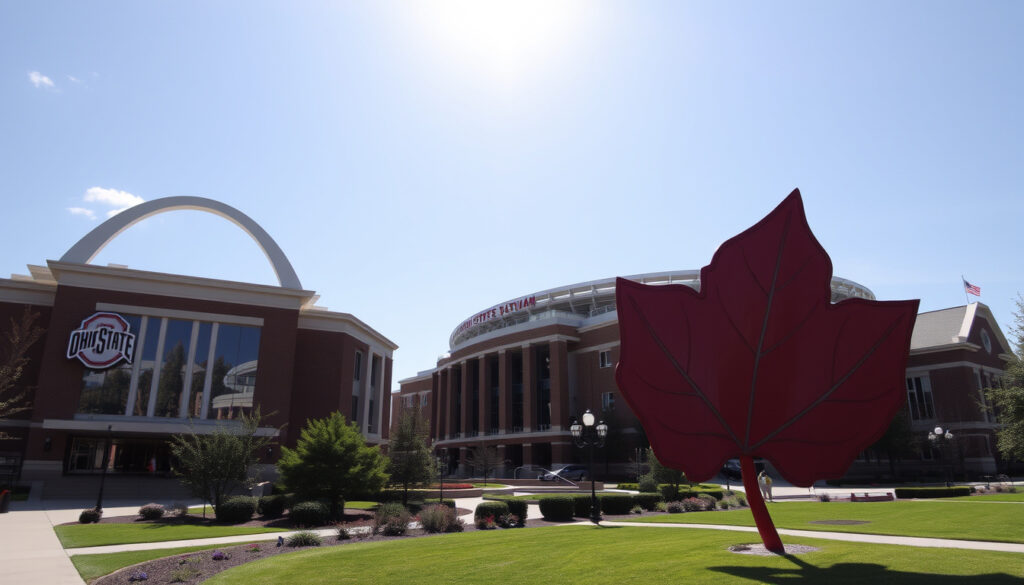
Ohio State University: Rankings, Name Facts & Trademark
Few university debates get as personal as the name of Ohio State. This article unpacks the trademark battle over “The,” the school’s actual academic standing, and why more than 65,000 students choose Columbus every year.
Founded: 1870 ·
Undergraduate enrollment: Over 50,000 ·
US News ranking (2026): #41 among national universities ·
Public university ranking in Ohio: Highest-ranked
Quick snapshot
- #41 national university (Ohio State News)
- Highest-ranked public university in Ohio (Ohio State Undergraduate Admissions)
- Strong research output and 200+ undergraduate majors (Ohio State Undergraduate Admissions)
- Approximately 57% acceptance rate (Ohio State Undergraduate Admissions)
- Holistic review process (Ohio State Undergraduate Admissions)
- Test-optional policy for 2025 (Ohio State Undergraduate Admissions)
- Over 50,000 undergraduates (Ohio State Undergraduate Admissions)
- Over 15,000 graduate students (Ohio State Undergraduate Admissions)
- One of the largest U.S. universities by enrollment (Ohio State University)
Six key facts, one pattern: Ohio State’s scale is matched by its relentless brand-consciousness.
| Attribute | Value |
|---|---|
| Year founded | 1870 |
| Undergraduate enrollment | Over 50,000 |
| Graduate enrollment | Over 15,000 |
| US News ranking (2026) | #41 |
| Athletic conference | Big Ten Conference |
| Medical center | Wexner Medical Center |
Is Ohio State a top university?
National and global rankings
- Ohio State ranks 41st among national universities in the U.S. News & World Report 2026 Best Colleges ranking, a position it held in 2025 as well (Ohio State News, official university news service).
- The Center for World University Rankings (CWUR) places Ohio State 55th globally in 2025 (CWUR, independent ranking body).
- In patent rankings, the university jumped to 21st nationally and 30th globally in 2026, up seven and ten spots respectively from 2024 (Ohio State Research Impact, university innovation office).
Academic reputation indicators
- Ohio State is the highest-ranked public university in Ohio (Ohio State Undergraduate Admissions, official admissions office).
- Time magazine ranks it #5 among all U.S. public universities (same source).
- With over 200 undergraduate majors and a Carnegie R1 classification, the institution competes with flagship publics across the Big Ten and beyond.
A #41 national ranking places Ohio State squarely in the competitive second tier of American universities. For Ohio residents, it offers flagship prestige without private tuition.
The implication: Ohio State’s ranking places it among the top public universities, but not in the same tier as private elites.
Why do people say The Ohio State University?
Historical origin of the definite article
- The university was founded in 1870 as Ohio Agricultural and Mechanical College. In 1878, the state legislature changed the name to The Ohio State University, embedding “The” in the official title (Wikipedia, community-edited encyclopedia).
- The “The” was intended to signal the institution’s role as the state’s flagship land-grant university — a contrast with the other “Ohio State University” (without the article) implied by the more generic name.
- Other public universities like “University of Michigan” use a prepositional structure; Ohio State’s “The” is an adjective that emphasizes uniqueness.
Official name adoption
- The name with “The” has been the legal corporate name ever since 1878. Modern branding, especially in sports, has turned it into a rallying cry — “Thee” Ohio State University, pronounced with emphasis.
- The university itself uses “The Ohio State University” in all official communications, and its trademark filing in 2019 was a natural extension of that branding.
The pattern: The “The” is a historical artifact that has been leveraged into a modern branding tool.
Did Ohio State trademark the word ‘the’?
Trademark filing details
- In 2019, Ohio State filed a federal trademark application for the word “THE” with the U.S. Patent and Trademark Office (USPTO) for use on apparel — specifically International Class 25 (clothing) (IP Osgoode, academic intellectual property blog at York University).
- The USPTO granted the trademark in 2021 (registration effective 2022) after a years-long examination process (NBC News, national news organization).
Opposition and public reaction
- The filing was widely mocked online, but the trademark is limited in scope: it only covers apparel and does not restrict ordinary speech using the word “the” (NBC News).
- A law school analysis confirms that trademark law only prevents confusing or infringing commercial use — not everyday language (IP Osgoode).
- In 2025, Ohio State also filed a TTAB opposition against the BUCKEYE TEARS trademark for beer and liquor, showing an active enforcement posture (CMDA Law, trademark-focused legal firm).
What this means: The trademark on “The” is a narrow commercial protection, not an attempt to control language.
Is Ohio State a hard college to get into?
Acceptance rate trends
- The most recently published acceptance rate is approximately 57% (Ohio State Undergraduate Admissions). This makes it moderately selective — easier than top privates but competitive among Ohio publics.
- The university has not yet published acceptance data for the most recent cycle as of this writing, so exact figures may shift slightly.
Admissions criteria
- Ohio State uses a holistic review process, considering GPA, course rigor, extracurriculars, and personal essays.
- For 2025, the university maintains a test-optional policy, meaning applicants may choose to submit SAT/ACT scores or not.
- Compared to the University of Cincinnati (acceptance rate ~85%) or Kent State (~87%), Ohio State is significantly more selective.
Ohio State’s application volume has grown faster than seats, pushing acceptance rates down over the past decade. The test-optional policy adds uncertainty for borderline applicants.
The catch: While the acceptance rate is moderate, out-of-state applicants face a more competitive landscape.
Why is Ohio State University so popular?
Athletic prominence and Big Ten membership
- Ohio State’s football program is one of the largest and most followed in the country, with a fan base that regularly sells out 102,780-seat Ohio Stadium (Wikipedia).
- The university is a member of the Big Ten Conference, one of the most prestigious athletic conferences in the nation.
Academic program diversity and research strength
- Ohio State offers over 200 undergraduate majors and hundreds of graduate programs across all fields.
- Its Wexner Medical Center is a top-tier academic medical system, and the university is classified as an R1 doctoral research institution.
Alumni network and economic impact
- The alumni network exceeds 500,000 members worldwide, providing strong career connections.
- Ohio State’s economic impact on the state of Ohio is estimated at over $15 billion annually, making it a major engine for the region.
The pattern: Ohio State’s popularity is a self-reinforcing cycle of athletics, academics, and alumni impact.
Timeline signal
- 1870 – University founded as Ohio Agricultural and Mechanical College (Wikipedia).
- 1878 – Name changed to The Ohio State University with “The” in the official name (Wikipedia).
- 2019 – University filed trademark application for the word “The” on apparel (IP Osgoode).
- 2021 – U.S. Patent and Trademark Office granted the trademark (NBC News).
- 2025 – Ohio State Board of Trustees holds brief meeting with statement on university direction (CMDA Law).
The timeline reinforces how the branding has evolved from a simple name change to a controversial trademark.
What’s clear and what’s not
Confirmed facts
- University ranks #41 among national universities (US News 2026) (Ohio State News).
- Trademark granted for “The” on apparel in 2021 (NBC News).
- Undergraduate enrollment exceeds 50,000 (Ohio State Undergraduate Admissions).
- Wexner Medical Center is a major academic medical system (Ohio State University).
What’s unclear
- Official name includes “The” since 1878 — relies on Wikipedia, which is not a primary source.
- Exact acceptance rate for the most recent admission cycle not published as of this writing.
- Whether the trademark will be legally challenged in court remains open.
- Full financial details of the billionaire donor relationships are not publicly disclosed.
- The university’s total enrollment figures are approximate and may vary.
What insiders and officials say
Ohio State is opposing a BUCKEYE TEARS trademark application for beer and liquor, showing that the university actively defends its brand even beyond the word “The.”
CMDA Law, trademark enforcement analysis (2025)
The university cannot stop anyone from using the word ‘the’ in everyday speech — this is a narrow commercial protection.
NBC News, reporting on trademark scope
Ohio State is the highest-ranked public university in Ohio and 15th among all publics nationally in U.S. News & World Report’s 2025 ranking.
Ohio State Undergraduate Admissions, official facts page
These sources together paint a picture of an institution that carefully manages its brand.
Summary
Ohio State is a massive public research university that has woven its brand into American sports culture and academic rankings. The trademark over “The” is a business move, not a gag — but it has made the school even more recognizable. For prospective students weighing a large public option, the trade-off is clear: you get Big Ten scale, research firepower, and a polarizing name that everyone recognizes — but you compete for space with 50,000 other undergraduates. For Ohio residents, the value proposition is hard to beat: flagship prestige at in-state tuition.
Frequently asked questions
What is the difference between Ohio State University and The Ohio State University?
They are the same institution. “The Ohio State University” is the official corporate name since 1878. “Ohio State University” is an informal shorthand.
Does Ohio State have a medical school?
Yes, the Ohio State University College of Medicine is part of the Wexner Medical Center, a major academic medical system.
How many campuses does Ohio State have?
Ohio State has its main campus in Columbus and five regional campuses: Lima, Mansfield, Marion, Newark, and Wooster (Ohio State ATI).
What is the main campus address?
The main campus is located at 281 W Lane Ave, Columbus, OH 43210, United States.
Is Ohio State a land-grant university?
Yes, it was founded as the Ohio Agricultural and Mechanical College under the Morrill Act of 1862 and remains Ohio’s flagship land-grant institution.
What is the average class size at Ohio State?
Class sizes vary widely — introductory courses may have hundreds of students, while upper-level seminars are much smaller. The student-to-faculty ratio is approximately 17:1.
Does Ohio State offer online degrees?
Yes, Ohio State offers several fully online bachelor’s and master’s programs through Ohio State Online.
More related posts
 Stevie Nicks 2025 Tour: Full Dates, Setlist & More
 Best Free Calorie Counter Apps (2025): Truly Free
 Fundamental Theorem of Calculus: FTC 1 vs FTC 2 Explained
 Pottery Painting Near Me: Co t, Location & Arthriti Benefit
 AT&T Customer Service Number 24/7: Official Contact Guide
 Safest Countries in the World 2025: Top 10 GPI Rankings