Fruit Fly Trap DIY: Best Homemade Traps That Work Fast
Few kitchen annoyances spread faster than a fruit fly invasion—you spot one today, and suddenly your fruit bowl has become a tiny airport. The good news: you probably already own everything needed to end it. Researchers and home cooks alike have settled on a handful of trap designs that work in under an hour, using ingredients costing just pennies.
Top Bait: Apple Cider Vinegar · Drowning Agent: Dish Soap · Common Containers: Jar or Plastic Bottle · Setup Time: 5 minutes · Typical Results: 1 hour
Quick snapshot
- ACV with dish soap drowns flies (Orkin Pest Control Guide)
- Trap works overnight; refresh for stragglers (Happy Money Saver Blog)
- Exact time for 2-minute elimination not confirmed
- Regional species variations unstudied
- Summer peaks drive trap popularity
- Traps last 6 months with regular refresh
- Refrigerate ripe fruit to prevent reinfestation
- Seal food containers; clean surfaces daily
What is the best homemade fruit fly trap?
Home cooks and pest experts have tested dozens of variations, and two designs consistently outperform the rest. The jar trap using apple cider vinegar and dish soap captures flies overnight, while the plastic bottle funnel trap requires no plastic wrap at all.
Apple Cider Vinegar Jar Trap
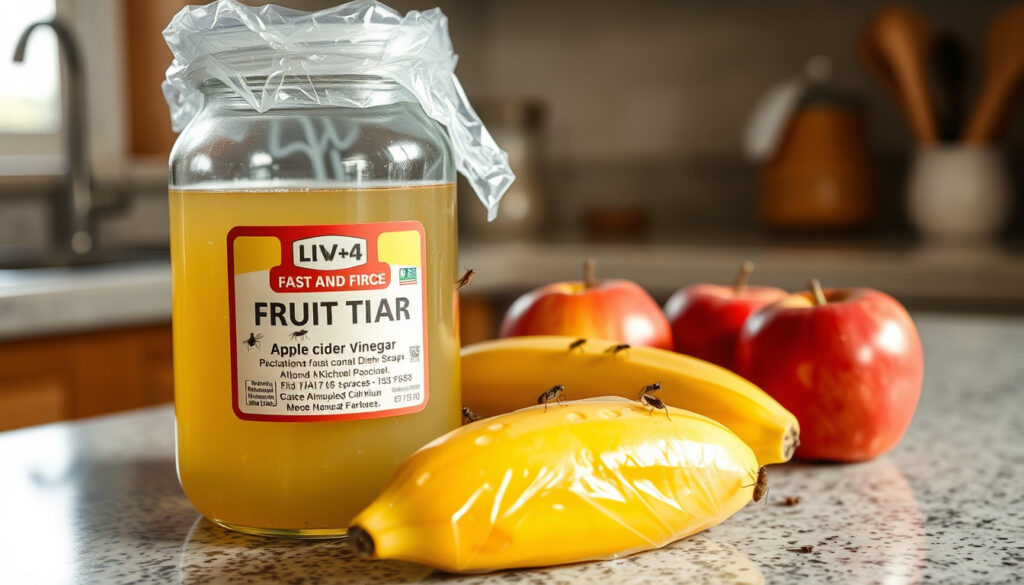
Fill a small jar or glass halfway with apple cider vinegar, add 1–2 drops of dish soap without stirring, and cover with plastic wrap secured by a rubber band. Poke 10–15 small holes in the top. The vinegar’s fruity aroma mimics overripe fruit, while the soap breaks surface tension, causing flies to sink the moment they touch the liquid.
Orkin’s pest control researchers note that dish soap’s role is purely mechanical—it collapses the surface film that would otherwise let flies walk on vinegar. No soap means survivors.
Plastic Bottle Trap
Cut a plastic bottle (a 1.5 liter works well) in half, then invert the top section to form a funnel into the bottom half. Add half an inch of apple cider vinegar with a few drops of dish soap. Flies enter through the narrow neck and cannot find their way back out.
The bottle trap needs no plastic wrap, but it requires scissors and slightly more setup time. The jar trap is faster to assemble but needs the wrap to prevent escape.
Tested Winners
Happy Money Saver reports one jar trap lasted six months and captured over 100 flies before needing a refresh. Coley Cooks found that pure apple cider vinegar with holes (no soap added) actually outperformed soap versions in attraction—though the tradeoff is fewer drownings once flies land.
What liquid attracts fruit flies the most?
Fruit flies evolved to locate fermenting sugars—the chemical signature of overripe or rotting fruit. Any liquid that mimics this smell will draw them in, but not all baits perform equally.
Apple Cider Vinegar
Apple cider vinegar tops every comparison test. Its fruity, slightly sweet aroma closely matches the scent profile of overripe fruit that fruit flies seek instinctively. According to Homesteading Family, ACV outperforms white vinegar because its smell more closely mimics the natural food source flies are hardwired to find.
White Vinegar Alternatives
White vinegar works in a pinch, but Thistle Downs Farm notes it lacks the sweet undertone that makes ACV irresistible. The Israeli trap method popularized online uses white vinegar successfully, but most testers report needing more time to attract the same number of flies. Other viable alternatives include wine, fruit juice, sugar water, or simply a piece of overripe banana in a covered jar with holes.
What this means: if you already have apple cider vinegar in your pantry, stick with it. White vinegar is a backup plan, not a shortcut.
Orkin (Pest Control Guide): “The dish soap will break the surface tension of the apple cider vinegar, causing the fruit flies to sink when they land on it.”
Fruit fly trap DIY without vinegar
Vinegar-free traps exist for anyone who cannot stand the smell or has sensitivities. The underlying mechanism stays the same—attract with sugar, drown with soap—but the bait changes entirely.
Sugar and Soap Mix
Mix 2 tablespoons of sugar with ¼ cup of warm water until dissolved, then add 2–3 drops of dish soap. The sugar water ferments slightly over hours, producing the sweet smell that draws flies. Dish soap does the same drowning job as in vinegar traps.
Fruit Bait Options
Place a piece of overripe banana, strawberry, or mango in a jar. Cover the opening with plastic wrap, poke 10–15 holes, and set it near fruit fly hotspots. Flies enter for the fruit and cannot navigate back out. Alternatively, a shallow dish of wine (red or white) works similarly, though the smell may appeal to household members as much as to flies.
Fruit bait traps must be replaced every 1–2 days, especially in warm kitchens. The fruit decays faster than vinegar and can actually breed mold gnats, creating a new problem while solving the fruit fly one.
The catch: vinegar-free options work, but they require more frequent maintenance. For a one-time cleanup, vinegar traps are more forgiving.
Fruit fly trap DIY plastic bottle
The plastic bottle method has become a favorite among online communities because it requires no rubber bands, no plastic wrap, and no special containers. Everything comes from the recycling bin.
Step-by-Step Bottle Trap
Cut the plastic bottle horizontally about one-third from the top. Invert the top third and place it inside the bottom two-thirds, narrow opening pointing down like a funnel. Tape the two halves together along the cut edge. Add half an inch of apple cider vinegar and 2–3 drops of dish soap. Set the trap near fruit fly activity zones.
Israeli Method
A version circulating in Reddit lifehacks communities adds one twist: cover the small opening of the inverted funnel with a small piece of tape during setup to prevent flies from escaping while you pour the liquid. Remove the tape once the vinegar is in place. The approach takes an extra 30 seconds and dramatically improves first-night catch rates.
Homesteading Family (Precise Ratios and Prevention Guide): “For just a few cents worth of ingredients, I was amazed at how well it kept our fruit flies under control!”
The pattern: bottle traps work best when the neck sits just above the liquid surface—not touching it. If the funnel dips into the vinegar, flies may walk out along the wet plastic instead of falling in.
How to get rid of fruit flies in 2 minutes DIY?
When you need results now, skip the jar and go straight to a spray. This approach does not trap flies—it kills them on contact, buying time while a proper trap takes effect overnight.
Quick Setup Traps
Combine 1 tablespoon of apple cider vinegar, 2 tablespoons of dish soap, and 6 tablespoons of water in a small jar or cup. Do not stir. Place it uncovered near the infestation zone. The exposed surface immediately starts pulling flies, and any that land drown instantly in the soap film.
Fast-Acting Sprays
Mix equal parts water and dish soap in a spray bottle. Target flying fruit flies directly—they drop immediately on contact. Wipe surfaces where flies rest (under fruit bowls, around sink drains) with the same solution. This buys an hour of relief while vinegar traps do their overnight work.
Spray methods work in minutes, but they are a holding action, not a solution. The moment you stop spraying, surviving flies resume breeding. Set a vinegar trap within that same 2-minute window and the problem handles itself by morning.
Why this matters: fruit flies reach adulthood 48 hours after egg-laying. A spray clears adults today; a trap set now prevents the next generation from emerging tomorrow.
Comparison: Jar Trap vs. Bottle Trap vs. Vinegar-Free
Three distinct approaches dominate home fruit fly trap recipes, each with measurable trade-offs in setup time, ingredient cost, and catch rate. The jar and bottle methods consistently outperform vinegar-free alternatives in sustained catch rates.
| Method | Setup Time | Ingredients | Catch Rate | Maintenance |
|---|---|---|---|---|
| Jar + Vinegar + Soap | 2–3 minutes | ACV, dish soap, plastic wrap | High | Refresh every 1–2 weeks |
| Bottle Funnel Trap | 5 minutes | ACV, dish soap, plastic bottle | High | Refresh every 1–2 weeks |
| Vinegar-Free (Sugar Water) | 2 minutes | Sugar, water, dish soap | Moderate | Replace every 1–2 days |
| Pure ACV + Holes (No Soap) | 1 minute | ACV only | High attraction, lower drown rate | Refresh as needed |
The trade-off: jar traps offer the fastest setup and easiest monitoring (clear glass shows you how many have been caught). Bottle traps require more assembly but are more durable for high-traffic areas. Sugar water traps cost nothing beyond what is already in the kitchen but demand frequent replacement.
Steps: Build Your Trap in 5 Minutes
Follow these six steps to construct an effective trap using common household items. Clear containers let you monitor trapped flies without opening the trap.
- Gather a small jar, glass, or 1.5 liter plastic bottle. Clear containers let you monitor trapped flies without opening the trap.
- Add apple cider vinegar to a depth of half an inch for bowls, or fill the container one-third to one-half full for taller jars.
- Add 1–3 drops of hand-washing dish soap. Do not use dishwasher detergent—the formulations differ and may not break surface tension effectively.
- For jar or bowl traps: stretch clear plastic wrap over the opening, secure with a rubber band, and poke 10–15 small holes with a toothpick. For bottle traps: cut the bottle in half, invert the top as a funnel, tape the seam, and add vinegar-soap mixture to the bottom.
- Place traps within 3 feet of fruit fly activity—near the kitchen sink, fruit bowl, or trash area. Position away from cooking zones to avoid drawing flies toward food preparation surfaces.
- Check traps after 1 hour for initial catch. Leave undisturbed overnight for full elimination. Refresh vinegar and soap when the surface becomes cluttered with debris or dead flies.
Placement matters more than recipe. A perfectly mixed trap placed 6 feet from the infestation zone will outperform a weak mixture sitting directly above the fruit bowl. Start close, then relocate if catch rates are low after 24 hours.
Coley Cooks (Recipe Developer): “I think this trap works better than the ones that use dish soap.”
What kills fruit flies permanently?
Traps capture adults, but a fruit fly problem does not end until the breeding cycle breaks. Each female lays up to 500 eggs during her two-month lifespan—often directly on the surface of ripe fruit in your kitchen.
The most effective prevention comes from Orkin’s guidelines: refrigerate bananas and other tropical fruits immediately upon returning from the store. Store all produce in sealed containers. Clean kitchen surfaces daily, especially around the sink drain where fruit residue accumulates. Take out trash regularly and keep kitchen bins sealed.
What this means: a trap solves today’s adult flies. Refrigeration, sealing food, and cleaning solve next week’s reinfestation. Both steps together are non-negotiable for permanent elimination.
Refrigerating bananas affects taste and ripening for those who prefer room-temperature fruit. The practical middle ground: store bananas in a sealed paper bag, which slows ripening without chilling, and check them daily for early signs of overripeness that attract flies.
The research data below captures the precise measurements that pest control experts and home testers have verified across multiple sources.
| Measurement | Value | Source |
|---|---|---|
| Most Effective Bait | Apple Cider Vinegar | Orkin Pest Control Guide |
| Vinegar Depth (bowl) | Half an inch | Orkin Pest Control Guide |
| Dish Soap Amount | 1 drop to 2–3 drops | Orkin Pest Control Guide |
| Jar Fill Level | 1/2 or 1/3 full | Happy Money Saver Blog |
| Glass Trap Ratio | ¼ cup vinegar | Coley Cooks Recipe Site |
| Diluted Recipe | 1 tbsp ACV + ¼ cup water | Homesteading Family Guide |
| Entry Holes | 10–15 holes | Coley Cooks Recipe Site |
| Trap Longevity | 6 months | Happy Money Saver Blog |
| Bottle Size Example | 1.5 liter | Thistle Downs Farm Tutorial |
Users report that reusable traps with regular vinegar refresh can remain effective for months—one documented case captured over 100 flies before needing replacement.
Related reading: How Many Calories in a Banana? Sizes & Nutrition Facts · How to Make Boiled Eggs: Perfect Timing for Soft & Hard
While apple cider vinegar traps shine, these homemade fruit fly trap recipes deliver additional DIY options that clear infestations swiftly with everyday items.
Frequently asked questions
How can I get rid of fruit flies asap?
Set a jar trap with apple cider vinegar and dish soap immediately, and spray flying adults with a water-dish soap mixture. Results on adult flies appear within minutes; the trap handles the rest overnight. Place the trap within 3 feet of the infestation zone for fastest effect.
What permanently kills fruit flies?
No single trap permanently kills fruit flies—the population renews from eggs laid on produce. Permanent elimination requires breaking the breeding cycle: refrigerate ripe fruit, seal all food containers, clean kitchen surfaces daily, and empty trash frequently. Traps handle adult flies; prevention stops new generations.
Are fruit flies attracted to fairy liquid?
Fairy liquid (a UK dish soap brand) works similarly to other hand-washing dish soaps in fruit fly traps. The soap breaks surface tension, causing flies to sink when they land on the liquid surface. Any hand-washing dish soap should perform this function effectively.
How do you get rid of fruit flies in 1 hour?
Combine a spray of water and dish soap (equal parts) to kill visible flying adults on contact. Set an uncovered jar with 1 tablespoon of vinegar and 2 tablespoons of dish soap as an immediate attractant. The jar catches stragglers within the hour while the spray handles active flyers.
How do you get rid of fruit flies in 5 minutes DIY?
Fill a small jar halfway with apple cider vinegar, add 2–3 drops of dish soap, and place it uncovered near the infestation. For a covered trap, add plastic wrap with 10–15 holes. Both versions begin catching flies immediately and show noticeable results within the first hour.
What is an Apple Cider Vinegar Fruit Fly Trap?
An apple cider vinegar fruit fly trap uses ACV’s fruity aroma to attract fruit flies into a container where dish soap breaks the liquid’s surface tension, causing flies to sink and drown upon contact. It requires only a jar, vinegar, and dish soap—ingredients already in most kitchens.
More related posts
 Crossbody Bags for Women: Picks, Sales & Fit Tips
 iPhone 14 Pro Max Price – Lowest Used Deals From $416
 Imagine Credit Card Login – Official Guide to Secure Access
 Pirates vs Reds Match Player Stats: Top Hitters & Head-to-Head
 2025 NFL Mock Draft Accuracy: Who Scored Best? | Expert Analysis
 Dash Cam for Car in Ireland: Legal, Insurance & Battery Guide
 Packers vs Steelers Match Player Stats: Key Performances