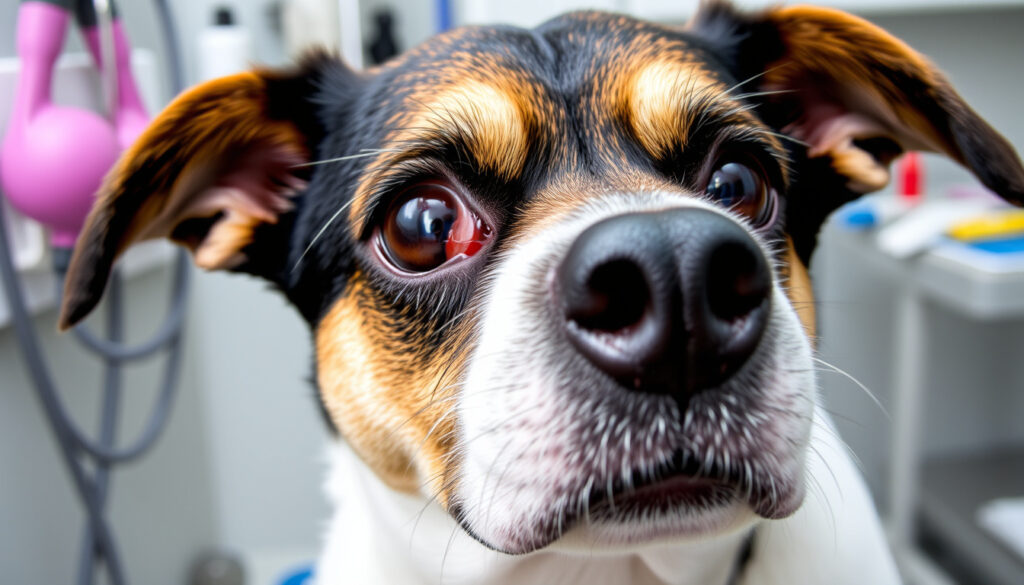
Cherry Eye in Dogs: Causes, Treatment, and Surgery Costs
Few dog health issues look more startling than a bright red lump suddenly appearing in the corner of your dog’s eye. That lump, often called cherry eye, is actually a small tear gland that has slipped out of place, and it shows up more often in puppies and young adult dogs than in older pets, according to VCA Hospitals (a veterinary hospital network); although the condition is not a tumor, as ACVO (a veterinary ophthalmology organization) explains, it is not something to ignore, and this guide sorts out the breeds, surgical options, and costs that owners actually need to know.
Typical onset: Before 2 years of age VCA Hospitals · Biggest breed risk: Brachycephalic breeds such as English Bulldogs and French Bulldogs ACVO · Surgical cost range: A few hundred dollars to over $2,000 per eye PetMD (a veterinary health resource)
What Is Cherry Eye?
- Prolapse of the third eyelid gland VCA Hospitals.
- Appears as a red, swollen mass at the inner corner of the eye ACVO.
- Not a tumor or cancer ACVO.
Causes and Risk Factors
- Weak connective tissue around the gland VCA Hospitals.
- Genetic predisposition in specific breeds PDSA (UK animal charity).
- Often occurs in dogs under 2 years old Blue Cross.
Breeds at Higher Risk
- Bulldogs (English and French) VCA Hospitals.
- Beagles, Cocker Spaniels, Shih Tzus ACVO.
- Other brachycephalic breeds PDSA.
Treatment Options
- Manual replacement by a veterinarian Blue Cross.
- Surgical repositioning (most effective) PetMD.
- Home care: artificial tears, warm compresses (temporary relief only) PetMD.
Cherry eye has a consistent profile: young dog, flat face or hound breed, and a red swelling at the inner corner of the eye.
| Field | Details |
|---|---|
| Common name | Cherry eye |
| Medical term | Prolapsed gland of the nictitans, or prolapsed third eyelid gland |
| Typical age of onset | Usually before 2 years of age VCA Hospitals |
| Most at risk | English Bulldog, French Bulldog, Boston Terrier, Beagle, Shih Tzu, Lhasa Apso, Pekingese, Cane Corso, Cocker Spaniel, and other brachycephalic breeds ACVO |
| Common signs | Red, cherry-like mass at the inner corner of the eye; possible eye discharge |
| Standard treatment | Surgical repositioning of the gland; topical medication alone rarely resolves it VCA Hospitals |
| Risk if untreated | Chronic eye discharge, dry eye, and potential damage to the eye’s surface VCA Hospitals |
| Estimated cost | A few hundred dollars per eye; specialist surgery can reach $2,000 or more PetMD |
What is cherry eye in dogs?
- A tear gland normally tucked behind the third eyelid slips over the eyelid edge.
- The exposed gland forms a red, round mass that looks like a small cherry, which is where the condition gets its name ACVO.
- It is most often seen in puppies and young dogs, not geriatric dogs VCA Hospitals.
The medical name is prolapsed gland of the nictitans, or prolapsed third eyelid gland. The third eyelid is the pale membrane that sweeps across the inner corner of the eye, and it carries an important tear gland. When the connective tissue that anchors that gland weakens, the gland flips outward and becomes visible VCA Hospitals.
What causes cherry eye in dogs?
- Genetics play a large role, and breed is the biggest risk factor VCA Hospitals.
- Weak connective tissue allows the gland to pop loose from its normal position.
- No guaranteed prevention exists, but breeding selection may reduce risk VCA Hospitals.
The condition is not usually caused by trauma. It is a developmental weakness in the tissue that holds the gland in place, which is why it tends to appear on its own in young dogs VCA Hospitals.
What dog breed is most prone to cherry eye?
Brachycephalic and hound breeds dominate the list, with VCA Hospitals and ACVO both naming the same core group:
- English Bulldog and French Bulldog
- Boston Terrier, Shih Tzu, Lhasa Apso, and Pekingese
- Beagle, Bloodhound, Great Dane, Mastiff, and Newfoundland
- Cocker Spaniel, Neapolitan Mastiff, and Tibetan Mastiff
Why did my dog randomly get cherry eye?
Onset is usually spontaneous and linked to a genetic weakness in connective tissue, not trauma. It often appears before two years of age.
Is cherry eye painful for dogs?
- Cherry eye itself is often not acutely painful PetMD.
- Dogs may experience mild discomfort or a scratchy feeling.
- Heavy discharge or secondary problems can cause redness, squinting, or pawing at the face.
Although the mass can look angry and infected, the exposed tissue is tear gland tissue, not an abscess. Many dogs continue eating, playing, and acting normally, which can make the condition easy to dismiss PetMD.
Are dogs in pain with cherry eyes?
As noted, the condition is usually not acutely painful, but secondary irritation can cause discomfort. PetMD confirms that the prolapsed gland itself is often painless.
Does cherry eye go away on its own?
- Cherry eye rarely resolves without veterinary intervention PetMD.
- The prolapsed gland can become irritated and may lead to chronic dry eye if left untreated VCA Hospitals.
- Dogs may experience mild discomfort but not severe pain; however, secondary infections can cause pain.
Because the third eyelid gland produces a meaningful share of the tear film, surgical replacement is usually recommended rather than leaving the tissue exposed VCA Hospitals. This is why “wait and see” is rarely the right plan.
Can a dog live with cherry eye?
Yes, a dog can live with cherry eye, but the risk of developing dry eye and eye surface damage increases over time. Early surgery is recommended to avoid long-term complications.
Is it okay to leave cherry eye untreated?
- Untreated cherry eye can persist as a chronic red lump at the eye corner.
- Long-term problems can include conjunctivitis, dry eye, and corneal damage VCA Hospitals.
- The longer the gland remains exposed, the more likely the eye surface is to become irritated.
Because the third eyelid gland produces a meaningful share of the tear film, surgical replacement is usually recommended rather than leaving the tissue exposed VCA Hospitals. This is why “wait and see” is rarely the right plan.
How can you treat cherry eye in dogs?
- Surgery is the standard treatment for most dogs.
- The procedure repositions the gland and reattaches it to the third eyelid VCA Hospitals.
- Topical antibiotics or anti-inflammatories may be used before or after surgery, but medication alone rarely fixes the problem.
- Step 1 – Veterinary consultation: Have the prolapsed gland examined to confirm cherry eye and rule out other conditions. VCA Hospitals emphasizes early diagnosis.
- Step 2 – Manual reduction (possible): Some veterinarians may attempt to manually reposition the gland, but recurrence is common. PetMD notes this is not a permanent fix.
- Step 3 – Surgical repositioning: The standard treatment is a surgical procedure (e.g., pocket technique) that reattaches the gland. PetMD reports success rates are generally good.
- Step 4 – Post-operative care: Anti-inflammatory medication and monitoring for recurrence are essential. VCA Hospitals states that 5% to 20% of patients may need additional surgery.
Surgery aims to save the gland rather than remove it. Gland removal is a last resort because it can increase the risk of chronic dry eye later in life PetMD.
Can you treat cherry eye at home?
Home care such as warm compresses or artificial tears can soothe but do not fix the prolapse. Veterinary treatment is required to permanently reposition the gland.
How do you pop a cherry eye back in?
Manual replacement should only be performed by a veterinarian. Attempting to pop it back in at home can damage the gland or cause further irritation.
How do you massage a dog’s cherry eye?
Massage may temporarily reposition the gland, but recurrence is common. It is not a substitute for surgery.
How to treat cherry eye in dogs without surgery
Non-surgical options like eye drops or lubricants may reduce inflammation but rarely hold the gland in place. Surgery remains the definitive treatment.
How much does cherry eye surgery cost?
- Standard cherry eye surgery often costs a few hundred dollars per eye PetMD.
- Specialist-level surgery can reach $2,000 or more per eye PetMD.
- The price depends on the clinic, dog size, surgical technique, and aftercare needed.
Owners of at-risk breeds can reduce financial surprise by asking for a full surgical estimate that includes anesthesia, monitoring, medication, and recheck appointments.
Can other dogs catch cherry eye?
- No. Cherry eye is not contagious ACVO.
- It is a structural problem in the gland’s connective tissue, not an infection.
- One dog in a household does not put other dogs at risk.
Because the problem is inherited rather than infectious, contact does not matter. The condition cannot be passed through grooming, sharing water bowls, or playing at the dog park VCA Hospitals.
Confirmed facts
- Fact: Cherry eye is normal tear gland tissue that has slipped out of place ACVO.
- Fact: Untreated cherry eye can lead to dry eye and eye surface problems VCA Hospitals.
- Fact: Surgical repositioning is preferred over removal whenever possible PetMD.
- Not true: Cherry eye is not cancer and not a tumor ACVO.
- Not true: It is not caused by an eye infection and it is not contagious ACVO.
The paradox: A lump that looks like a growth is actually displaced normal tissue, which is why the condition’s nickname is both vivid and misleading.
Veterinary sources on cherry eye
“The red mass that looks like a small cherry is actually tear gland tissue that has slipped out of place.”
“Genetics play a large role in development, and breed is the biggest risk factor.”
“Specialist surgery can cost $2,000 or more.”
For owners of high-risk breeds, the takeaway is straightforward: a cherry-red lump at the inner corner of the eye should be examined by a veterinarian quickly enough to protect the dog’s tear gland and long-term eye comfort. For a breeder with a line of Boston Terriers or Bulldogs, asking about cherry eye in pedigrees is a small step that can make a meaningful difference in the next generation’s eye health.
Related reading: What Is POTS Disease? Symptoms, Causes & Treatment · Osgood-Schlatter Disease: Causes, Treatment & Recovery
akc.org, metlifepetinsurance.com, goodrx.com, acvo.org, ndsr.co.uk, carecredit.com, amcny.org
Frequently asked questions
How is cherry eye treated when it appears in both eyes?
Both eyes may need to be monitored, but each eye can be treated surgically when the gland prolapses. The goal is the same for both sides: reposition the gland and preserve tear production VCA Hospitals.
Can eye drops cure cherry eye?
Medication can reduce inflammation and manage discharge, but it does not usually hold the gland permanently in place. Surgery remains the standard approach in most dogs PetMD.
What are the long-term risks of leaving the gland exposed?
Long-term risks include chronic discharge, conjunctivitis, dry eye, and damage to the eye’s surface VCA Hospitals.
How successful is cherry eye surgery?
Success rates are generally good when the gland is repositioned rather than removed, though recurrence and the need for follow-up surgery are possible PetMD.
Is cherry eye ever an emergency?
It is not usually an emergency in the same way a deep corneal ulcer is. However, a red mass at the eye corner should be examined promptly because other eye conditions can cause similar signs VCA Hospitals.
Should I ask for a veterinary ophthalmologist?
For a first-time cherry eye in a high-risk dog, a general practice vet may be able to perform the surgery. A veterinary ophthalmologist is usually a good option when the condition recurs, when the other eye is affected, or when the dog already has tear film problems PetMD.
More related posts
 Benefits of Fish Oil: What Science Says About Daily Use
 Best Free Calorie Counter Apps (2025): Truly Free
 Law & Order: Special Victims Unit status, cast, FAQs 2025
 Beauty and the Beast 2017: Box Office, Cast, Criticisms
 Where to Watch Ted Lasso: Streaming on Apple TV+ & Alternatives
 iPhone 14 Pro Max Price – Lowest Used Deals From $416
 College Football Games Today Live: Schedule & Channels
 Extended Stay Near Me: Cheap Hotels in Ireland 2025