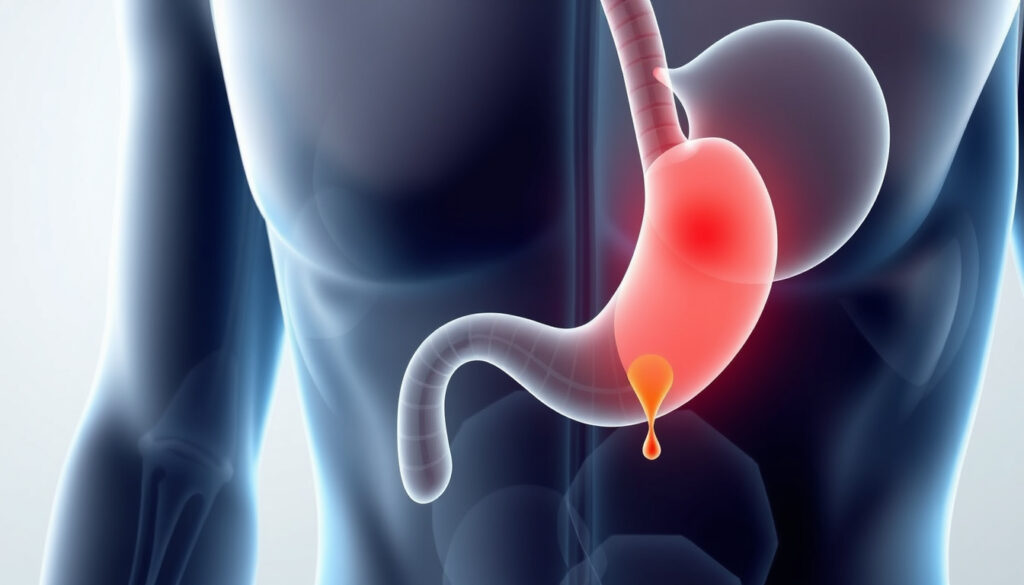
Gastroesophageal Reflux Disease Symptoms: Complete Guide
Anyone who has felt that familiar burning sensation creeping up after a big meal knows the discomfort of acid reflux. But when heartburn becomes a weekly occurrence, it may signal something more persistent: gastroesophageal reflux disease (GERD).
Prevalence of GERD in adults: Approximately 20% of the U.S. population (NIDDK) ·
Most common symptom: Heartburn (American Academy of Family Physicians) ·
Number of core symptoms listed by major health organizations: 8 core symptoms (American Academy of Family Physicians)
Quick snapshot
- Heartburn is the most common symptom (NIDDK)
- Regurgitation occurs in up to 80% of patients (American Academy of Family Physicians)
- PPIs are the most effective medication for healing esophagitis (Mayo Clinic)
- Obesity is a major risk factor (NIDDK)
- Exact mechanism linking GERD to chronic cough is not fully understood (World Gastroenterology Organisation)
- Long-term PPI safety remains debated (StatPearls / NCBI Bookshelf)
- Efficacy of many natural remedies lacks rigorous clinical trials (World Gastroenterology Organisation)
- Symptoms typically worsen after large meals or when lying down (American Academy of Family Physicians)
- Nighttime symptoms affect about 75% of GERD patients, disrupting sleep (American Academy of Family Physicians)
- Infants often outgrow GERD by age 1–2 (NIDDK)
- See a doctor if symptoms persist despite lifestyle changes (Mayo Clinic)
- Seek emergency care for chest pain with exertion, shortness of breath, or jaw pain (Mayo Clinic)
- Diagnosis may involve endoscopy or pH monitoring (NIDDK)
The table below captures the essential numbers every patient should know about GERD.
| Attribute | Value |
|---|---|
| Prevalence | ~20% of U.S. adults experience GERD symptoms weekly (NIDDK) |
| Primary cause | Lower esophageal sphincter dysfunction (NIDDK) |
| Most effective medication | Proton pump inhibitors (e.g., omeprazole) (Mayo Clinic) |
| Symptom that mimics heart attack | Chest pain from acid reflux (American Academy of Family Physicians) |
| Percentage of infants with GERD | About 50% of infants under 3 months have reflux; most outgrow it (NIDDK) |
What are the 8 symptoms of GERD?
Gastroesophageal reflux disease (GERD) symptoms extend beyond the classic heartburn. The American Academy of Family Physicians (AAFP) outlines a core set of eight symptoms, some of which are easily mistaken for other conditions.
Heartburn and regurgitation
- Heartburn: a burning sensation in the chest, often after eating or when lying down (NIDDK).
- Regurgitation: the sensation of acid or food backing up into the throat or mouth, occurring in up to 80% of patients (AAFP).
Heartburn alone is not enough for a GERD diagnosis—regurgitation is the second hallmark symptom. Patients who experience both should consider a medical evaluation.
Difficulty swallowing (dysphagia)
- Dysphagia, or the feeling that food is stuck in the throat, may indicate esophageal damage from chronic acid exposure (AAFP).
- This is considered an alarm symptom—it warrants prompt endoscopy to rule out strictures or Barrett’s esophagus.
Chronic cough and hoarseness
- GERD can trigger a chronic cough, especially at night, by irritating the throat and airways (World Gastroenterology Organisation).
- Hoarseness and a sore throat in the morning are common atypical presentations.
- This symptom often overlaps with conditions like postnasal drip or asthma, making diagnosis tricky.
Chest pain and nausea
- Non-cardiac chest pain from GERD can mimic a heart attack—sharp, squeezing, or burning (AAFP).
- Nausea and vomiting may occur, especially in severe cases or after large meals.
Nighttime GERD symptoms
- About 75% of GERD patients report nocturnal symptoms, which can disrupt sleep and lead to daytime fatigue (NIDDK).
- Elevating the head of the bed by 6–8 inches can reduce nighttime reflux.
The pattern: eight symptoms, but heartburn and regurgitation dominate. For patients with atypical symptoms like chronic cough or chest pain, differentiating GERD from other causes is critical.
What is the cause of GERD?
GERD arises when the lower esophageal sphincter (LES) fails to act as a one-way valve. The NIDDK (NIDDK) identifies several contributing factors.
Lower esophageal sphincter dysfunction
- The primary cause is a weakened or inappropriately relaxed LES that allows stomach contents to flow backward.
- Transient LES relaxations are normal, but frequent episodes lead to GERD.
Hiatal hernia
- A hiatal hernia can push the stomach above the diaphragm, impairing the LES’s ability to close (Mayo Clinic).
- Not all hiatal hernias cause GERD, but they are a risk factor.
Lifestyle and dietary triggers
- Obesity increases intra-abdominal pressure, promoting reflux (NIDDK).
- Pregnancy, smoking, and alcohol consumption also relax the LES.
- Fatty foods, chocolate, caffeine, and spicy meals can trigger symptoms.
Obesity and pregnancy
- Obesity is a major modifiable risk factor—weight loss is one of the most effective lifestyle interventions (NIDDK).
- Pregnancy-related hormonal changes and increased abdominal pressure often cause temporary GERD.
Obesity is the most modifiable risk factor. A 10% weight loss can significantly reduce GERD symptoms, but the effect is often underestimated by patients.
How to cure acid reflux?
Treatment follows a stepped approach: start with lifestyle changes, add medications if needed, and consider surgery for refractory cases. The American Society for Gastrointestinal Endoscopy (ASGE) recommends PPIs at the lowest effective dose for the shortest duration.
Lifestyle changes and dietary modifications
- Weight loss, head-of-bed elevation (6–8 inches), and avoiding meals 2–3 hours before bedtime (NIDDK).
- Eliminating trigger foods: fatty meals, chocolate, spicy foods, citrus, and carbonated drinks.
- Quitting smoking and reducing alcohol intake.
Here is how the main medication classes compare for GERD management.
| Medication class | Examples | How it works |
|---|---|---|
| Antacids | Calcium carbonate, magnesium | Neutralize acid quickly for short-term relief (Mayo Clinic) |
| H2 blockers | Famotidine, cimetidine, nizatidine | Reduce acid production; provide longer relief than antacids (Mayo Clinic) |
| Proton pump inhibitors (PPIs) | Omeprazole, lansoprazole, esomeprazole | Strongest acid blockers; heal esophageal damage (Mayo Clinic) |
| Potassium-competitive acid blockers | Vonoprazan | Newer class; rapid onset of action (StatPearls / NCBI Bookshelf) |
The catch: stronger medications carry more potential side effects, so starting with the lowest effective dose is the recommended strategy.
Surgical interventions (fundoplication, LINX)
- Surgery is reserved for patients with severe GERD who do not respond to medication or who cannot tolerate long-term PPIs (Mayo Clinic).
- Fundoplication wraps the stomach around the LES to strengthen the valve.
- LINX uses a magnetic ring to augment the LES.
Natural remedies: what works and what doesn’t
- Ginger, chamomile tea, and low-acid beverages (e.g., alkaline water) may provide temporary relief (NIDDK).
- Chewing gum increases saliva production, which neutralizes acid.
- Evidence for apple cider vinegar, baking soda, or aloe vera is limited and inconsistent.
PPIs heal the esophagus but may mask symptoms of more serious conditions. Patients on long-term PPIs should discuss the need for ongoing use with their doctor.
What is commonly mistaken for acid reflux?
GERD’s ability to mimic other conditions is one of its most dangerous features. The World Gastroenterology Organisation (WGO) emphasizes that atypical presentations may require investigation for upper gut malignancy, achalasia, or eosinophilic esophagitis.
Heart attack vs. GERD chest pain
- Both can cause chest pressure, burning, or pain. However, heart attack pain often radiates to the arm, jaw, or back and is accompanied by shortness of breath or nausea.
- If you’re unsure, seek emergency care—do not assume it’s GERD.
Gallbladder disease and gastritis
- Gallbladder disease triggers upper abdominal pain after fatty meals, similar to GERD, but pain is typically in the right upper quadrant.
- Gastritis causes a burning stomach pain and is often caused by H. pylori or NSAIDs, not acid reflux.
Esophageal motility disorders
- Achalasia and esophageal spasms cause dysphagia and chest pain that can be mistaken for GERD. Barium swallow or manometry can differentiate (WGO).
Anxiety and panic attacks
- Anxiety can produce chest tightness, a lump in the throat (globus sensation), and hyperventilation that mimics GERD. Differentiating requires a careful history.
The implication: misdiagnosis is common. A patient with chronic cough or chest pain may be treated for asthma or heart disease when the real culprit is acid reflux. Looking at the throat can help—What Does Strep Throat Look Like? and Normal Throat vs Sore Throat are useful comparisons for throat-related symptoms.
Can gastroesophageal reflux go away on its own?
Prognosis depends on the severity and duration. Occasional heartburn is normal and may resolve with simple lifestyle changes. Chronic GERD, however, is typically a lifelong condition that requires management.
Mild vs. chronic GERD
- Mild, infrequent reflux can be controlled with antacids and diet adjustments (NIDDK).
- Chronic GERD (symptoms more than twice a week) usually needs ongoing medication or lifestyle changes.
When does GERD require treatment?
- Treatment is necessary when symptoms interfere with quality of life, cause sleep disturbance, or lead to complications such as esophagitis, strictures, or Barrett’s esophagus.
- Alarm symptoms (dysphagia, bleeding, weight loss, anemia) demand immediate evaluation (AAFP).
Potential complications of untreated GERD
- Untreated GERD can progress to erosive esophagitis, Barrett’s esophagus, and esophageal adenocarcinoma (NIDDK).
- Strictures from scarring cause dysphagia and require dilation.
- While GERD itself is not life-threatening, the risk of esophageal cancer increases with long-standing, untreated reflux.
In infants
- GERD in infants is common—about 50% of babies under 3 months spit up regularly. Most outgrow it by age 1–2 (NIDDK).
- In adults, it is typically a chronic condition.
Step-by-Step Guide to Managing GERD Symptoms
- Keep a symptom diary – Track what you eat, when symptoms occur, and their severity for two weeks.
- Make immediate lifestyle changes – Elevate the head of your bed 6–8 inches, avoid eating 3 hours before bedtime, and lose weight if overweight (NIDDK).
- Identify and eliminate trigger foods – Common triggers include high-fat meals, chocolate, citrus, tomatoes, spicy foods, and caffeine.
- Try over-the-counter antacids or H2 blockers – For occasional symptoms, antacids provide quick relief; H2 blockers like famotidine offer longer control (Mayo Clinic).
- Consult a doctor for persistent symptoms – If symptoms occur more than twice a week or do not improve in 2–4 weeks, see a healthcare provider. They may prescribe PPIs or recommend diagnostic tests (ASGE).
- Consider surgery if medication fails – For severe cases, fundoplication or LINX device can provide long-term relief (Mayo Clinic).
Confirmed facts
- GERD is caused by a weak lower esophageal sphincter (NIDDK).
- Heartburn and regurgitation are the most common symptoms (AAFP).
- PPIs are effective for healing esophagitis (Mayo Clinic).
- Obesity is a major risk factor (NIDDK).
What’s unclear
- The exact mechanism linking GERD to chronic cough is not fully understood (WGO).
- Long-term PPI use may be associated with side effects, but causality is debated (StatPearls).
- The efficacy of many natural remedies lacks rigorous clinical trials.
“Lifestyle changes and nonprescription medicines are often the first line of treatment for GERD. Antacids can provide quick relief by neutralizing stomach acid.”
— Mayo Clinic (gastroenterology department)
“Elevating the head of your bed by 6 to 8 inches using a foam wedge or extra pillows can help reduce nighttime reflux.”
— NIDDK (National Institute of Diabetes and Digestive and Kidney Diseases)
“If you have chest pain that is sharp or squeezing, especially if it spreads to your arm or jaw, call 911 immediately—do not assume it’s just heartburn.”
— NIDDK (emergency guidance)
For the millions of Americans who live with GERD, the path to relief starts with recognizing the symptoms and taking action. The choice is clear: manage it early with proven lifestyle changes and medications, or risk the complications of chronic, untreated reflux. Patients who track symptoms, adjust their diet, and consult a primary care physician about PPIs or H2 blockers have the most reliable route to long-term control.
niddk.nih.gov, aafp.org, aafp.org, ncbi.nlm.nih.gov, nursingcecentral.com, pmc.ncbi.nlm.nih.gov
For a deeper look at managing this condition, see our guide on the symptoms and treatment of GERD.
Frequently asked questions
What is the difference between GERD and acid reflux?
Acid reflux is the occasional backward flow of stomach acid into the esophagus. GERD is a chronic condition where reflux occurs more than twice a week and causes symptoms or tissue damage (NIDDK).
Can GERD cause chest pain that feels like a heart attack?
Yes. GERD-related chest pain can mimic a heart attack. If you have chest pain with shortness of breath, arm pain, or sweating, seek emergency care immediately (AAFP).
What are the best foods to eat for GERD?
Non-citrus fruits (bananas, melons), lean proteins, whole grains, and vegetables like broccoli and green beans are generally well-tolerated. Avoid high-fat, spicy, and acidic foods (NIDDK).
Is it safe to take PPIs long-term?
Long-term PPI use has been associated with potential risks, including vitamin B12 deficiency, kidney disease, and increased risk of infections. The ASGE recommends using the lowest effective dose for the shortest duration (ASGE).
Can GERD be cured without surgery?
Many people manage GERD effectively with lifestyle changes and medications. Surgery is typically reserved for severe cases that do not respond to other treatments (Mayo Clinic).
Does stress cause GERD?
Stress does not directly cause GERD, but it can worsen symptoms by increasing stomach acid production and triggering behaviors like overeating or smoking (WGO).
How is GERD diagnosed?
Diagnosis is often based on symptom history and response to medication. An upper endoscopy can confirm esophagitis, and pH monitoring can measure acid exposure (NIDDK).
More related posts
 Used Mini Cooper for Sale Ireland: Prices, Dealers
 Grand Duchess Christmas Tree – Luxembourg’s Private Royal Tradition
 Apple Music for Artists: Claim, Payouts & Spotify Comparison
 Synchrony Bank CD Rates: Current APYs, Safety, and $100k
 Where Is the Winter Olympics 2026? Milano Cortina Locations
 New York Yankees Score: Latest Results and Key Updates
 Tour de France Standings – 2025 Final GC and Top 10
 Where to Watch Los Angeles Rams vs Chicago Bears: Channel & Time