How Much Water Does AI Use? Per Query and Global Impact
Every time you ask an AI assistant a question, a tiny stream of water is used somewhere in the world. The numbers behind AI’s water consumption are big enough to raise questions about the environmental trade-offs.
Annual data center water consumption: 560 billion liters (Bloomberg) · Projected by 2030: 1.2 trillion liters (Engineers Ireland) · Water per 100-word AI prompt: ~519 ml (one bottle, EESI) · Projected global AI water use by 2027: 1.1–6.6 billion cubic meters (UK Gov ICT)
Quick snapshot
- Data centers consume 560 billion liters of water annually (Bloomberg)
- Each 100-word AI prompt uses roughly 519 ml (EESI)
- Training GPT-3 can consume 5.4 million liters in direct water use (arXiv preprint)
- Exact water use per query varies widely by model, hardware, and location (Lincoln Institute of Land Policy)
- Net environmental benefit vs water cost is debated (World Bank Blogs)
- Future projections depend on AI adoption rates and efficiency improvements (UK Government Sustainable ICT)
- 2024: Media coverage of AI water consumption spikes
- June 2025: EESI publishes 519 ml per 100-word prompt
- July 2025: Engineers Ireland reports 560B liters, projects 1.2T by 2030
- Sep 2025: UK Gov predicts up to 6.6 billion m³ by 2027
- Regulatory scrutiny likely to increase (UK Government Sustainable ICT)
- Tech companies exploring recycled water and closed-loop cooling (World Economic Forum)
- Total water use could double by 2030 if trends continue (Reuters)
Four key statistics stand out from the research:
| Metric | Value | Source |
|---|---|---|
| Annual data center water use | 560 billion liters | Bloomberg |
| Projected 2030 consumption | 1.2 trillion liters | Bloomberg |
| Water per 100-word AI prompt | 519 ml | EESI |
| Global AI water use by 2027 (estimate) | 1.1–6.6 billion m³ | UK Government Sustainable ICT |
| Daily water use of a 100 MW data center | ~2 million liters | Bloomberg |
| Texas data centers water use (2025) | 49 billion gallons | Lincoln Institute of Land Policy |
| GPT-3 training direct water use | 5.4 million liters | arXiv preprint |
| AI-related water demand by 2027 (World Bank) | 4.2–6.6 billion m³ | World Bank Blogs |
How much water does all AI use in a day?
Daily consumption across all data centers
- A typical 100-megawatt data center can consume about 2 million liters of water per day (Bloomberg).
- Globally, all data centers together use roughly 560 billion liters annually — that’s about 1.5 billion liters per day (Bloomberg).
- In Texas alone, data centers are projected to use 49 billion gallons of water in 2025 (Lincoln Institute of Land Policy).
The pattern: daily water use is not uniform — it spikes with GPU-intensive tasks and varies by local climate and cooling technology.
Projected growth by 2030
- Bloomberg reports that annual consumption could rise to 1.2 trillion liters by 2030 (Bloomberg).
- Reuters, citing UN researchers, projects data centers could use 4.5 trillion liters annually by 2026 and 9.3 trillion by 2030 (Reuters).
- The UK Government’s Sustainable ICT blog estimates AI-related global water demand could reach 1.1–6.6 billion cubic meters by 2027 (UK Government Sustainable ICT).
AI companies face a trade-off: more capable models require more training and more queries, which drives up water use. But efficiency gains in cooling and renewable energy could flatten the curve — if operators invest in them now.
What this means: even conservative projections show at least a doubling of water consumption by the end of the decade. The question isn’t whether AI will use more water, but how much that growth can be decoupled from model expansion.
How much water does AI use per 100 words?
Per query vs. per training run
- According to the Environmental and Energy Study Institute (EESI), a 100-word AI prompt consumes roughly 519 ml of water — the equivalent of a standard water bottle (EESI).
- Training a single large model like GPT‑3 can use 5.4 million liters of water directly in data center cooling (arXiv preprint).
- An estimate from the University of California, Riverside suggests 20 queries use up to one bottle of freshwater (Lincoln Institute of Land Policy).
The contrast: inference (per-query) water use is measured in milliliters; training water use is measured in millions of liters. Both matter, but on very different scales.
Variation between AI models
- Some platforms may use only a few spoonfuls of water per query, depending on model size and data center efficiency (Lincoln Institute of Land Policy).
- The arXiv paper notes that water consumption per 10 to 50 medium-length responses equals roughly 500 ml (arXiv preprint).
- Indirect water use (for electricity generation) can make up 80% or more of a data center’s total water footprint (World Bank Blogs).
The catch: per-request comparisons are useful, but they obscure the fact that total water demand is dominated by training runs and electricity-related water consumption.
Is AI damaging our water supply?
Strain on local water systems
- Data centers often withdraw freshwater for evaporative cooling, which consumes rather than returns it to the watershed (UK Government Sustainable ICT).
- In water-stressed regions like parts of Texas and the Western U.S., this competes directly with residential and agricultural use (Lincoln Institute of Land Policy).
- The World Bank notes that while some facilities use reclaimed water or closed-loop systems, many still rely on potable water (World Bank Blogs).
The implication: local water availability becomes a constraint on where data centers can be built — and not every region can afford the trade-off.
Comparison to other industries
- Agriculture remains the world’s largest water consumer, but data center growth outpaces many sectors in rate of increase (World Economic Forum).
- Reuters reports that power and water consumption from AI could double by 2030, a faster growth rate than most industrial sectors (Reuters).
Why this matters: the absolute volume of water used by AI is still a fraction of global consumption, but its concentrated and rapid growth makes it a flashpoint in local water debates.
Does AI actually waste water?
Cooling technology and efficiency
- Evaporative cooling is the largest direct water user in data centers (UK Government Sustainable ICT).
- Modern data centers can reuse water multiple times in closed-loop systems, reducing net consumption (World Economic Forum).
- The World Bank highlights that water for electricity generation — often overlooked — can dwarf direct cooling use (World Bank Blogs).
The trade-off: whether water is “wasted” depends on whether it is consumed (evaporated, not returned to source) and on the local water stress context.
Water recycling practices
- Some hyperscale operators use treated wastewater or recycled greywater for cooling (World Economic Forum).
- Closed-loop cooling systems can reduce water consumption by 80% compared to once-through cooling (UK Government Sustainable ICT).
- However, adoption of these technologies varies widely, and many data centers still lack transparency about their water sources (World Bank Blogs).
Consumer-facing tech companies face reputational risk if they report only direct water use while ignoring the much larger indirect footprint. Clear, scope-based reporting should be the minimum standard.
The pattern: “waste” is a function of design choices. With current technologies, water consumption per query can vary by an order of magnitude depending on cooling system and local grid mix.
How damaging is AI to the environment?
Carbon footprint alongside water
- AI contributes to greenhouse gas emissions through the massive energy demands of training and inference (Reuters).
- Reuters reports that carbon dioxide emissions from data centers could rise from 189 million tons to 399 million tons by 2030 (Reuters).
- Water consumption is one of several environmental costs; lifecycle assessments also include mineral extraction for hardware and e-waste disposal (UK Government Sustainable ICT).
E-waste and hardware lifecycle
- Short replacement cycles for GPUs and servers generate growing streams of electronic waste (World Economic Forum).
- The UK Government blog notes that hardware manufacturing accounts for scope 3 water use in AI’s supply chain (UK Government Sustainable ICT).
Why this matters: water is only one part of AI’s environmental footprint. A complete picture requires coupling water metrics with energy, carbon, and material flow analyses — something few public datasets currently provide.
Timeline: AI water consumption milestones
- — Widespread media coverage of AI water consumption begins; GPT‑3 training water estimates circulate (arXiv preprint).
- — EESI publishes article citing 519 ml per 100-word prompt (EESI).
- — Engineers Ireland reports 560 billion liters annual consumption, projects 1.2 trillion by 2030 (Bloomberg).
- — UK Government Sustainable ICT blog predicts AI water use could reach 6.6 billion cubic meters by 2027 (UK Government Sustainable ICT).
- — Projected consumption of 1.2 trillion liters if current trends continue (Bloomberg).
What we know — and what remains unclear
Confirmed facts
- Data centers consume billions of liters of water annually.
- Each 100-word AI prompt uses about 519 ml based on current averages.
- Water use is concentrated in cooling operations.
What’s unclear
- Exact water use per query varies by model, hardware, and location.
- Future projections depend on AI adoption rates and efficiency improvements.
- Net environmental benefit vs cost of water is debated.
Expert perspectives
“Each 100-word AI prompt uses roughly one bottle of water — 519 milliliters.”
— Environmental and Energy Study Institute (EESI)
“Data centers today consume about 560 billion liters of water per year. By 2030, that number could hit 1.2 trillion liters.”
— Engineers Ireland (via Bloomberg)
“AI-related global water use could increase from 1.1 billion to 6.6 billion cubic metres by 2027.”
— UK Government Sustainable ICT (UK Government Sustainable ICT)
Summary: The real cost of AI’s thirst
The numbers make one thing clear: AI’s water consumption is no longer a niche concern. Per-query use may be small, but multiplied across billions of prompts and massive training runs, the totals are measured in trillions of liters. For tech companies operating in water-stressed regions, the choice is clear: invest in water-efficient cooling and recycled water, or face regulatory backlash and community opposition.
Related reading
foodandwaterwatch.org, news.un.org, moduledge.com, bcg.com, cvatinfo.com
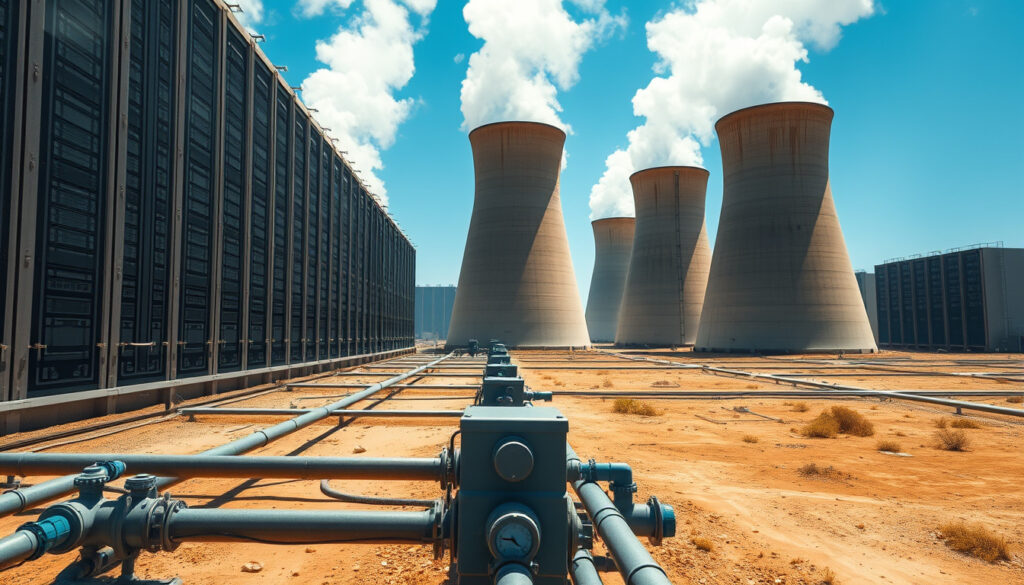
To understand the scale of this consumption, it helps to first examine how AI data centers consume water and the infrastructure behind it.
Frequently asked questions
How does AI water usage compare to other industries?
Agriculture remains the largest water consumer globally, but data centers are growing at a much faster rate. In water-stressed areas, data center demand can compete with residential and agricultural users (World Economic Forum).
Can AI water usage be reduced with better cooling?
Yes. Closed-loop cooling systems can cut water consumption by up to 80%, and using reclaimed water instead of potable supplies reduces strain on local resources (UK Government Sustainable ICT).
Does training an AI model use more water than running inference?
Generally, yes. Training a large model like GPT‑3 can consume millions of liters of water for cooling, whereas a single query uses milliliters. However, inference demand at scale can approach training-level totals (arXiv preprint).
Is the water used by AI data centers recycled?
Some hyperscale operators recycle water using closed-loop systems, but many facilities still rely on once-through evaporative cooling. Industry adoption of recycling remains uneven (World Bank Blogs).
What percentage of global water consumption does AI account for?
While exact figures are debated, current data center water use is less than 1% of global freshwater withdrawals. But its rapid growth — projected to double by 2030 — makes it a significant regional issue (Reuters).
Are there regulations on data center water consumption?
Regulation is emerging. The UK government’s Sustainable ICT blog calls for more transparency, and some local authorities now require water impact assessments for new data centers (UK Government Sustainable ICT).
How do tech companies report their water footprint?
Large companies like Microsoft and Google publish water stewardship reports, but methodologies vary. Scope definitions (direct cooling vs. indirect electricity-generation water) are not standardized, making cross-company comparisons difficult (World Bank Blogs).
More related posts
 But I’m a Cheerleader Guide: LGBTQ Themes, Rating & Streaming
 Why Am I Bleeding on the Pill When I Shouldn’t Be?
 Chicken Thighs in Oven: Cooking Times, Temperatures & Tips
 Summer Fridays Lip Gloss: Viral, Dupes, and Fakes
 Japanese Restaurant Near Me: Dublin Spots & Dining Etiquette
 Thank You in Italian: Grazie Pronunciation & Common Mistakes
 Grow a Garden Codes (May 2026): Active Codes & How to Redeem
 Crossbody Bags for Women: Picks, Sales & Fit Tips