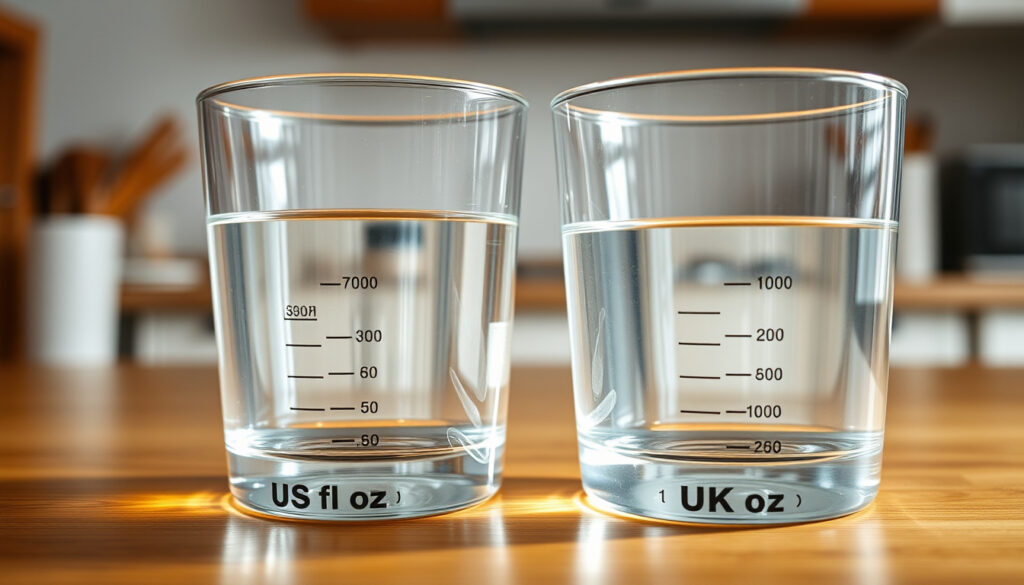
How Many ml in an oz? US vs UK Fluid Ounces Conversion
If you’ve ever followed a recipe from a different country or measured medicine with a syringe, you’ve probably wondered: how many ml actually fit into an ounce? The answer isn’t a single number, thanks to a historical split between US and UK measurement systems.
US fluid ounce: 29.5735 ml ·
UK/imperial fluid ounce: 28.4131 ml ·
Common culinary rounding: 30 ml ·
Difference between US and UK: 1.1604 ml per oz ·
Year of UK fluid ounce definition: 1824
Quick snapshot
- 1 US fl oz = 29.5735 ml (Wikipedia)
- 1 UK fl oz = 28.4131 ml (NIST Handbook 44)
- FDA labeling uses 30 ml per fluid ounce (Wikipedia)
- Exact historical motivation for the US/UK split beyond the 1824 imperial act
- Whether rounding to 30 ml is safe for medical dosing (depends on required precision)
- 1824: UK defines imperial fluid ounce as 1/20 of an imperial pint (Merriam-Webster)
- US kept the older wine gallon system, creating a lasting divergence (Merriam-Webster)
- Scroll down for the conversion table, step-by-step formula, and answers to common questions
The snapshot above makes clear that the ounce-to-ml conversion depends on which system you use.
Key facts at a glance
Here are the key conversion figures:
| US fluid ounce to ml | 29.5735 |
|---|---|
| UK fluid ounce to ml | 28.4131 |
| Rounding used in recipes | 30 ml per oz |
| Difference (US minus UK) | 1.1604 ml |
| Year imperial fluid ounce defined | 1824 |
These figures are the foundation for all conversions.
How many ml are in an ounce?
There is no universal “ounce” in the world of liquid measurement. Two major systems exist, and the number of millilitres depends on which one you’re using.
What is the difference between US and UK fluid ounces?
The US fluid ounce is part of the US customary system: 1/16 of a US pint. The UK imperial fluid ounce is 1/20 of an imperial pint — the pint itself is larger in the imperial system. As the NIST Handbook 44 explains, “the British fluid ounce is smaller than the U.S. fluid ounce.” In fact, 1 US fl oz equals 1.041 British fl oz, and 1 British fl oz equals 0.961 US fl oz.
What is the exact conversion for 1 US fl oz?
One US fluid ounce equals exactly 29.5735295625 millilitres. For everyday use, it is rounded to 29.57 ml. This is the standard cited by the Wikipedia entry on fluid ounces and backed by the NIST SP 447 historical reference.
What is the exact conversion for 1 UK fl oz?
One UK imperial fluid ounce is exactly 28.4130625 millilitres — about 1.16 ml less than its US counterpart. This value was established by the Merriam-Webster dictionary and the UK Weights and Measures Act 1985.
Three ounces, three numbers. One pattern: the US ounce is the largest, the UK ounce is the smallest, and a third “food labeling ounce” of exactly 30 ml sits in between, authorised by the FDA rounding rule for nutrition labels.
For precision work — science, medicine, and manufacturing — always check which ounce system a measurement uses. The 1.16 ml gap per ounce compounds rapidly when you scale up.
Here’s a side-by-side comparison of the three common definitions:
| System | Definition | Exact millilitres |
|---|---|---|
| US customary | 1/16 US pint | 29.5735 |
| UK imperial | 1/20 imperial pint | 28.4131 |
| FDA labeling (US) | Rounding for nutrition | 30.0000 |
This table shows the precise differences between the three main standards.
Is 1 oz the same as 30 ml?
Only if you’re using the US food labeling standard — and you’re not measuring medicine. For all other cases, it’s an approximation.
Why is 30 ml used as a round number?
The US Food and Drug Administration allows manufacturers to round 1 fluid ounce to 30 ml on nutrition labels because the difference between 29.57 ml and 30 ml (0.43 ml) is negligible in dietary contexts. According to Wikipedia, this rule applies only to food and beverage labelling. Recipes from American cookbooks often adopt the same rounding for simplicity.
Is 30 ml accurate for all types of ounces?
No. For a UK imperial ounce, 30 ml is about 1.6 ml too much — a 5.6% error. That can ruin a cake or throw off a chemical reaction. Medical syringes always use the exact US ounce (29.57 ml) unless specifically marked otherwise, because dosing errors matter.
If a syringe says “1 oz = 30 ml,” it likely follows the FDA rule — but verify with the manufacturer. In clinical settings, rely on the exact conversion.
The implication: only use 30 ml as a shortcut in casual cooking, not in baking or medicine.
How do I convert ml to oz?
Switching between millilitres and ounces is straightforward once you pick the right system.
What is the formula to convert ml to oz?
- US ounces: ml ÷ 29.5735 = US fl oz
- UK ounces: ml ÷ 28.4131 = UK fl oz
For example, 100 ml ÷ 29.5735 = 3.38 US fl oz. The same volume equals 3.52 UK fl oz because the UK ounce is smaller.
How to convert ounces to ml?
- US ounces: oz × 29.5735 = ml
- UK ounces: oz × 28.4131 = ml
Multiply by the appropriate factor. One easy rule of thumb: for US recipes, multiply ounces by 30 for a quick mental estimate, but switch to 29.57 when precision matters.
How to convert ounces to millilitres in three steps
Whether you’re baking, mixing chemicals, or dosing medicine, this three-step process works every time.
- Identify the ounce type. Is it US, UK, or FDA labelling? The label usually says “US fl oz” or “imp fl oz.” If in doubt, assume US unless the recipe is from the UK or Commonwealth.
- Pick the correct multiplier. Use 29.5735 (US), 28.4131 (UK), or 30 (FDA). Write it down or keep this page open.
- Multiply and round. Multiply the number of ounces by the multiplier. Round to two decimal places for most cooking, or keep more digits for science.
For instance, a recipe calls for 4 US fluid ounces of milk: 4 × 29.5735 = 118.29 ml. With the rounding rule: 4 × 30 = exactly 120 ml. Both are acceptable for baking, but the first is more accurate.
How many ml in 2 oz?
Two ounces is one of the most common measurement requests in cooking and medicine. Here are the exact values.
- 2 US fl oz = 59.147 ml
- 2 UK fl oz = 56.826 ml
- 2 FDA oz = 60 ml
How many ml in 4 oz?
Scaling up: 4 US fl oz = 118.294 ml; 4 UK fl oz = 113.652 ml; 4 FDA oz = 120 ml. Many liquid measuring cups use the rounded 120 ml mark.
How many ml in 8 oz?
8 US fluid ounces make one US cup: exactly 236.588 ml. The UK equivalent is 227.304 ml. The FDA rounding gives 240 ml per cup.
Common conversions at a glance:
| Ounces | US (ml) | UK (ml) | FDA label (ml) |
|---|---|---|---|
| 1 | 29.57 | 28.41 | 30 |
| 2 | 59.15 | 56.83 | 60 |
| 4 | 118.29 | 113.65 | 120 |
| 8 | 236.59 | 227.30 | 240 |
| 16 (1 US pint) | 473.18 | — | 480 |
The pattern: the US values are largest, the UK values smallest, and FDA rounding sits in between.
How many ml in an oz of water, oil, or milk?
This question matters because people often confuse weight ounces with fluid ounces. Here’s the short answer: 1 fluid ounce of any liquid occupies the same volume — roughly 29.57 ml (US) — but its weight changes.
Does the type of liquid affect the conversion?
No. A fluid ounce is a unit of volume, not weight. One US fluid ounce of water, olive oil, milk, or mercury all fill the same space: 29.5735 ml. That’s why you can use the same conversion formula no matter the liquid — it’s purely a volume shift.
Why is an ounce of water different from an ounce of oil?
Because an “ounce” can also be a weight unit (avoirdupois ounce = 28.35 grams). A weight ounce of water equals about 28.35 g, which happens to be close to 1 fluid ounce in volume (since water’s density is near 1 g/ml). But an ounce of oil by weight takes up more volume because oil is less dense. The Britannica Dictionary clarifies: “fluid ounce” always means volume; “ounce” without a modifier usually means weight. So when a recipe says “1 oz of oil,” check the context: it may mean a weight ounce (28.35 g) rather than a fluid ounce.
For syringes and medical dosing, the measurement is always fluid volume. A syringe labelled “1 oz” means it holds 30 ml (FDA standard) or 29.57 ml (exact US) — not a weight measurement. According to Metric Views (UK measurement blog), UK products sometimes use the US ounce definition to meet American labelling requirements, adding another layer of confusion.
When a label says “1 oz” without specifying fluid or weight, look for “fl oz” or “Net Wt.” Trust only the unit abbreviation: “fl oz” = volume, “oz” may be weight.
“The U.S. fluid ounce is equal to 29.5735 millilitres.”
— NIST Special Publication 811 (Guide for the Use of the International System of Units)
“The imperial fluid ounce is defined as one twentieth of an imperial pint, or exactly 28.4130625 millilitres.”
— UK Weights and Measures Act 1985
For anyone who has ever stared at a foreign recipe or measured a child’s medicine, the trade-off is clear: use 29.57 ml per ounce for accuracy, and reserve the 30 ml shortcut for casual cooking. Knowing which ounce you’re dealing with — US, UK, or FDA — is the only way to get the right ml every time.
en.wikipedia.org, de.wikipedia.org, dictionary.com, ids-water.com, en.wiktionary.org, math.tools
Frequently asked questions
What is the difference between a fluid ounce and a regular ounce?
A fluid ounce measures volume (like a cup), while a regular (avoirdupois) ounce measures weight. One US fluid ounce of water weighs about 1.043 ounces by weight. Always check the label for “fl oz” — if it’s just “oz,” it’s likely weight.
How many ml in 1 oz of flour?
Flour is a dry ingredient, so the question mixes units. If the recipe intends fluid ounces (rare for flour), use 29.57 ml. But most often “oz of flour” means weight (28.35 g). Use a kitchen scale for accuracy.
How many ml in a shot glass (1.5 oz)?
A standard US shot is 1.5 fl oz = 44.36 ml (exact) or 45 ml when rounded. UK shots vary but typically 25 ml or 35 ml, not based on the ounce system.
How many ml in 1 oz of medicine using a syringe?
Medical syringes in the US are calibrated in millilitres. An ounce-marked syringe holds 30 ml if it follows FDA labelling. Always verify with your pharmacist; do not assume because dosing accuracy is critical.
Can I use 30 ml as a standard for all conversions?
Only for rough estimates in cooking. For baking, chemistry, or any precision work, use the exact conversion: 29.57 ml for US, 28.41 ml for UK.
How many ml in 1 oz of water at room temperature?
Water at room temperature: 1 US fl oz = 29.57 ml. 1 UK fl oz = 28.41 ml. Temperature changes volume slightly (density), but the effect is less than 0.1% over normal kitchen temperatures — negligible for most uses.
Related reading:
- 48 Inches in Feet: Conversion and Height Guide for Kids — Another handy unit conversion.
- How Many Work Days in a Year? 2026 Guide by Country — A different kind of “how many” evergreen guide.
More related posts
 Orange County Credit Union – Routing Number, Branches, Phone & Zelle
 How to Convert Word to PDF: Free Methods & Troubleshooting
 Michaels Coupon 40% Off Printable PDF – 2025 Availability Guide
 What Is a Z Fold Phone? Samsung Galaxy Z Fold 7 Guide
 2026 Winter Olympics Closing Ceremony: Date, Time & Performers
 Hootie and the Blowfish: Biggest Hits, Name Origin & Lawsuit
 Kimberly J. Brown: Halloweentown Star’s Life & Career Update
 Crossbody Bags for Women: Picks, Sales & Fit Tips