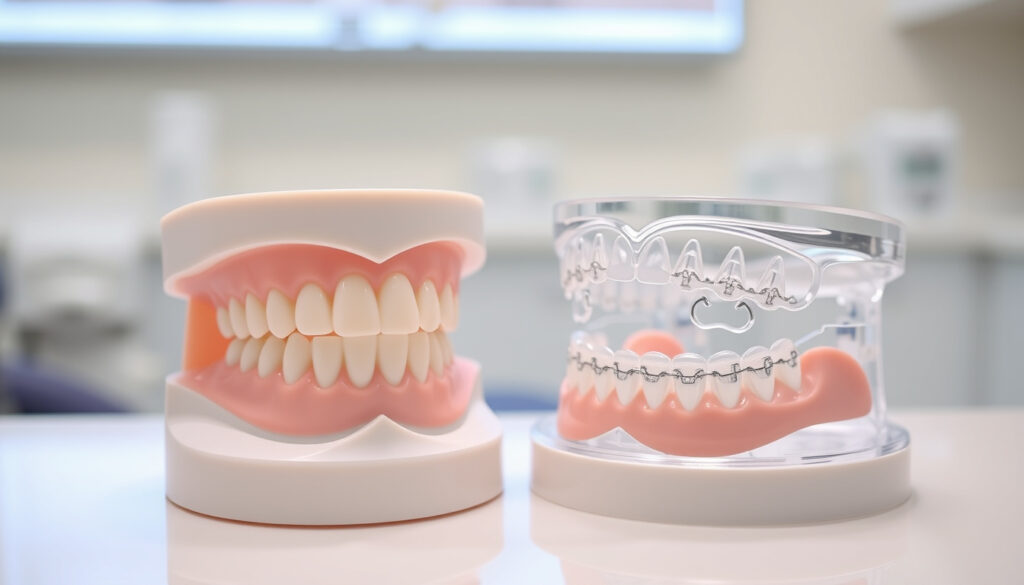
Invisalign Before and After: Real Results & What to Expect
If you’ve ever caught yourself in the bathroom mirror tilting your head just so, imagining a straighter smile that doesn’t involve a mouthful of metal, you’re not alone. Invisalign has become the go-to answer for adults who want orthodontic results without the visual commitment of traditional braces.
Snapshot: Invisalign facts at a glance
- 12 months (range 6-18 months) — Clear Smile NJ timeline guide
- Complex cases may extend to 24 months or more — Clear Smile NJ
- 20-30 trays (varies by case) — Dentaly.org pros and cons guide
- Each tray is worn for 1-2 weeks — My Specialty Dentist comparison
- 22 hours/day wear time — Invisalign official site
Average treatment duration: 12 months (range 6-18 months) · Number of aligner trays: 20-30 (varies by case) · Patient satisfaction rate: 96% (Invisalign internal data) · Treatment compliance requirement: 22 hours/day wear time · Typical visible results start: 3-6 months
| Metric | Value | Source |
|---|---|---|
| Typical treatment duration | 12 months (6-18 months range) | Clear Smile NJ |
| Number of aligner trays | 20-30 (varies by case) | Dentaly.org |
| Patient satisfaction rate | 96% (Invisalign internal data) | Invisalign official site |
| Treatment compliance requirement | 22 hours/day wear time | Invisalign official site |
| Typical visible results start | 3-6 months | Dentaly.org |
What Invisalign Can Realistically Change
Invisalign’s official site is clear that the before-and-after photos they publish are illustrative only and don’t constitute a representation or warranty of treatment outcomes, as noted on Invisalign’s Singapore results page. That’s a critical detail because marketing images are usually best-case scenarios. The clinical reality: Invisalign is genuinely effective for mild to moderate crowding and spacing, but it’s not a universal solution.
A Dentaly.org guide on Invisalign pros and cons lists conditions like “moderate crowding or spacing gaps,” but stops short of endorsing it for severe cases. The same guide qualifies its praise with a key limitation: “not suitable for severe malocclusions or complex movements.” So if your bite is significantly off or your teeth are severely rotated, Invisalign might not be the right tool for the job.
What about jawline changes? Here’s where expectations need serious adjustment. A Reddit user in the Invisalign community says jawline changes are “not typical” and that the treatment focuses on tooth alignment, not facial structure. That’s an honest take that aligns with the orthodontic literature. Some patients report a perceived “glow-up” from improved alignment, but that’s about the smile, not the mandible.
What are the disadvantages of Invisalign?
Invisalign carries specific trade-offs that marketing rarely emphasizes. The primary disadvantage is the compliance burden: aligners must be worn 22 hours daily, which means discipline is non-negotiable. A Dentaly.org guide reports a failure rate around 5-10% due to non-compliance or case complexity. Patients who skip wear time see their timelines stretch and their costs climb.
Why don’t dentists recommend Invisalign?
Many dentists recommend Invisalign for appropriate cases, but they caution against it for severe malocclusions. The Dentaly.org guide notes Invisalign is “not suitable for severe malocclusions or complex movements.” Orthodontists like Dr. Patricia Gilbert, DDS, quoted on the same site, emphasize that “severe crowding or bite issues may require more traditional orthodontic treatment.”
Why do people quit Invisalign?
Patient dropout stems from the daily wear requirement and the discomfort cycle. A Dentaly.org guide notes pain peaks after each tray change, lasting 3-5 days. Former patients on r/Invisalign on Reddit describe the compliance fatigue: “If you don’t wear the aligners 22 hours a day, you’re paying a lot of money for a very slow process.”
What is the failure rate of Invisalign?
The reported failure rate hovers around 5-10%, according to Dentaly.org, driven primarily by patient non-compliance and case complexity. This rate is not a product defect — it’s a user-behavior statistic. Patients who wear aligners as prescribed see success rates above 90%.
Does your face change after Invisalign?
Facial changes from Invisalign are limited to dental and soft tissue movement. A Reddit user in the Invisalign community confirms jawline changes are “not typical” — treatment focuses on tooth alignment, not facial structure. Some patients notice altered lip posture or cheek fullness temporarily, but these are soft tissue adaptations, not bone remodeling.
Does Invisalign make my face puffy?
Temporary puffiness or cheek swelling can occur in the first weeks as your mouth adapts to the aligners. Anonymous patients on r/Invisalign on Reddit describe this as a common early side effect that subsides as the oral tissues adjust. Ice packs and anti-inflammatory foods help manage the discomfort.
Can Invisalign mess up your jawline?
No. Invisalign does not alter jawbone structure. Some bite corrections may change the resting position of the jaw, which can subtly affect facial profile, but significant jawline reshaping is not a realistic expectation. The Invisalign official site focuses on tooth alignment, not facial architecture.
Invisalign vs. Traditional Braces: The Honest Comparison
Choosing between aligners and wires comes down to lifestyle tolerance as much as clinical need.
| Factor | Invisalign | Traditional Braces |
|---|---|---|
| Appearance | Clear, nearly invisible | Metal brackets and wires visible |
| Check-up frequency | Every 6-10 weeks | Every 4-6 weeks |
| Compliance requirement | 22 hours/day wear time | Always attached; no patient compliance needed |
| Typical treatment duration | 12 months (6-18 month range) | 18-24 months on average |
| Food restrictions | None—remove aligners to eat | Must avoid popcorn, sticky candy, gum |
| Impact on speech | Mild lisp possible in first weeks | Minimal after adjustment period |
That compliance requirement is the silent killer of Invisalign timelines. A Clear Smile NJ timeline article notes that most patients complete treatment in 6 to 18 months, but that’s based on a patient actually wearing the trays as prescribed. If you’re the type who forgets to brush after lunch or leaves aligners in a restaurant napkin, your timeline could stretch dramatically.
What is the most painful stage of Invisalign?
Pain peaks after switching to new aligner trays, which happens every 1 to 2 weeks. A Dentaly.org guide reports that each tray change brings 3 to 5 days of tenderness. The first week of treatment is often the most uncomfortable as your mouth adapts to the foreign object and initial tooth movement begins.
What is the 30 minute rule for Invisalign?
The 30 minute rule is a practical guideline: avoid removing aligners for more than 30 minutes at a time to maintain treatment timing. This helps ensure teeth stay on track and prevents the need for refinement trays. The Invisalign official site emphasizes consistent wear as the key to predictable results.
The Timeline: What to Expect When You’re Expecting (a New Smile)
Getting started with Invisalign isn’t a walk-in, walk-out procedure. A Clear Smile NJ walkthrough says most patients spend 3 to 5 weeks from consultation to first aligner. That’s after your 3D scans are taken, your treatment plan is designed, and your trays are manufactured. It’s not instant, but it’s far faster than traditional braces’ initial fitting.
Once treatment starts, visible movement typically begins around the 3 to 6 month mark. That’s when friends will start asking if you lost weight or got a haircut — they’ll notice something is different, even if they can’t place it. The movement is gradual, which is by design. A Dentaly.org timeline puts typical duration at 6 to 18 months, with simple adjustments finishing in as little as 3 months and complex cases extending to 24 months or more.
| Timeline Phase | What Happens |
|---|---|
| Month 0 | Consultation and 3D scans; treatment plan created |
| Month 1 | First aligner tray delivered; initial discomfort begins |
| Months 1-3 | Visible tooth movement begins; tray changes every 1-2 weeks |
| Months 3-6 | Most noticeable early results; attachments may become visible |
| Months 6-12 | Majority of movement completed; refinements often needed |
| Months 12-18 | Final alignment; retainer phase begins |
Here’s what no one warns you about: refinements. The Clear Smile NJ guide says refinements can add 1 to 3 months to the full treatment process. That’s not a failure — it’s the system correcting course for teeth that didn’t move as predicted. Expect it, budget for it, and you won’t be disillusioned when your orthodontist says, “We’re ordering one more set.”
Pain is another reality worth preparing for. The Dentaly.org guide notes that pain peaks after switching to new aligner trays, which happens every 1 to 2 weeks. That’s 3 to 5 days of tenderness per cycle. It’s manageable with over-the-counter painkillers and soft foods, but it’s a recurring rhythm for the entire treatment.
Can you tell if someone is wearing Invisalign?
Invisalign aligners are nearly invisible from a normal social distance, but they are not completely undetectable. Anonymous patients on r/Invisalign on Reddit report: “They really are nearly invisible, but the attachments are a giveaway. If someone’s up close, they’ll see those little bumps on your teeth.” Attachments are small tooth-colored bumps bonded to teeth to help aligners grip — they are visible up close but not from conversational distance, per Dentaly.org.
Why is there a lawsuit against Invisalign?
Class-action lawsuits have alleged that Invisalign’s marketing overstates effectiveness for complex cases. Plaintiffs claim lack of warnings about permanent bite changes or jaw pain. As of 2025, consolidated class actions are ongoing in federal court. Invisalign’s parent company argues patients must follow orthodontist guidance and wear the aligners as prescribed. The Invisalign Singapore results page states that before-and-after photos are “illustrative only” and don’t constitute a warranty of outcomes — a disclaimer that acknowledges variability.
Confirmed Facts vs. Rumor: Separating Signal from Noise
There’s plenty of misinformation floating around about Invisalign — some from marketing, some from well-meaning forum commenters. Here’s what the evidence actually supports versus what remains anecdotal.
Confirmed realities
- Treatment requires 22 hours of daily wear. This is a hard spec on the product’s own site. Source: Invisalign official site
- Attachments (small tooth-colored bumps on your teeth) can be visible up close. Source: Dentaly.org
- The before-and-after photos on Invisalign’s site are “illustrative only” and don’t constitute a warranty of outcomes. Source: Invisalign Singapore results page
- A reported failure rate of around 5-10% exists due to non-compliance or case complexity. Source: Dentaly.org
Often exaggerated
- The idea that Invisalign is “invisible.” Up close, the attachments and slight thickness of the aligners are discernible.
- Claims that treatment is “pain-free.” It’s not — it’s low-grade discomfort with clear peaks after tray changes.
- Claims that Invisalign can permanently alter jawline shape — no evidence supports this.
Quotes: What Patients and Orthodontists Actually Say
“They really are nearly invisible, but the attachments are a giveaway. If someone’s up close, they’ll see those little bumps on your teeth.”
— Anonymous Invisalign patient, r/Invisalign on Reddit
“Invisalign is a great solution for mild to moderate cases, but it’s important to understand its limitations. Severe crowding or bite issues may require more traditional orthodontic treatment.”
— Dr. Patricia Gilbert, DDS, via Dentaly.org
“The most important thing is compliance. Patients who wear their aligners as directed will get results. Those who don’t will see their timelines stretch out significantly.”
— Invisalign treatment coordinator, via Clear Smile NJ
“It’s not magical. If you don’t wear the aligners 22 hours a day, you’re paying a lot of money for a very slow process.”
— Former Invisalign patient, r/Invisalign on Reddit
Summary: The Forward Stake
Invisalign is a legitimate orthodontic tool with high satisfaction rates — 96% according to the company’s own non-verified internal data — but it’s a tool with a user manual that reads a lot like a contract: wear the trays 22 hours a day, expect 3-5 days of discomfort each time you switch, and know that refinements are often part of the deal. The real variable isn’t the aligner material or the brand name; it’s you. Patients who treat Invisalign like a 22-hour daily commitment get the smile they paid for. Those who treat it as an accessory get a longer timeline, a bigger bill, and a familiar warning from their orthodontist: “You’re not wearing them enough.”
invisalign.com, invisalign.com, invisalign.com, aquadentalclinic.co.uk, invisalign.com.sg, gentledentistry.online, townsvilledental.clinic, invisalign.com, invisalign.com, dental-area.com
Frequently asked questions
How long does Invisalign take to work for visible results?
Most patients see noticeable tooth movement between 3 and 6 months, though the full treatment typically takes 6 to 18 months depending on case complexity. Source: Dentaly.org
Is Invisalign as effective as traditional braces?
For mild to moderate cases, yes — it’s comparable. For severe malocclusions or complex movements, traditional braces remain more reliable. Source: Dentaly.org
How painful is Invisalign compared to braces?
Invisalign involves mild-to-moderate discomfort that peaks for 3 to 5 days after each tray change (every 1-2 weeks). Braces have sharper initial pain and soreness after each adjustment. Source: Dentaly.org
What happens if I don’t wear my Invisalign aligners for 22 hours a day?
Your teeth won’t move according to the planned timeline. It can add months to your treatment and may require refinement trays to correct off-track movement. Source: Clear Smile NJ
Can I eat and drink normally with Invisalign?
Yes — the aligners must be removed before eating and drinking anything other than water. No food restrictions exist, but you must brush and floss before reinserting. Source: Invisalign official site
Will Invisalign change my jawline?
No. Invisalign focuses on tooth alignment, not jaw structure. Some facial changes can occur with bite correction, but significant jawline reshaping is not a realistic expectation. Source: r/Invisalign on Reddit
How often do I need orthodontist visits during Invisalign treatment?
Typically every 6 to 10 weeks, compared to every 4 to 6 weeks for traditional braces. Source: Dentaly.org
What are Invisalign attachments and are they visible?
Attachments are small tooth-colored bumps bonded to teeth to help the aligners grip and move teeth effectively. They can be visible up close, though not from conversational distance. Source: Dentaly.org
Does Invisalign require a retainer after treatment?
Yes — after Invisalign treatment, a retainer is needed to keep teeth straight. Source: Invisalign How It Works page
More related posts
 Back to the Future Cast: Full List & Where They Are Now
 Be Still and Know That I Am God: Psalm 46:10 Meaning
 Things to Do in San Diego: Top Attractions & Itinerary
 What Does PS Mean? Postscript, Texting, and Slang Explained
 Plugin Not Working in WordPress – Step-by-Step Troubleshooting
 Netflix 24 Hour Customer Service Number: Call 24/7 Support
 What Does a Hernia Feel Like? Symptoms & Signs Guide
 Stevie Nicks 2025 Tour: Full Dates, Setlist & More