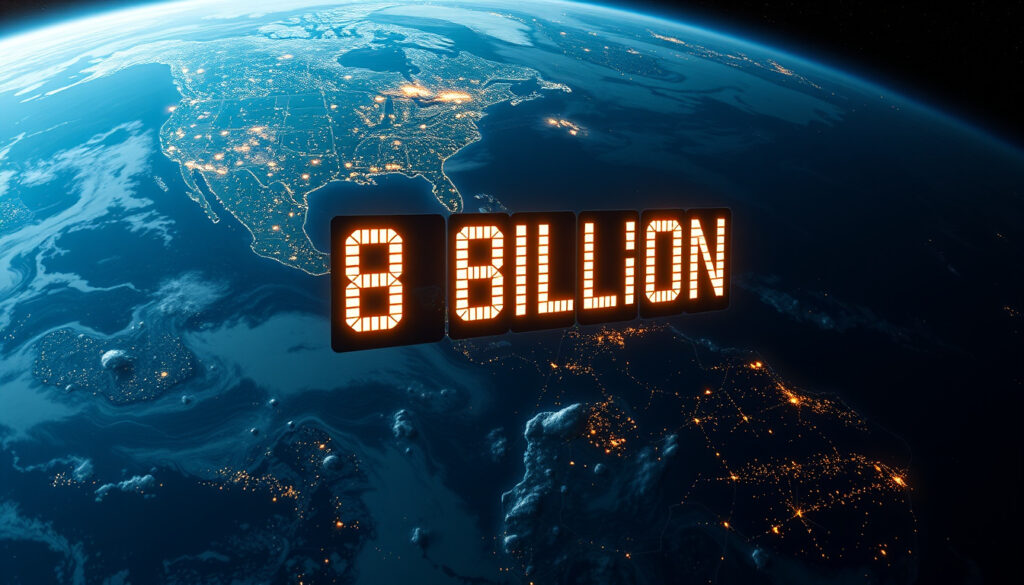
How Many People Are in the World 2024? Live Count & Facts
World population trackers rarely agree—one shows 8.3 billion while another hovers near 8.1 billion. According to the United Nations’ latest estimates, the world reached 8.2 billion people in 2024. This article untangles what that number means, why the figures differ, and what the trajectory looks like for the decades ahead.
World Population 2024: 8.2 billion · 2023 Population: 8.09 billion · Growth Rate 2024: 0.87% · Reached 8 Billion: November 2022 · Projected 2026: 8.3 billion
Quick snapshot
- 8.2 billion total in 2024 (UN DESA)
- 8 billion reached November 15, 2022 (United Nations)
- 0.87% annual growth rate (INED)
- Exact live count varies by tracker source
- Precise peak timing beyond mid-2080s uncertain
- 2022: 8 billion milestone hit (United Nations)
- 2024: 8.2 billion current estimate (United Nations)
- 2084: Projected peak at 10.3 billion (Our World in Data)
- 2037: Projected 9 billion (Population Connection)
- 2061: Projected 10 billion (Population Connection)
- Post-2084: Gradual population decline (Population Connection)
| Metric | Value |
|---|---|
| 2024 Population | 8.2 billion (UN DESA) |
| Live Counter Estimates | 8.1–8.3 billion |
| 8 Billionth Birth | November 15, 2022 |
| 1% of Population | 82 million |
| Growth 2023–2024 | 0.87% |
How many people are in the world in 2024 today?
Live counters
Real-time population trackers like Worldometers and US Census Bureau’s world popclock offer second-by-second estimates. These tools pull from the UN World Population Prospects 2024 revision and apply current birth, death, and migration rates to project a live number. The US Census Bureau world popclock (official US government estimate) and Worldometers (a widely referenced live counter) both base their figures on the UN’s modeling. Live counters have an approximately 0.5% margin of error compared to official UN projections, according to StatsPanda.
Official 2024 estimates
The United Nations Population Division’s World Population Prospects 2024—the 28th edition since 1951, drawing on 1,910 censuses conducted between 1950 and 2023—places the global population at 8.2 billion in 2024. The French National Institute for Demographic Studies (INED) independently confirms this figure.
The gap between live counters and official estimates reflects modeling choices rather than data errors. Live trackers use slightly different assumptions about fertility, mortality, and net migration, which compound over time.
India became the world’s most populous nation in 2023, overtaking China, per UN 2024 data. China now faces a fertility rate of just 1.01 births per woman—well below replacement level—while India’s population continues growing. For governments planning infrastructure, healthcare, and education, the difference between 8.1 and 8.3 billion translates to millions of people needing schools, hospitals, and housing.
Is there actually 12 billion people?
Current reality
No. The claim that Earth already hosts 12 billion people is a persistent myth with no basis in demographic data. The UN World Population Prospects 2024 puts the current figure at 8.2 billion. Even the most generous live counter estimates fall short of 8.5 billion.
The confusion sometimes arises from misreading older projections or conflating cumulative births throughout human history with the current living population. Every person who has ever lived is not alive today—life expectancy was dramatically lower for most of human history, and the global population only crossed 1 billion for the first time around 1804.
Growth projections
The UN projects the global population will reach approximately 9 billion by 2037 and 10 billion by 2061, before peaking at just under 10.3 billion in the mid-2080s. The 2024 revision lowered the 2100 estimate by 700 million compared to projections made a decade ago, reflecting faster-than-expected declines in fertility rates globally.
What is 1% of the world population?
Based on 2024 figures
One percent of the current 8.2 billion world population is approximately 82 million people. To put that in perspective: that’s roughly the entire population of Germany, Egypt, or Thailand living in a single percentage point.
The global population is unevenly distributed. Roughly 60% of the world’s people live in Asia, with China and India together accounting for over 35% of humanity. Africa holds about 18%, Europe roughly 10%, and the Americas the remaining 12% or so.
Eighty-two million is not an abstract number when you consider that Niger, Somalia, and eight other countries are projected to double their populations by 2054, according to UN Media. A country adding 82 million people over a decade faces entirely different policy challenges than one losing population.
Can Earth support 1 trillion people?
New estimations
No. Even the most optimistic carrying-capacity models place Earth’s sustainable population in the low billions, not trillions. Current peer-reviewed research on planetary boundaries, food systems, and water resources consistently indicates that a trillion humans would require resources far exceeding what Earth can regenerate.
Carrying capacity debates
Scientists disagree on precise limits—the carrying capacity depends on consumption patterns, technology, and lifestyle choices. However, virtually all serious estimates fall between 8 and 10 billion for a reasonable quality of life. The UN’s projection of a peak near 10.3 billion already assumes continued improvements in agricultural efficiency and energy systems.
One in four people worldwide already live in countries where the population has peaked and is declining, according to the United Nations. This shift—from high growth to stagnation or decline—is itself reshaping global economics, migration patterns, and geopolitical power.
Who was the 8 billionth person born?
UN designation
The UN does not officially designate a specific child as the “8 billionth person.” Instead, November 15, 2022 was symbolically marked as the approximate day humanity crossed that threshold. The UN chose this date based on probabilistic modeling, not a literal birth certificate count.
Personal stories
Several media outlets, including The Guardian, highlighted families who gave birth on or around that date as symbolic representatives of the milestone. These stories humanized an abstract statistic—reminding readers that every increment in the global count is a real child born to a real family.
The world celebrated reaching 8 billion while simultaneously confronting what that growth means for resources, climate, and opportunity. For new parents in high-fertility countries, 8 billion is not a milestone to commemorate—it’s the daily reality of crowded schools, overstretched clinics, and fierce competition for jobs.
World population timeline
Eight data points span seven decades of demographic history and six decades of projected growth.
| Year | Milestone | Source |
|---|---|---|
| 1951 | World Population Prospects revisions begin (28th edition released 2024) | UN DESA |
| 2011 | World reaches 7 billion | Live Population |
| November 15, 2022 | World reaches 8 billion | United Nations |
| 2023 | India overtakes China as most populous nation | Our World in Data |
| 2024 | World population reaches 8.2 billion | UN DESA |
| 2037 | Projected 9 billion | Population Connection |
| 2061 | Projected 10 billion | Population Connection |
| 2084 | Projected peak at 10.3 billion | Our World in Data |
The implication: the slowing pace between milestones reveals that fertility declines are already reshaping the trajectory, even before the mid-century peak.
What’s confirmed and what’s still unclear
Confirmed
- UN estimates 8.2 billion in 2024, verified by multiple independent sources including INED and Worldometers
- World population reached 8 billion on November 15, 2022, per the United Nations
- Peak projected for mid-2080s at 10.3 billion
- India overtook China as most populous nation in 2023
- UN lowered 2100 projection by 700 million versus a decade ago
Unclear
- Exact live count varies between trackers—Worldometers shows higher figures than Live Population
- Post-peak trajectory beyond 2084 depends on fertility assumptions not yet knowable
- Regional variations within continents not fully captured in global aggregates
What experts say
“The world’s population will peak in the mid-2080s, growing over the next sixty years from 8.2 billion people in 2024 to around 10.3 billion.”
— Navid Hanif, UN Assistant Secretary-General for Economic Development (UN Media)
“The size of the world’s population in 2100 is now expected to be six per cent lower—or 700 million fewer—than anticipated a decade ago.”
— Navid Hanif, UN Assistant Secretary-General (UN Media)
Related reading: How Deep Is the Ocean · How Much Caffeine Is Too Much
UN estimates peg 2024’s global population at 8.2 billion, with 2025 population projections forecasting a rise to 8.3 billion by next year amid 0.87% annual growth.
Frequently asked questions
Where does 90% of the world live?
No single region holds 90% of the world’s population. However, Asia dominates: China and India alone account for over 35%. If you include Southeast Asia, East Asia, and South Asia, the continent holds roughly 60% of humanity. The next-largest concentrations are in Africa (18%) and Europe (10%).
Is 50% of the world female?
Approximately 49.5–50% of the world’s population is female, depending on the year and methodology. Globally, there are slightly more women than men, though the ratio varies by country due to differences in life expectancy and birth ratios.
How many people are in the world 2024 by country?
India leads with approximately 1.43 billion people (overtaking China in 2023), followed by China at roughly 1.41 billion. The United States sits third at about 340 million. These figures shift daily as live counters update.
What is the world population 2025?
The UN does not publish a separate 2025 estimate, but based on the 0.87% growth rate, the 2025 world population is projected to be approximately 8.27 billion. Live counters like the US Census Bureau offer daily estimates.
How many people are in the world 2050?
The UN projects the world population will reach approximately 9.7 billion by 2050. However, the 2024 revision lowered this estimate compared to previous projections, reflecting faster fertility declines than anticipated.
What was world population 2023?
The UN estimates the world population at approximately 8.09 billion at the start of 2023, growing to 8.2 billion by the end of that year. Worldometers’ historical data shows similar figures.
World population by country—how is it tracked?
Each country conducts its own census and vital statistics registration, feeding data to organizations like the UN Population Division, World Bank, and national statistical agencies. The UN synthesizes this data, adjusted for undercount and using modeling to fill gaps, into its World Population Prospects series.
More related posts
 1-888-280-4331 Amazon Phone Number: Official Support
 Watch Final Destination Bloodlines: HBO Max, Prime Video & More
 The Book of Boba Fett: Cancelled, Viewing Order & Reception
 How to Convert Word to PDF: Free Methods & Troubleshooting
 How to Make Boiled Eggs: Perfect Timing for Soft & Hard
 Everything but the House: Is It Legit? (2025 Guide)
 What Is the Capital of Australia? Sydney or Canberra
 T-Mobile Pay Bill: Online, Phone & Guest Pay Guide